
Exploring the Meaning of Trophos in Greek
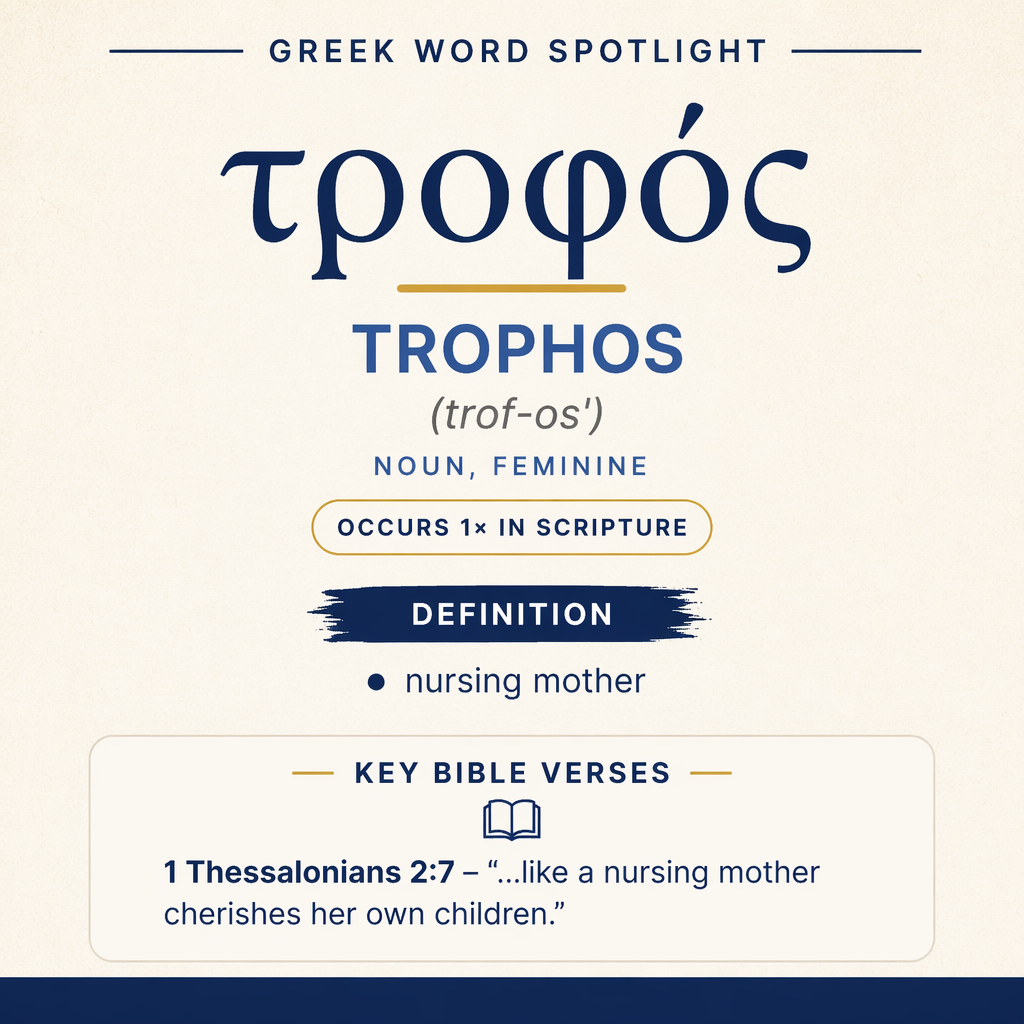
τροφός means “nursing mother” and appears in 1 Thessalonians 2:7.
Verse Context
In 1 Thessalonians 2:7, it appears in the comparison: “like a nursing mother cherishes her own children.”
Learn More →τροφός means “nursing mother” and appears in the New Testament in Paul’s description of his manner of ministry toward the Thessalonian believers. The single occurrence places the word inside a vivid comparison that highlights tenderness and personal care.
Root and Related Words
τροφός is connected with the verb trephō (τρέφω), “to feed.” This relationship aligns the noun with the ordinary, bodily work of nourishment and sustained care, setting the maternal image in the realm of provision rather than status or authority.

Occurrences
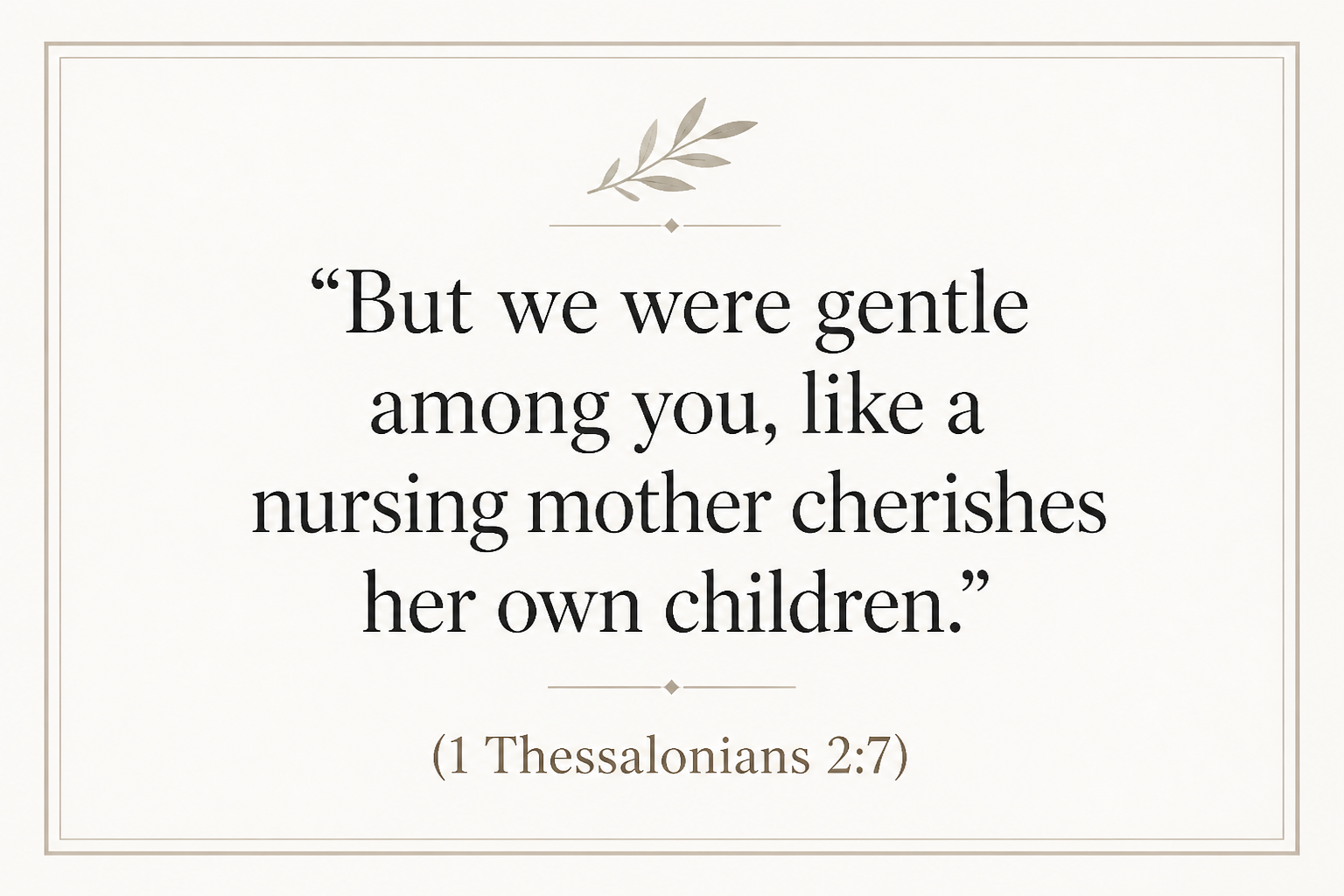
“But we were gentle among you, like a nursing mother cherishes her own children.” (1 Thessalonians 2:7)
Here τροφός stands at the center of an analogy: Paul and his companions describe their conduct as “gentle,” and they select the picture of “a nursing mother” to define what that gentleness looked like in practice. The comparison is not simply to motherhood in general but specifically to the mother in the act and role of nursing. That choice directs the reader to a kind of care that is close-range and physically attentive, the sort of care that cannot be carried out from a distance.
The clause “cherishes her own children” further shapes the force of τροφός in this scene. The nursing mother is portrayed not as a hired caretaker but as one who holds an intimate bond with “her own children,” and the verb “cherishes” places emphasis on warm, protective attentiveness. In Paul’s sentence, the maternal image functions as an interpretive lens: it explains what “gentle among you” meant in real relational terms. Gentleness is not presented as mere politeness or restraint; it is framed as active, nurturing concern patterned after a mother who nurses and cherishes.
Because the image is introduced with “like,” τροφός operates figuratively, mapping the qualities associated with a nursing mother onto the conduct of Christian ministers. The comparison also implies vulnerability and self-giving. Nursing, as an act of feeding, presupposes that the one who nourishes offers of herself for another’s well-being. Within the verse’s own wording, that implication supports the moral texture of “we were gentle,” describing a posture that seeks the good of others through patient, sustaining care.
Sense and Usage
In its lone New Testament use, τροφός serves as a concrete, domestic image to communicate relational tone. The term “nursing mother” evokes the daily rhythm of tending a child: staying near, responding to need, and providing nourishment. Even without expanding beyond the definition, the immediate context in 1 Thessalonians 2:7 shows how the word can carry a cluster of implications that fit the scene: tenderness (“gentle”), affection (“cherishes”), and personal investment (“her own children”). The noun is thus well suited to depict a manner of leadership that is not detached or purely instructional, but protective and affectionate.
The presence of “cherishes” in the same comparison keeps the sense from being reduced to the act of feeding alone. A nursing mother feeds, but she also warms, protects, and comforts. The verse’s phrasing suggests that what Paul wants to highlight is the whole nurturing posture: the inner disposition (“gentle”) expressed in an outward pattern of care (“cherishes”). τροφός therefore functions as an image-word that compresses a recognizable household relationship into a single reference point, enabling Paul to communicate emotional texture with economy.
The association of τροφός with trephō (τρέφω), “to feed,” fits the verse’s movement from character (“gentle”) to behavior (“cherishes”). Feeding is a sustained activity rather than a momentary gesture; it involves repeated attention over time. Read within the verse, that helps explain why the nursing-mother analogy is persuasive: it naturally conveys ongoing, patient care rather than a single act of kindness. The definition “nursing mother” also carries an implied asymmetry of strength and dependence: the child receives, the mother provides. In 1 Thessalonians 2:7, that asymmetry supports the idea that Paul and his companions approached the Thessalonians in a way that prioritized the others’ welfare, not their own prominence.
At the same time, the phrase “her own children” anchors the image in genuine attachment. The analogy’s persuasive power depends on the widely understood reality that a mother’s cherishing of her own children is not a performance but an expression of real belonging. Thus, within this one occurrence, τροφός communicates not only tenderness but also sincerity—care that arises from personal concern rather than from obligation.
Imagery
The picture carried by τροφός in 1 Thessalonians 2:7 is domestic and intimate: gentleness expressed through the close, attentive care of a mother nursing and cherishing her children. By choosing this image, the verse frames Christian ministry in terms of warmth, protection, and nourishment—qualities that fit naturally within the scene of a mother caring for her own child.
Sources: Lexical data from Strong’s Exhaustive Concordance and the Translators Brief Lexicon of Extended Strongs for Greek (STEPBible, CC BY). Occurrence data from the Translators Amalgamated Greek New Testament (STEPBible, CC BY). Scripture quotations from the World English Bible (public domain).





