Exploring the Meaning of Triakonta in Greek
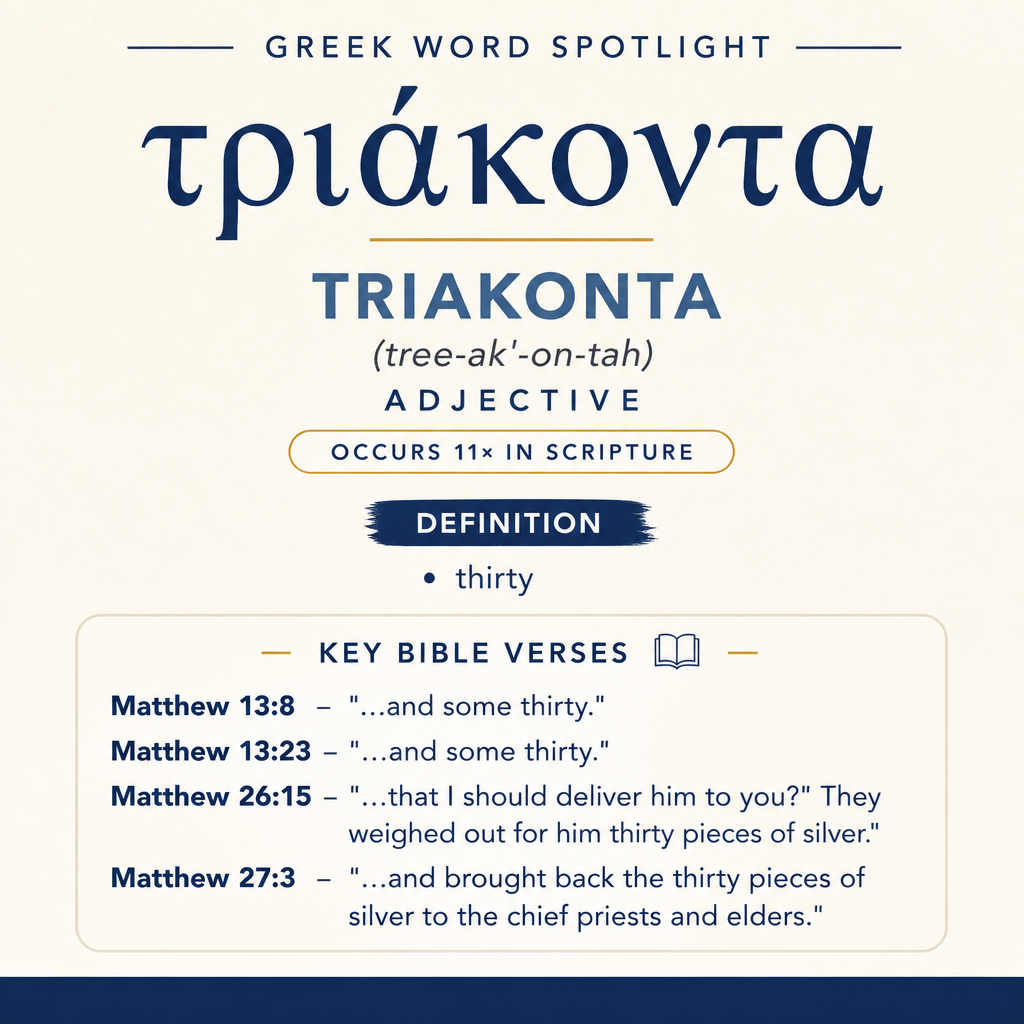
τριάκοντα (Triakonta) means “thirty” and occurs 11 times in Scripture, including Matthew, Mark, and Luke.
Core Meaning
τριάκοντα is defined as “thirty.” It is used as a numerical descriptor in the listed passages.
Learn More →Parable Fruit Yield
In Matthew 13:8 and Mark 4:8, 4:20, it describes a yield of “thirty times.” Matthew 13:23 also includes “thirty” in the fruit-bearing sequence.
Learn More →Key Narrative Uses
In Matthew 26:15; 27:3; 27:9, it refers to “thirty pieces of silver.” In Luke 3:23, it states Jesus was “about thirty years old” when he began to teach.
Learn More →τριάκοντα expresses the number “thirty.” In the New Testament it appears in sayings of Jesus about fruitfulness, in the passion narrative’s accounting of Judas’s payment and return, and in a few chronological or measurement notices.
Occurrences
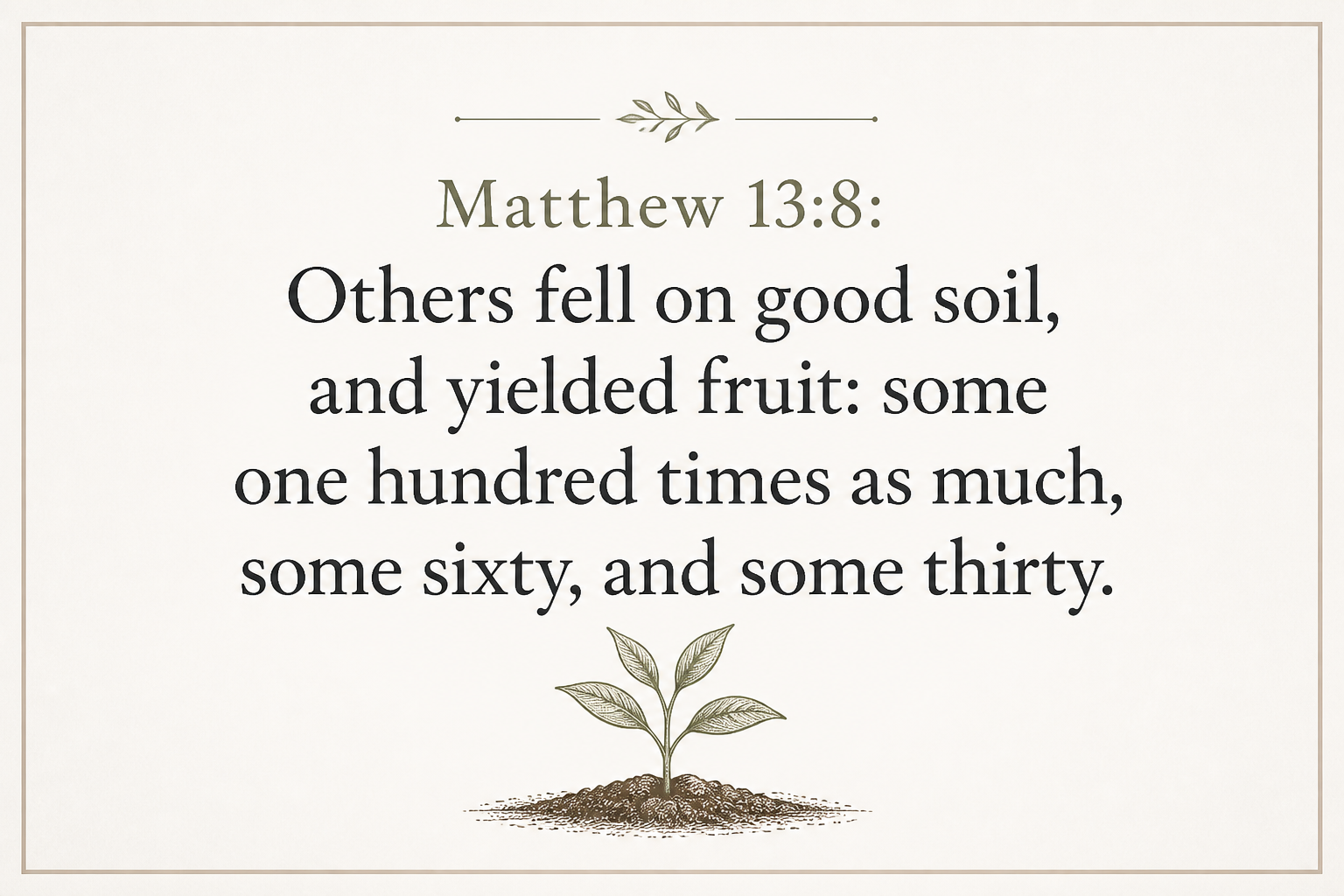
Matthew 13:8: Others fell on good soil, and yielded fruit: some one hundred times as much, some sixty, and some thirty.
Here τριάκοντα marks the lowest of three stated yields from seed that lands on “good soil.” The clause lists three results side by side (“one hundred… sixty… thirty”), so “thirty” functions as a real, countable return within a range of abundant outcomes rather than as a mere approximation.
Matthew 13:23: What was sown on the good ground, this is he who hears the word, and understands it, who most certainly bears fruit, and produces, some one hundred times as much, some sixty, and some thirty.”
In this explanation of the parable, τριάκοντα again appears as the smallest figure in a triplet of harvest multiples. The number helps structure the comparison: the same “good ground” can result in differing levels of “fruit,” yet even “thirty” belongs to the category of genuine productivity (“most certainly bears fruit”).
Matthew 26:15: and said, “What are you willing to give me, that I should deliver him to you?” They weighed out for him thirty pieces of silver.
τριάκοντα specifies the exact amount measured out in response to Judas’s question about payment. The scene is transactional—“give me… deliver him”—and “thirty” fixes the agreement in a concrete sum, expressed as “pieces of silver” and presented as something that can be “weighed out.”
Matthew 27:3: Then Judas, who betrayed him, when he saw that Jesus was condemned, felt remorse, and brought back the thirty pieces of silver to the chief priests and elders,
τριάκοντα identifies the same payment now being returned. The number ties the remorseful action (“brought back”) to the earlier exchange: the quantity is unchanged, and the phrase “the thirty pieces of silver” points to a definite, recognized amount connected with the betrayal.
Matthew 27:9: Then that which was spoken through Jeremiah the prophet was fulfilled, saying, “They took the thirty pieces of silver, the price of him upon whom a price had been set, whom some of the children of Israel priced,
τριάκοντα is embedded in a citation framed as fulfillment, where the amount is explicitly interpreted as “the price of him upon whom a price had been set.” In this wording, “thirty” is not only a quantity of silver; it is the numeric content of “price,” serving as the stated figure by which a person was “priced.”
Mark 4:8: Others fell into the good ground, and yielded fruit, growing up and increasing. Some produced thirty times, some sixty times, and some one hundred times as much.”
In Mark’s form of the parable, τριάκοντα appears with the explicit multiplier “times.” The number belongs to a pattern of growth (“growing up and increasing”) and measures the extent of that increase: “thirty times” is the first tier of a graded set of outcomes.
Mark 4:20: Those which were sown on the good ground are those who hear the word, and accept it, and bear fruit, some thirty times, some sixty times, and some one hundred times.”
Here τριάκοντα again quantifies fruit-bearing as a multiple, in a sentence that links receptive hearing (“hear… accept”) with tangible yield (“bear fruit”). The “thirty times” figure supports the point that the hearing-and-accepting response produces measurable results, though not all results are identical in scale.
Luke 3:23: Jesus himself, when he began to teach, was about thirty years old, being the son (as was supposed) of Joseph, the son of Heli,
τριάκοντα provides an age marker for Jesus at the outset of his public teaching activity. The phrase “about thirty years old” uses the number to situate a life stage, offering readers a temporal reference point connected with the beginning of a new phase (“when he began to teach”).
John 5:5: A certain man was there who had been sick for thirty-eight years.
Although the verse gives the fuller number “thirty-eight,” τριάκοντα contributes the “thirty” component of the duration. The narrative uses the long span (“had been sick for thirty-eight years”) to stress the chronic nature of the man’s condition; the number makes the suffering concrete in years rather than in general terms.
John 6:19: When therefore they had rowed about twenty-five or thirty stadia, they saw Jesus walking on the sea, and drawing near to the boat; and they were afraid.
τριάκοντα appears as the upper figure in a distance estimate (“about twenty-five or thirty stadia”). Within the sentence, the range frames the moment when the disciples “saw Jesus walking on the sea”; “thirty” helps express how far they had progressed in their effort at rowing before the startling sight and their fear.
Galatians 3:17: Now I say this: A covenant confirmed beforehand by God in Christ, the law, which came four hundred thirty years after, does not annul, so as to make the promise of no effect.
In Paul’s chronological argument, τριάκοντα contributes to the compound time span “four hundred thirty years.” The number functions as part of the interval that separates “a covenant confirmed beforehand” from “the law,” supporting the reasoning that a later event “does not annul” what was confirmed earlier.

Sense and Usage
Across these passages, τριάκοντα operates as a precise numerical anchor in several kinds of statements. In the parable of the sower (Matthew 13:8, 13:23; Mark 4:8, 4:20), it belongs to a fixed trio of yields—“one hundred… sixty… thirty”—and, in Mark, to explicitly multiplied returns (“thirty times”). There the number supports comparison: fruitfulness is real and countable, and the teaching can speak of differing degrees without denying the genuineness of the lesser amount.
In Matthew’s passion narrative (Matthew 26:15; 27:3; 27:9), τριάκοντα is attached to “pieces of silver” and so functions as the definite quantity that defines the transaction. The repetition of the same amount across agreement (“They weighed out for him…”), remorseful return (“brought back the thirty pieces…”), and interpretive citation (“the price…”) shows how a number can carry narrative continuity: the same measurable sum links decision, consequence, and reflection within the storyline.
In Luke 3:23, the number is used in an approximate age notice (“about thirty years old”), giving a rounded figure that orients the reader in time at the start of Jesus’s teaching. In John 5:5 and John 6:19, τριάκοντα helps quantify either long duration (“thirty-eight years”) or travel distance (“twenty-five or thirty stadia”); in both cases the number works as a concrete measure within lived experience—illness endured over years, and rowing effort measured in stadia. In Galatians 3:17, the number serves an argumentative purpose within a longer span (“four hundred thirty years”), where the stated interval reinforces the logical relationship between what is “confirmed beforehand” and what “came… after.”
Imagery
These occurrences place τριάκοντα in scenes where counting matters: seed yields tallied by multiples, silver weighed out and handled, years and stadia marking duration and distance, and a long interval forming part of a theological argument. The number repeatedly turns an idea into a measurable quantity—fruit “produces,” silver is “weighed out,” sickness lasts “years,” and time stretches “after”—so that each scene can be narrated and understood with a definite scale.
Sources: Lexical data from Strong’s Exhaustive Concordance and the Translators Brief Lexicon of Extended Strongs for Greek (STEPBible, CC BY). Occurrence data from the Translators Amalgamated Greek New Testament (STEPBible, CC BY). Scripture quotations from the World English Bible (public domain).