Exploring the Meaning of Hudria in Greek
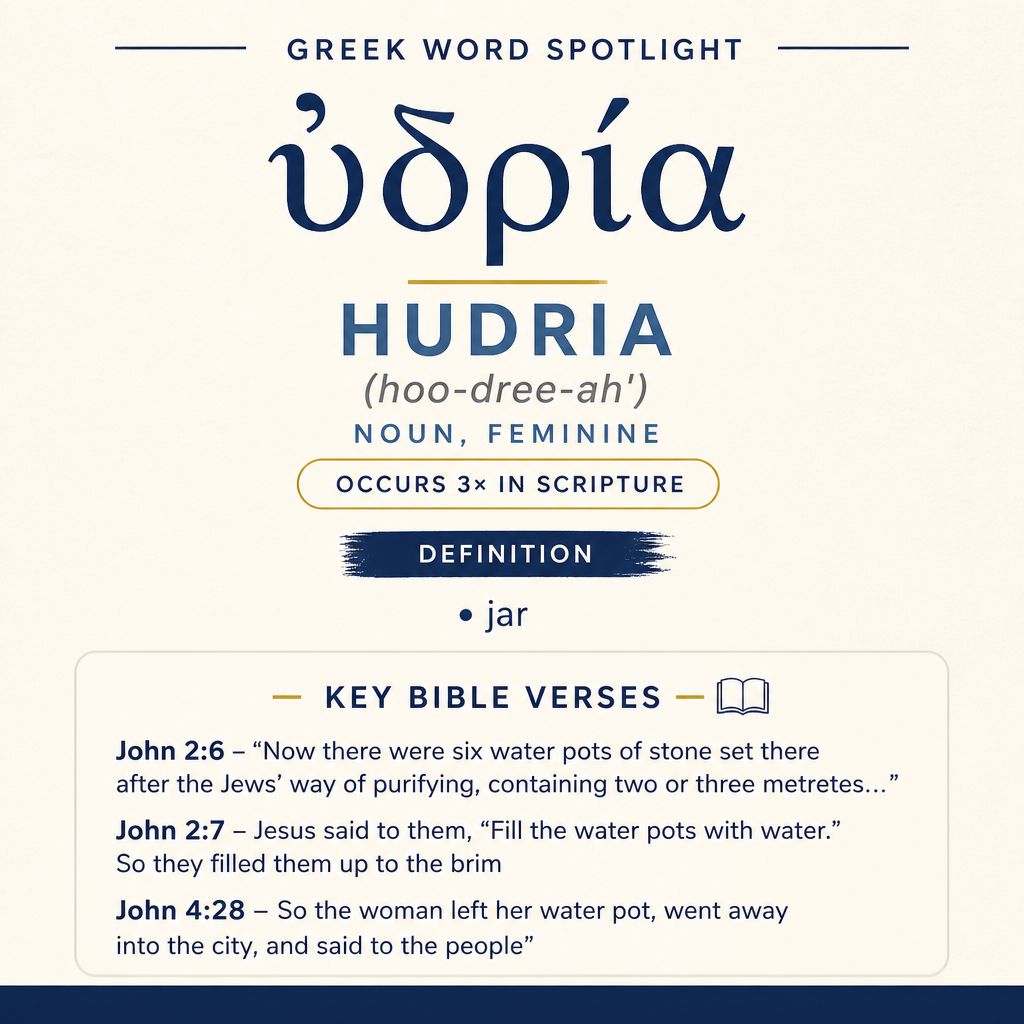
ὑδρία means “jar” and appears in John 2:6–7 and John 4:28.
John 2 Setting
In John 2:6–7 it refers to six stone water pots used for the Jews’ purification, which Jesus commands to be filled.
Learn More →John 4 Scene
In John 4:28 the woman leaves her water pot and goes into the city to speak to the people.
Learn More →ὑδρία means “jar” and appears in the Gospel of John in two scenes: the stone vessels at the wedding in Cana and the Samaritan woman’s vessel at the well. In each setting it points to an ordinary container whose presence and handling are integral to what happens next.
Root and Related Words
ὑδρία (Hudria) is related to ὕδωρ (hydor), “water” (Strong’s G5204).

Occurrences
John 2:6: “Now there were six water pots of stone set there after the Jews’ way of purifying, containing two or three metretes apiece.”
Here ὑδρία names substantial jars that are already “set there,” part of the arranged setting rather than something newly introduced. They are specified as “of stone,” which marks them out as durable, heavy vessels suited to being stationed in place. The verse also ties their presence to “the Jews’ way of purifying,” locating these jars within an established pattern of ritual practice: they belong to a customary arrangement for purification and are therefore more than incidental household items in the scene. Their capacity—“two or three metretes apiece”—adds a concrete sense of scale. The narrative draws attention to how much these jars can hold, preparing the reader to think in terms of quantity and fullness when the jars are acted upon in the following verse.
John 2:7: “Jesus said to them, “Fill the water pots with water.” So they filled them up to the brim.”
In this line, ὑδρία functions as the direct object of a command: the jars become the focus of coordinated action. The instruction “Fill the water pots with water” links the container to its contents in a tightly connected way; the point is not simply that water is present, but that it is deliberately put into these particular vessels. The response—“So they filled them up to the brim”—brings the jars’ capacity into the foreground. The phrase “to the brim” presents the jars as measurable containers with a definable limit and emphasizes that the filling is complete, not partial. Within the immediate scene, the jars serve as the visible proof of compliance: their filled state demonstrates that the instruction has been carried out fully.
John 4:28: “So the woman left her water pot, went away into the city, and said to the people,”
In this occurrence, ὑδρία is a personal possession: “her water pot.” The jar is something she has brought with her and would ordinarily carry back, yet she “left” it behind. The verb choice makes the jar a concrete marker of a decisive change of direction. The sentence stacks actions in sequence—she left the jar, she went away into the city, and she spoke to the people—so the abandoned vessel becomes the first visible sign of her shift from one activity to another. The jar belongs to the setting she departs from, while the city is the destination she turns toward; leaving the jar underscores the urgency and focus of her movement into the public space where she addresses others.
Sense and Usage
Across these passages ὑδρία consistently denotes a jar as a real, handled object—something that can be set in place, filled, and left behind. John 2 portrays jars that are already part of the environment, described with material (“stone”), location (“set there”), and a recognized function (“after the Jews’ way of purifying”). These details show the jar operating as fixed equipment within a household or communal setting, defined not merely by shape but by its role in routine practices. The mention of capacity (“two or three metretes apiece”) keeps the reader thinking of the jar as a container whose size matters and whose contents can be measured.
John 2:7 then draws out what the definition “jar” implies in action: a jar is something that can be filled to a limit. The narrative does not treat the vessels as background props; instead, they become the focal point of obedience to a spoken command, and their “brim” becomes a boundary that can be reached. The jar’s significance in this moment is practical and visible: a jar can be filled completely, and its fullness can be observed.
In John 4:28 the jar is associated with a specific individual (“her water pot”) and serves as a narrative hinge. The act of leaving it behind only makes sense because a jar is normally carried for a purpose; as an everyday object it belongs to ordinary tasks and routines. The sentence uses the jar’s abandonment to highlight the woman’s sudden reorientation: she departs, and speech in the city follows immediately. Without adding extra explanation, the verse lets the jar stand as a concrete trace of what she was doing and what she is no longer doing in that moment.
Taken together, these occurrences show ὑδρία applied both to multiple large stationary jars and to a single personal jar. In both cases the word retains its simple reference to a container, while the surrounding narrative uses that concreteness to communicate setting (jars “set there”), completion (filled “to the brim”), and urgency (a jar “left” behind as someone hurries elsewhere).
Imagery
The imagery of ὑδρία in John is shaped by ordinary physical interaction: jars stand ready, receive water, and can be carried or abandoned. In Cana, the jars are solid fixtures—stone vessels associated with purification and defined by their large capacity. In Samaria, the jar is the kind of object that accompanies a person and normally determines the rhythm of going and returning; leaving it behind sharpens the picture of rapid departure and public announcement. In both scenes, the jar is quiet but vivid: a tangible container that anchors the narrative in everyday life.
Sources: Lexical data from Strong’s Exhaustive Concordance and the Translators Brief Lexicon of Extended Strongs for Greek (STEPBible, CC BY). Occurrence data from the Translators Amalgamated Greek New Testament (STEPBible, CC BY). Scripture quotations from the World English Bible (public domain).