
Exploring the Meaning of Time in Greek
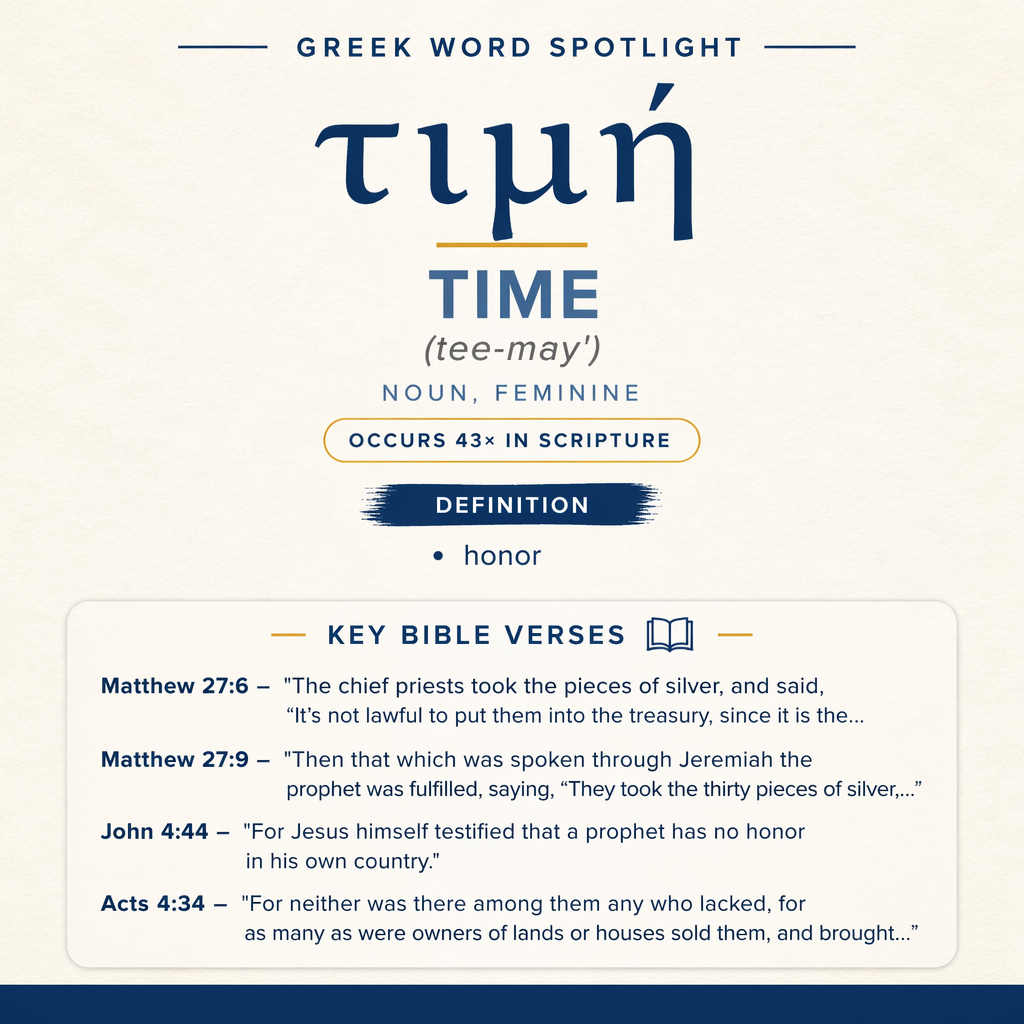
τιμή means “honor” and occurs 43 times in Scripture, including Matthew 27:6, John 4:44, and Acts 4:34.
Scripture Footprint
This word occurs 43 times in Scripture. It appears in passages such as Matthew 27:6–9 and John 4:44.
Learn More →Sample Contexts
John 4:44 uses τιμή in the statement that a prophet has no honor in his own country. Acts includes it in contexts involving a price (Acts 4:34; 5:2–3; 7:16).
Learn More →τιμή denotes “honor,” and in these passages it appears both as social esteem and as a concrete “price” attached to money, goods, or property. The occurrences move between public regard (or its lack) and the counted value of silver and possessions.
Occurrences
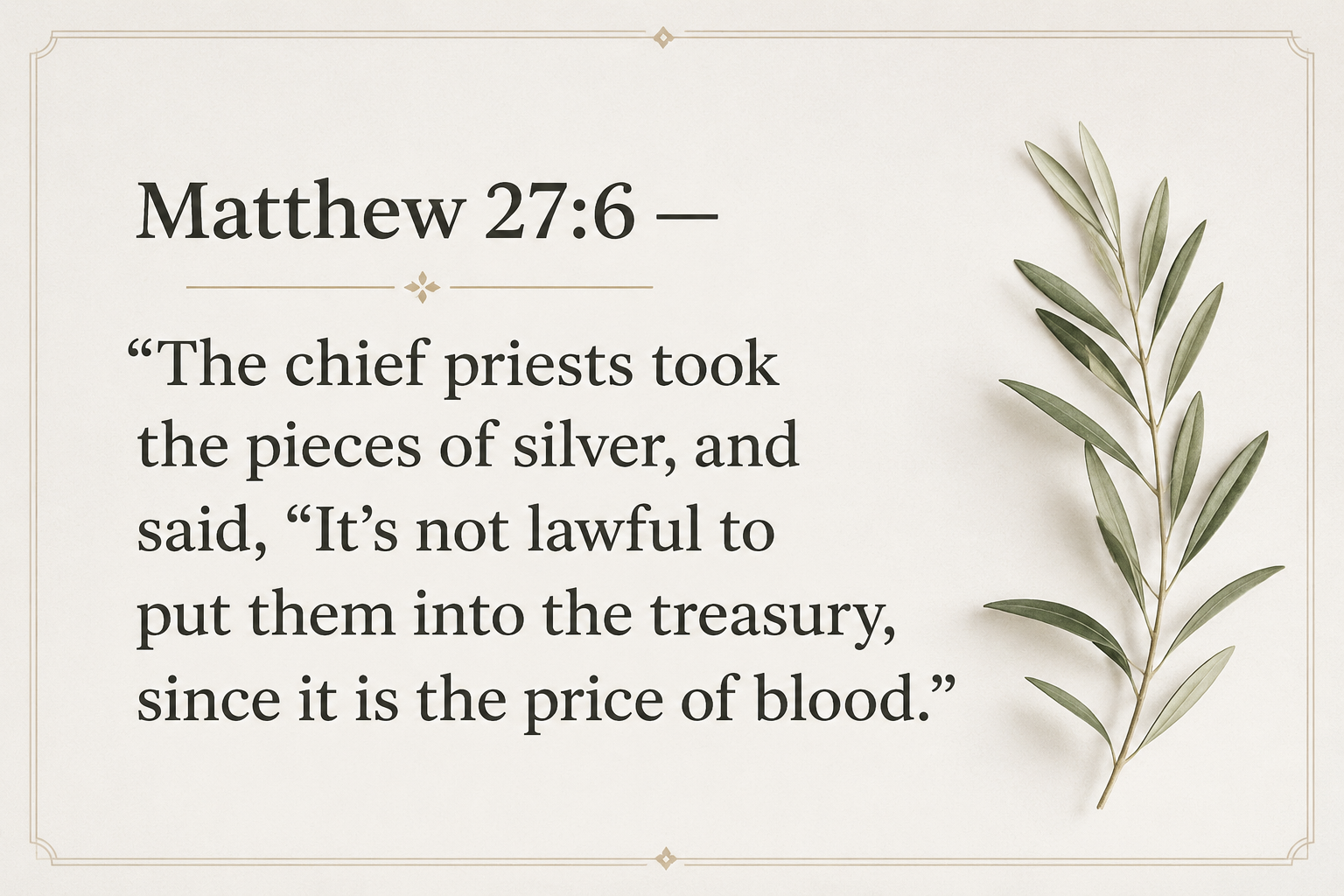
Matthew 27:6 — “The chief priests took the pieces of silver, and said, “It’s not lawful to put them into the treasury, since it is the price of blood.””
Here τιμή belongs to the realm of valuation: the silver is identified as a “price,” and that “price” is morally stained by its connection with blood. The priests’ decision about where the money may be placed turns on what the money represents as a price, not merely on the coins themselves.
Matthew 27:9 — “Then that which was spoken through Jeremiah the prophet was fulfilled, saying, “They took the thirty pieces of silver, the price of him upon whom a price had been set, whom some of the children of Israel priced,”
In this citation, τιμή is repeated to underscore an imposed valuation: a person is spoken of as having “a price” set upon him, and the thirty pieces of silver are named as that price. The language highlights the act of assigning worth in transactional terms, presenting “price” as something others determine and apply.
John 4:44 — “For Jesus himself testified that a prophet has no honor in his own country.”
τιμή here is explicitly social: “honor” is something a prophet can be denied within familiar surroundings. The statement frames honor as public recognition or esteem—an expected regard that, in this setting, is absent where it might seem most natural.
Acts 4:34 — “For neither was there among them any who lacked, for as many as were owners of lands or houses sold them, and brought the proceeds of the things that were sold,”
Although “honor” is not the surface topic, τιμή functions in the financial description: the sale of lands and houses yields proceeds that are brought for communal use. The term’s “price” sense fits the scene of liquidating property into a measurable value that can then be placed at the community’s disposal.
Acts 5:2 — “and kept back part of the price, his wife also being aware of it, then brought a certain part and laid it at the apostles’ feet.”
τιμή again refers to the sale-value of property (“the price”). The narrative contrast depends on the integrity of what is done with that price: part is withheld, while a portion is presented publicly. “Price” names the whole amount realized by sale, making the act of keeping back a defined portion more pointed.
Acts 5:3 — “But Peter said, “Ananias, why has Satan filled your heart to lie to the Holy Spirit and to keep back part of the price of the land?”
The same “price” is now the focus of accusation. τιμή anchors the charge in a concrete sum attached to “the land,” reinforcing that the issue is not vague generosity but the handling of a specific valuation and the deception surrounding it.
Acts 7:16 — “and they were brought back to Shechem, and laid in the tomb that Abraham bought for a price in silver from the children of Hamor of Shechem.”
τιμή is the purchase-price paid “in silver,” marking an agreed monetary value in a formal transaction. The emphasis rests on the legitimacy and concreteness of the purchase: the tomb is not merely taken or claimed; it is acquired at a price, in a specified medium.
Acts 19:19 — “Many of those who practiced magical arts brought their books together and burned them in the sight of all. They counted their price, and found it to be fifty thousand pieces of silver.”
Here τιμή is the calculable worth of the burned books. The act of “counting” their price underlines that the loss is measurable and substantial, and that the renunciation is not only symbolic; it involves forfeiting items with a large total valuation.
Acts 28:10 — “They also honored us with many honors, and when we sailed, they put on board the things that we needed.”
τιμή returns to the social sphere: “honored us with many honors” presents honor as expressed in repeated acts of esteem. The verse then links this honoring to practical generosity—supplying needed things for the voyage—so that honor is not only verbal regard but embodied in concrete support.
Romans 2:7 — “to those who by perseverance in well-doing seek for glory, honor, and incorruptibility, eternal life;”
In Paul’s list, τιμή is a sought-after good aligned with “glory” and “incorruptibility.” The context of perseverance in doing good portrays honor as something weighty enough to be pursued over time, a fitting counterpart to enduring moral action.
Romans 2:10 — “But glory, honor, and peace go to every man who does good, to the Jew first, and also to the Greek.”
τιμή here is not merely desired; it is something that “go[es] to” the one who does good. The distribution “to the Jew first, and also to the Greek” frames honor as a form of acknowledged regard that is imparted without ethnic restriction in this principle.
Romans 9:21 — “Or hasn’t the potter a right over the clay, from the same lump to make one part a vessel for honor, and another for dishonor?”
In this metaphor, τιμή characterizes a vessel’s role or status: one vessel is “for honor,” another “for dishonor.” Honor functions as a qualitative designation that marks a vessel as suited for a respected purpose, standing in explicit contrast to its opposite.

Sense and Usage
Across these passages, τιμή operates along two closely linked axes: (1) honor as social esteem and (2) honor as a measurable price. The “price” uses are strongly material: pieces of silver, proceeds from sales, a portion of a land’s sale-value, a purchase “in silver,” and the counted total of valuable books. In each case, τιμή signals that the object in view can be assessed, totaled, withheld, paid, or rejected because its value is definable. The narratives in Matthew and Acts especially treat price as something with moral and communal consequences: money identified as “the price of blood” is treated as unsuitable for the treasury (Matthew 27:6), and a concealed portion of a land’s price becomes the focal point of a confrontation about deception (Acts 5:2–3). Even where the text describes straightforward buying and selling (Acts 4:34; Acts 7:16), τιμή keeps attention on valuation as the hinge between property and the uses to which its value is put.
The “honor” uses foreground recognition and status. In John 4:44, honor is withheld from a prophet in his own country, presenting τιμή as a social good that depends on communal reception. In Acts 28:10, honor is multiplied (“many honors”) and expressed through hospitality and provision, showing honor as enacted in tangible acts. In Romans 2:7 and 2:10, honor is paired with other goods and tied to doing good, portraying τιμή as a kind of esteem that is not random or merely conventional but associated with moral perseverance and impartial bestowal. Romans 9:21 then places honor within an image of differentiated roles: “a vessel for honor” is defined by its intended standing in contrast to dishonor, making τιμή a marker of designated respectability.
Taken together, these passages allow τιμή to resonate between worth that can be counted and worth that is publicly accorded. The same word that can name the sum attached to silver and property can also name the esteem attached to persons and purposes. This gives the term a unified feel: whether the context is marketplace valuation or communal recognition, τιμή points to what something is treated as being worth within a given setting—by priests handling blood-money, by sellers and buyers, by communities receiving messengers, by hosts honoring travelers, or by a potter assigning roles to vessels.
Imagery
The most vivid images attached to τιμή here are monetary and practical: silver counted out as a set price (Matthew 27:9), proceeds laid down for communal care (Acts 4:34), a price partially withheld (Acts 5:2–3), a purchase made “for a price in silver” (Acts 7:16), and the public tallying of a large total after books are burned (Acts 19:19). Alongside these stands the quieter but pointed social image of honor granted or denied—“no honor in his own country” (John 4:44) versus being “honored…with many honors” (Acts 28:10)—and the crafted contrast of “a vessel for honor” (Romans 9:21), where honor becomes a visible designation of use and standing.
Sources: Lexical data from Strong’s Exhaustive Concordance and the Translators Brief Lexicon of Extended Strongs for Greek (STEPBible, CC BY). Occurrence data from the Translators Amalgamated Greek New Testament (STEPBible, CC BY). Scripture quotations from the World English Bible (public domain).





