
Exploring the Meaning of Trichinos in Greek
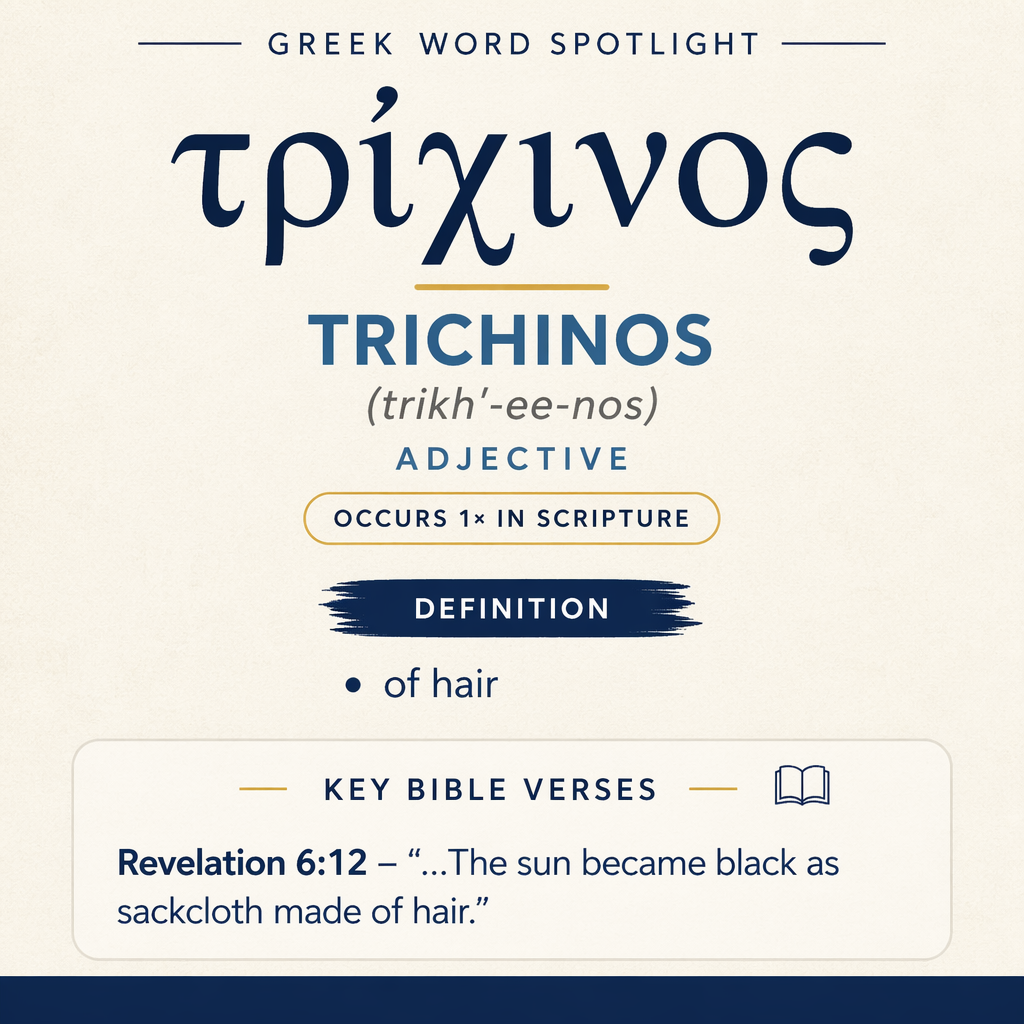
τρίχινος means “of hair” and appears once in Scripture in Revelation 6:12.
Verse Context
In Revelation 6:12, it describes sackcloth made of hair when the sun became black.
Learn More →τρίχινος means “of hair” and appears in the imagery of the sixth seal in Revelation. It functions as a descriptive term within a single, vivid comparison that helps shape how the cosmic signs are pictured.
Root and Related Words
τρίχινος is related to thrix (θρίξ), “hair” (Strong’s G2359), from which this adjective is derived.

Occurrences
“I saw when he opened the sixth seal, and there was a great earthquake. The sun became black as sackcloth made of hair, and the whole moon became as blood.” (Revelation 6:12)
Here τρίχινος qualifies the “sackcloth” in the clause, “black as sackcloth made of hair.” The word does not stand alone as an object in the scene; it attaches to the fabric and specifies what sort of sackcloth is in view—sackcloth characterized by hair. In the verse’s sequence of events, the opening of the seal is followed by an earthquake and then by striking changes in the heavens: the sun’s appearance is compared to a particular kind of sackcloth, and the moon’s appearance is compared to blood. τρίχινος therefore serves the first of these two comparisons by sharpening the visual texture of the darkness attributed to the sun: not merely “sackcloth,” but sackcloth “made of hair,” a concrete material description that intensifies the simile’s realism. The adjective anchors the image in something tactile and ordinary (a cloth defined by its hair composition) even as the scene describes extraordinary, large-scale upheaval (“a great earthquake,” the sun altered, “the whole moon” altered).
Sense and Usage
The sense “of hair” in τρίχινος operates as a material descriptor. In its lone attestation, it does not describe a person, an animal, or a bodily feature; it describes the substance of a manufactured item (“sackcloth made of hair”). This use highlights a common way adjectives of composition function: they mark what something is made from, and by doing so they guide the reader’s imagination toward a specific kind of surface and color. Revelation 6:12 presents rapid, forceful imagery; within that compressed style, τρίχινος contributes precision. The comparison is not simply to darkness in the abstract but to a particular cloth associated with hair as its defining feature, helping the reader picture a blackness that is heavy, opaque, and cloth-like in appearance.
Because τρίχινος is tied to “sackcloth,” its force comes through the combination rather than from the adjective in isolation. The verse’s simile depends on an object whose defining quality is its hair composition; τρίχινος supplies that defining quality and keeps the comparison from becoming generic. In the same sentence, the moon is compared to blood; together, the paired comparisons emphasize totalizing visual transformation (“The sun became…,” “the whole moon became…”). τρίχινος thus participates in a broader pattern of concrete imagery: vast cosmic bodies are described through everyday, physical referents, and the adjective “of hair” keeps one of those referents materially specific.
Imagery
In Revelation 6:12 the world-shaking and the commonplace are set side by side. “A great earthquake” frames the scene as catastrophic, yet τρίχινος directs attention to the kind of cloth one might recognize by touch and sight. By likening the sun’s blackness to “sackcloth made of hair,” the verse assigns the darkness a palpable character—an image of blackness that feels like an object laid over the light. The adjective is small, but it helps make the comparison concrete enough to be seen.
Sources: Lexical data from Strong’s Exhaustive Concordance and the Translators Brief Lexicon of Extended Strongs for Greek (STEPBible, CC BY). Occurrence data from the Translators Amalgamated Greek New Testament (STEPBible, CC BY). Scripture quotations from the World English Bible (public domain).





