Exploring the Meaning of Telos in Greek
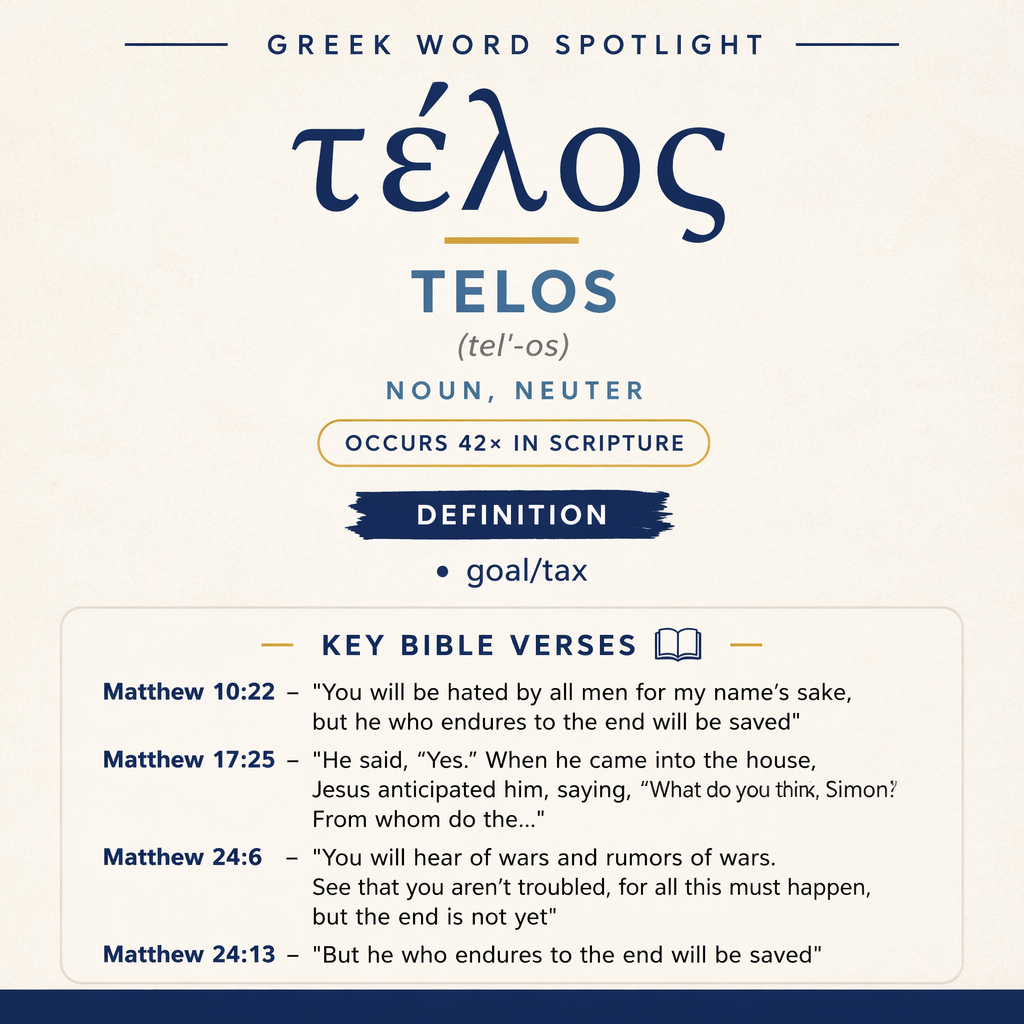
τέλος (Telos) means goal/tax and occurs 42 times in Scripture, including Matthew 10:22; 24:6,13–14; 17:25; 26:58; Mark 3:26; 13:7.
Usage in Matthew
Matthew uses τέλος in contexts of “the end,” including endurance to the end (Matthew 10:22; 24:13). It also appears in Matthew 17:25 and 26:58.
Learn More →Usage in Mark
Mark uses τέλος for an “end,” including “the end is not yet” (Mark 13:7). It also appears in Mark 3:26.
Learn More →τέλος expresses the idea of a goal or a tax, and in these passages it appears in sayings about endurance, public turmoil, kingdoms, conflict, and civic payments. The term can mark the point a process reaches, the outcome someone waits to see, or the kind of payment kings collect.
Occurrences
“You will be hated by all men for my name’s sake, but he who endures to the end will be saved.” (Matthew 10:22)
Here τέλος sets the stated goal of enduring: the endurance is not undefined persistence, but perseverance directed toward “the end.” In the sentence, salvation is linked to reaching that goal, so τέλος functions as the terminus that endurance aims at within the experience of being “hated by all men.”
“He said, “Yes.” When he came into the house, Jesus anticipated him, saying, “What do you think, Simon? From whom do the kings of the earth receive toll or tribute? From their children, or from strangers?”” (Matthew 17:25)
In this question about royal revenue, τέλος appears in the sphere of taxation: “toll or tribute.” The word contributes the concrete idea of money demanded by rulers, and the contrast (“their children” versus “strangers”) frames the payment as something expected from those outside the royal household rather than from the king’s own family.
“You will hear of wars and rumors of wars. See that you aren’t troubled, for all this must happen, but the end is not yet.” (Matthew 24:6)
τέλος here names a goal-point that is easily assumed but explicitly postponed. Wars and rumors are real and unsettling, yet they are not to be treated as the arrival of “the end.” The term therefore distinguishes between turbulent events that “must happen” and the later goal to which history is moving.
“But he who endures to the end will be saved.” (Matthew 24:13)
The wording parallels Matthew 10:22 and again makes τέλος the target of endurance. The saving is tied to endurance carried through until that goal is reached, so τέλος functions as the completing point that gives perseverance its direction and measure.
“This Good News of the Kingdom will be preached in the whole world for a testimony to all the nations, and then the end will come.” (Matthew 24:14)
In this statement, τέλος is placed after a worldwide proclamation: preaching “in the whole world” and testimony “to all the nations” are presented as prior to the arrival of “the end.” The word thus marks the goal-point that follows a defined sequence; it is the moment that “will come” after the stated condition is met.
“But Peter followed him from a distance, to the court of the high priest, and entered in and sat with the officers, to see the end.” (Matthew 26:58)
τέλος here is not the culmination of world events but the outcome of a specific unfolding situation. Peter’s actions—following at a distance, entering the court, sitting with officers—are motivated “to see the end,” that is, to see where the proceedings will reach. The word contributes the sense of awaiting the goal-point of a process already underway.
“If Satan has risen up against himself, and is divided, he can’t stand, but has an end.” (Mark 3:26)
In this argument, τέλος is the outcome of internal division: if a power is “divided,” it “can’t stand,” and the result is that it “has an end.” The word marks the goal-point of collapse implied by the logic of self-opposition, expressing a finishing outcome for something that cannot remain stable.
““When you hear of wars and rumors of wars, don’t be troubled. For those must happen, but the end is not yet.” (Mark 13:7)
This repeats the distinction made in Matthew 24:6: τέλος names the awaited goal, while wars and rumors are events that “must happen” but do not themselves constitute that goal-point. The word therefore functions to prevent premature identification of turmoil with the arrival of the end.
“You will be hated by all men for my name’s sake, but he who endures to the end will be saved.” (Mark 13:13)
As in the Matthean parallels, τέλος is the endpoint that endurance reaches. The clause “will be saved” is attached to enduring “to the end,” so the term contributes the notion of perseverance sustained until the intended goal is reached despite public hostility.
“and he will reign over the house of Jacob forever. There will be no end to his Kingdom.” (Luke 1:33)
τέλος here is negated: the reign is “forever,” and the kingdom has “no end.” The word contributes the idea of a goal-point that would normally close a reign, but in this case that closing point is explicitly denied; the kingdom’s duration is described as unbounded by an ending.
“yet because this widow bothers me, I will defend her, or else she will wear me out by her continual coming.’ ” (Luke 18:5)
In the judge’s reasoning, τέλος belongs to the sphere of pressure reaching an outcome: the widow’s repeated coming produces a result he wants to avoid—being “worn out.” The word contributes the sense of an effect that persistence drives toward, an end-result that motivates the decision “I will defend her.”
“When you hear of wars and disturbances, don’t be terrified, for these things must happen first, but the end won’t come immediately.” (Luke 21:9)
Here τέλος is again distinguished from alarming events. Wars and disturbances “must happen first,” and the end “won’t come immediately,” so the term functions as the goal-point that lies beyond preliminary upheavals. The instruction “don’t be terrified” is grounded in this spacing: the presence of disturbances does not mean the goal has arrived.

Sense and Usage
Across these texts τέλος operates with two concrete anchors: an envisioned goal and a demanded tax. The “tax” sense is explicit in Matthew 17:25, where the question about “toll or tribute” situates τέλος in ordinary structures of kingship and payment. The contrast between “children” and “strangers” makes the tax a marker of social position: it is something collected from those treated as outside the royal household.
The “goal” sense dominates the remaining passages and takes several shapes. In the endurance sayings (Matthew 10:22; Matthew 24:13; Mark 13:13), τέλος is the defined target of steadfastness under hatred; endurance is measured by whether it reaches that goal. In the eschatological instructions (Matthew 24:6, 14; Mark 13:7; Luke 21:9), τέλος is not merely a stopping point but the objective toward which events move, and the key pastoral function of the term in these lines is to separate present turmoil from that objective: wars, rumors, and disturbances “must happen,” but they are not themselves the goal. The same goal-oriented force appears in Matthew 26:58, but on a smaller scale: Peter wants to see how a particular sequence will turn out—what the “end” of the proceeding will be—showing τέλος as the outcome of an episode. Mark 3:26 uses τέλος as the inevitable result of a divided power’s inability to stand; the argument depends on the notion that certain internal conditions necessarily drive toward an ending. Luke 1:33 turns the term into a boundary-marker by denying it: if a kingdom has “no end,” then it is portrayed as not reaching a terminal goal-point at all, but continuing beyond the normal limits that close a reign.
Taken together, these uses show how τέλος can frame time and process: it can be awaited (“the end will come”), deferred (“not yet,” “won’t come immediately”), watched for in unfolding events (“to see the end”), reached by perseverance (“endures to the end”), or denied in the case of an everlasting kingdom (“no end”). Even where the scenes differ—public hatred, international unrest, judicial annoyance, a royal tax question—the word consistently helps define what outcome is in view and how present actions or events relate to that outcome.
Imagery
The passages create two recurring pictures. One is a horizon-line: wars and disturbances occupy the foreground, but τέλος sits beyond them as a goal that has not yet arrived (Matthew 24:6; Mark 13:7; Luke 21:9), and that will arrive after a worldwide testimony (Matthew 24:14). The other is a courtroom-and-court setting: taxes collected by kings (Matthew 17:25), officers in the high priest’s court where someone stays “to see the end” (Matthew 26:58), and a judge moved to act to prevent a wearying outcome (Luke 18:5). In both pictures, τέλος names what people are either driving toward, waiting to see, or trying to prevent.
Sources: Lexical data from Strong’s Exhaustive Concordance and the Translators Brief Lexicon of Extended Strongs for Greek (STEPBible, CC BY). Occurrence data from the Translators Amalgamated Greek New Testament (STEPBible, CC BY). Scripture quotations from the World English Bible (public domain).