
Exploring the Meaning of Teleutao in Greek
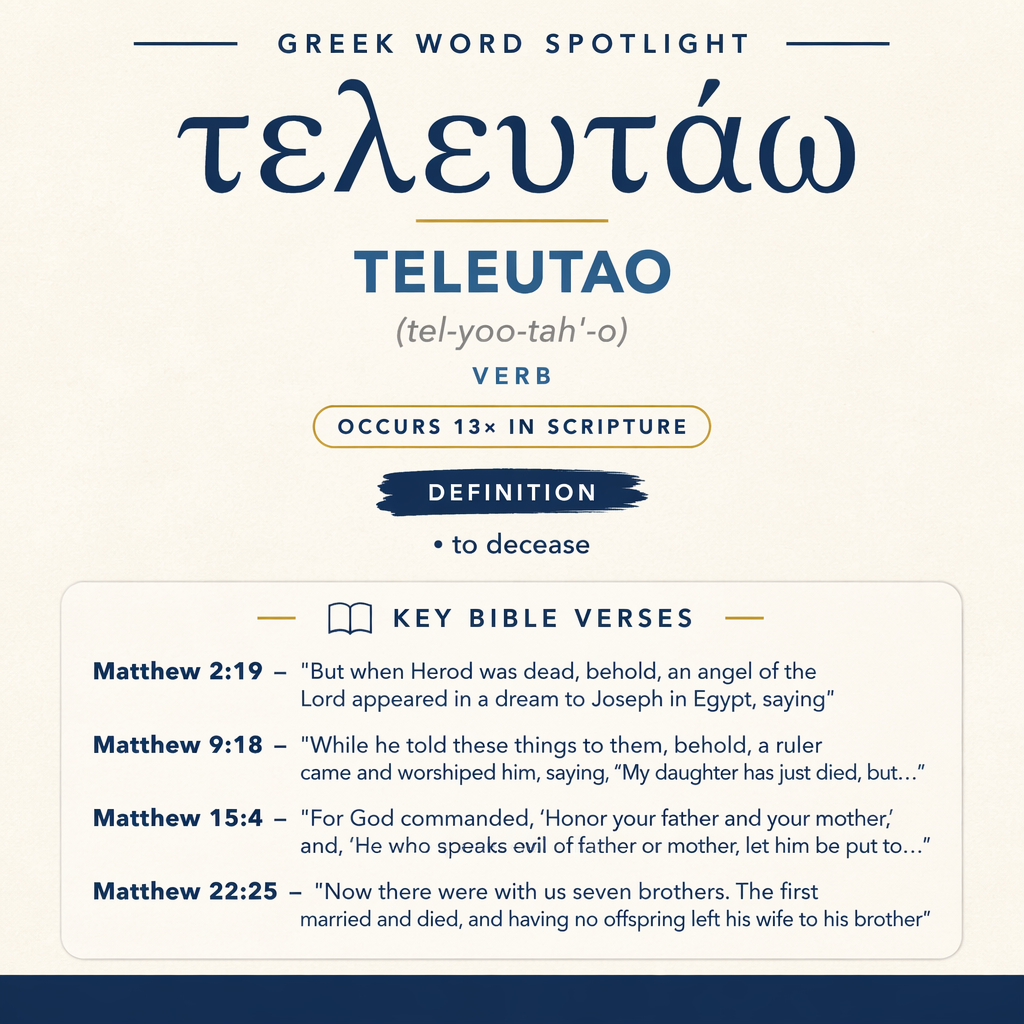
τελευτάω means “to decease” and occurs 13 times in Scripture, including Matthew (2:19; 9:18; 15:4; 22:25) and Mark (7:10; 9:44, 46, 48).
Core Meaning
τελευτάω is defined as “to decease.” In the listed verses it is used for being dead, having died, or being put to death.
Learn More →Matthew Examples
In Matthew 2:19 it describes Herod as dead, and in Matthew 9:18 a daughter as having just died. It also appears in Matthew 15:4 and 22:25.
Learn More →Mark Examples
In Mark 7:10 it appears in the command about being put to death for speaking evil of parents. In Mark 9:44, 9:46, and 9:48 it appears in the phrase “doesn’t die.”
Learn More →τελευτάω means “to decease,” describing the event of dying as it appears across narrative, legal citation, parable-like illustration, and apostolic speech. In the passages where it occurs, it can mark an individual’s death as a completed fact, a death approaching, or death invoked as a penalty.
Occurrences
“But when Herod was dead, behold, an angel of the Lord appeared in a dream to Joseph in Egypt, saying,” (Matthew 2:19)
Here τελευτάω functions as a time marker: Herod’s death creates the new situation in which the angel’s message comes to Joseph. The focus is not on the process of dying but on the death as an established reality that changes what can safely happen next.
“While he told these things to them, behold, a ruler came and worshiped him, saying, “My daughter has just died, but come and lay your hand on her, and she will live.”” (Matthew 9:18)
The ruler’s report uses death as the extreme boundary of need: his daughter’s decease is presented as immediate (“has just died”). The word therefore sets the scene for a request that assumes the death is real and decisive, even as the speaker expresses hope for reversal (“and she will live”).
“For God commanded, ‘Honor your father and your mother,’ and, ‘He who speaks evil of father or mother, let him be put to death.’” (Matthew 15:4)
In this quotation, τελευτάω belongs to a judicial frame: death is not an accident of life but a prescribed penalty (“let him be put to death”). The word contributes the severity of the sanction attached to dishonoring one’s parents.
“Now there were with us seven brothers. The first married and died, and having no offspring left his wife to his brother.” (Matthew 22:25)
Here τελευτάω is used in a chained family scenario, where one brother’s death creates an obligation and a new marital situation (“left his wife to his brother”). The decease is treated as the key transition that moves the narrative from one brother to the next.
“For Moses said, ‘Honor your father and your mother;’ and, ‘He who speaks evil of father or mother, let him be put to death.’” (Mark 7:10)
As in Matthew 15:4, death appears as a punitive outcome, attached to a specific kind of speech and posture toward parents. τελευτάω adds the weight of an ultimate penalty within a commandment-centered appeal.
“‘where their worm doesn’t die, and the fire is not quenched.’” (Mark 9:44)
This line places τελευτάω in a striking negative form: the “worm” is said not to die. The word’s contribution is to highlight ongoingness by denying the endpoint that death would normally supply, pairing the continued non-decease of the worm with the fire that “is not quenched.”
“‘where their worm doesn’t die, and the fire is not quenched.’” (Mark 9:46)
The repetition reinforces the same point: the expected termination (“die”) does not occur. τελευτάω here serves the rhetoric of permanence, with the non-dying worm presented as part of an unrelieved condition.
“‘where their worm doesn’t die, and the fire is not quenched.’” (Mark 9:48)
Again, the verb appears to deny cessation. By keeping “die” in view and then negating it, the saying intensifies the picture of a state that does not reach an ending point.
“A certain centurion’s servant, who was dear to him, was sick and at the point of death.” (Luke 7:2)
In this narrative introduction, τελευτάω marks a looming boundary rather than a completed event: the servant is “at the point of death.” The verb thereby expresses imminence—death as the near next step—while the servant’s value to the centurion (“dear to him”) heightens the urgency.
“Jesus said, “Take away the stone.” Martha, the sister of him who was dead, said to him, “Lord, by this time there is a stench, for he has been dead four days.”” (John 11:39)
Here τελευτάω supports a concrete, physical realism: the man’s death has persisted long enough to produce “a stench,” and the time is specified (“dead four days”). The word is tied to bodily decay and to the social fact of burial (“Take away the stone” implies a sealed tomb).
““Brothers, I may tell you freely of the patriarch David, that he both died and was buried, and his tomb is with us to this day.” (Acts 2:29)
In apostolic speech, τελευτάω functions as a publicly verifiable fact within an argument: David “died and was buried,” and the continuing presence of “his tomb” is cited. The decease is connected to burial as the confirmatory outcome, grounding the statement in shared knowledge (“with us to this day”).
“Jacob went down into Egypt and he died, himself and our fathers,” (Acts 7:15)
Here death is narrated as part of a larger family-historical movement (“went down into Egypt”), followed by the decease of Jacob and then “our fathers.” τελευτάω thus marks generational completion, naming death as the common endpoint within a lineage story.

Sense and Usage
Across these passages, τελευτάω consistently denotes decease, but it is deployed in several distinct communicative settings. In straightforward narrative, it can establish a new situation by marking a death that has already occurred (Matthew 2:19), or it can serve as a report of a death that has just happened and is treated as final by ordinary expectation (Matthew 9:18). It also appears where death is approached but not yet realized, giving language for a critical threshold—“sick and at the point of death” (Luke 7:2)—so that the reader is placed at the edge between life and decease.
In legal or commandment quotation, τελευτάω is framed as a penalty (“let him be put to death,” Matthew 15:4; Mark 7:10). In these contexts, the verb contributes not chronological information but moral gravity: death is invoked as the measure of seriousness attached to a particular offense. By contrast, in Matthew 22:25, death acts as a narrative hinge: “married and died” leads directly to the next social arrangement (“left his wife to his brother”), so that decease functions as the transition that rearranges responsibilities.
The sayings in Mark 9 use the verb in a deliberately paradoxical way: rather than describing a person who dies, they describe a “worm” that “doesn’t die” (Mark 9:44, 9:46, 9:48). The normal expectation that death ends activity is denied, and the denial is paired with a second denial of ending (“the fire is not quenched”). Within the sentence, τελευτάω supplies the conceptual endpoint—death—so that the negation can emphasize the absence of an endpoint.
John 11:39 anchors decease in sensory consequence and elapsed time: “there is a stench” because “he has been dead four days.” Here τελευτάω is not abstract; it is bound to the realities of a sealed burial place (“Take away the stone”) and the decay associated with an extended period after death. Acts 2:29 uses the verb in close association with burial and with a known location (“his tomb”), presenting death as something publicly attested. Acts 7:15 sets decease within collective memory, compressing the deaths of Jacob and “our fathers” into a single line that signals the passing of a generation.
Imagery
Even while meaning simply “to decease,” τελευτάω gathers distinct images from its contexts: a ruler speaking of a child who “has just died” (Matthew 9:18), a servant hovering “at the point of death” (Luke 7:2), a tomb closed by a stone and opened despite the warning of “a stench” (John 11:39), and a tomb that remains present “to this day” as a communal landmark of death and burial (Acts 2:29). Alongside these, the repeated claim that the “worm doesn’t die” (Mark 9:44, 9:46, 9:48) uses the very idea of death to paint the dread of a condition where the expected end never arrives.
Sources: Lexical data from Strong’s Exhaustive Concordance and the Translators Brief Lexicon of Extended Strongs for Greek (STEPBible, CC BY). Occurrence data from the Translators Amalgamated Greek New Testament (STEPBible, CC BY). Scripture quotations from the World English Bible (public domain).





