
Exploring the Meaning of Tarsos in Greek
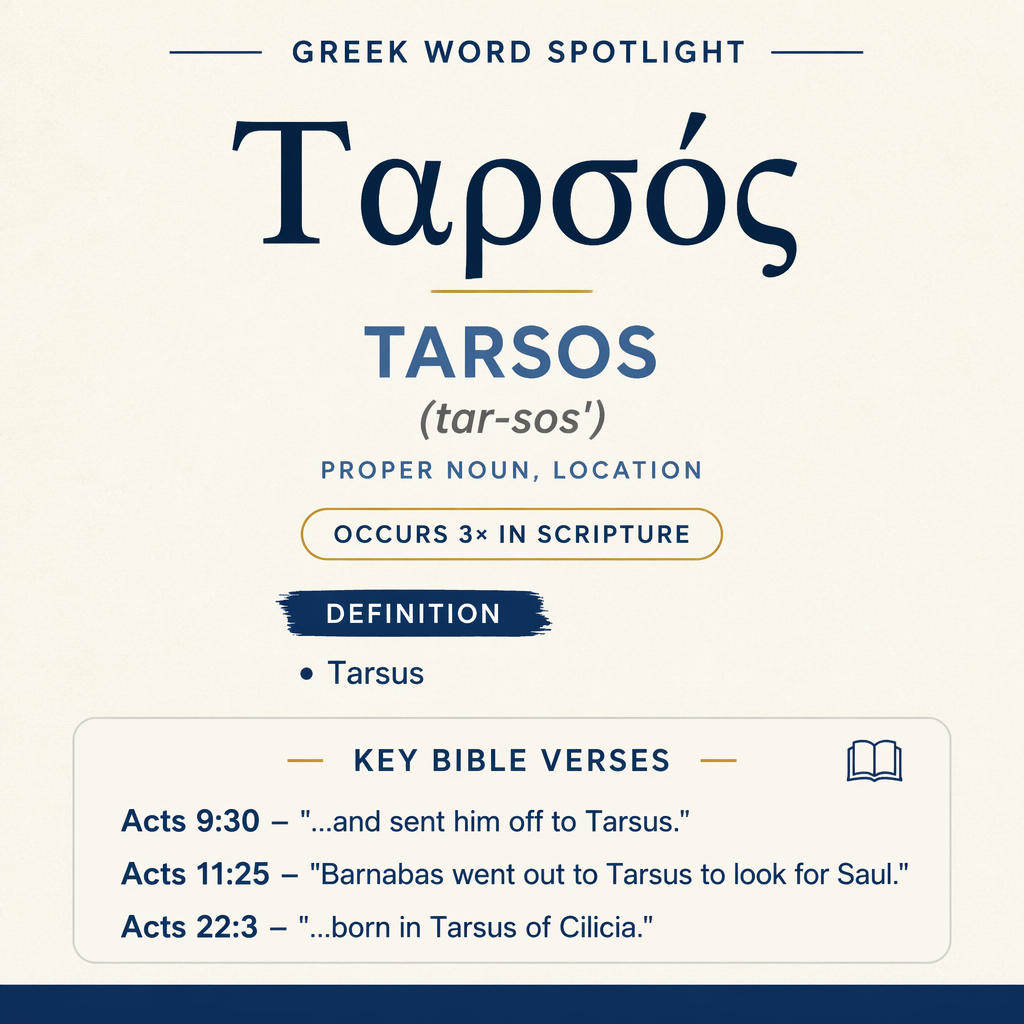
Ταρσός (Tarsos) means Tarsus and appears three times in Scripture: Acts 9:30, Acts 11:25, and Acts 22:3.
Acts References
Acts 9:30 records Paul being sent off to Tarsus, and Acts 11:25 records Barnabas going to Tarsus to look for Saul. Acts 22:3 identifies Tarsus of Cilicia as Paul’s birthplace.
Learn More →In the Narrative
In Acts, Tarsus is connected with Saul/Paul’s movements and background. It is both a destination (Acts 9:30; 11:25) and a birthplace (Acts 22:3).
Learn More →Ταρσός names the place called Tarsus. In Acts it functions as a concrete point of origin and destination, anchoring Saul’s story to identifiable locations and movements.
Occurrences
Acts 9:30 — “When the brothers knew it, they brought him down to Caesarea, and sent him off to Tarsus.”
Here Ταρσός marks the endpoint of a deliberate relocation. The verse presents a chain of actions taken by “the brothers”: they “brought him down to Caesarea” and then “sent him off to Tarsus.” Within that sequence, Tarsus is not introduced with explanation; it stands as a known destination that resolves the immediate situation that prompted their decision. The name gives the sentence a clear geographical finish line: Saul is moved from one city to another, and the narrative depicts this as purposeful and coordinated—escorted to a coastal hub (“Caesarea”) and then dispatched onward to Tarsus. As a place-name, Ταρσός contributes concreteness: Saul’s story is carried forward not only by events but by travel, and the route culminates in a specific city.
Acts 11:25 — “Barnabas went out to Tarsus to look for Saul.”
In this occurrence Ταρσός functions as the location of a search. Barnabas “went out” with a stated aim, “to look for Saul,” and Tarsus is the place where that aim is pursued. The wording implies that Saul’s whereabouts are associated with this city strongly enough that Barnabas’ search has a clear target. The place-name thus becomes a narrative hinge: Barnabas’ action is directional and intentional, and Ταρσός supplies the “where” that makes the search a real journey rather than a vague effort. The verse also creates continuity with prior movement: Saul is someone who can be sought and found in particular places, and Tarsus is one of those anchor points.
Acts 22:3 — ““I am indeed a Jew, born in Tarsus of Cilicia, but brought up in this city at the feet of Gamaliel, instructed according to the strict tradition of the law of our fathers, being zealous for God, even as you all are today.”
Here Ταρσός appears inside a self-description, where place of birth is part of establishing identity. The statement “born in Tarsus of Cilicia” sets a geographic origin, and it is immediately balanced by a second location: “brought up in this city.” Tarsus, then, is not presented as the whole of Saul’s formation; it is specifically the birthplace, contrasted with the city where he was raised and trained. This contrast allows the speaker to hold together multiple coordinates of belonging: ethnic identity (“a Jew”), birthplace (“born in Tarsus of Cilicia”), upbringing (“brought up in this city”), education (“at the feet of Gamaliel”), and religious posture (“zealous for God”). Within that layered claim, Ταρσός contributes a factual biographical detail that situates Saul geographically without displacing his present connection to the audience’s city.
Sense and Usage
Across these passages, Ταρσός consistently functions as a straightforward place-name, but its narrative role shifts with context. In Acts 9:30 it is the destination to which Saul is sent; the name closes a movement sequence and signals a transfer of location accomplished by others on his behalf. In Acts 11:25 it is the place Barnabas chooses to go in order to find Saul; the name supplies the concrete target of a purposeful expedition. In Acts 22:3 it is part of a personal résumé: Tarsus identifies Saul’s birth location, framed within a broader account that also includes upbringing, instruction, and zeal.
This range of use shows how a single geographic label can carry different kinds of narrative weight without changing its basic reference. As a destination, Tarsus receives Saul; as a search location, it “holds” him until Barnabas goes there; as a birthplace, it contributes to how Saul explains himself. In each case, Ταρσός enables the text to speak with specificity—people move to and from named places, seek others in named places, and describe themselves with reference to named places. The city’s name becomes a stable coordinate that supports shifting actions: sending, going, and speaking.
The phrase “Tarsus of Cilicia” in Acts 22:3 further tightens that specificity by coupling the city with a regional identifier. The effect is not to broaden the meaning of Ταρσός, but to place it within a larger map of locations already present in the surrounding narrative world (for example, the same verse also speaks of “this city”). This kind of pairing shows that the name can be used plainly on its own (“to Tarsus”) or with an added locator (“of Cilicia”) when the speaker’s aim is biographical clarity.
Imagery in Context
The imagery attached to Ταρσός in these verses is the imagery of routes and remembered origins. Acts 9:30 pictures a traveler being escorted and sent onward from one port city to another named destination. Acts 11:25 pictures a companion setting out on a purposeful journey to find a person in a specific place. Acts 22:3 places Tarsus in the mental geography of a personal story: a birthplace named alongside upbringing and instruction. In all three, Tarsus stands as a real point on the narrative map—arrived at, sought out, and recalled.
Sources: Lexical data from Strong’s Exhaustive Concordance and the Translators Brief Lexicon of Extended Strongs for Greek (STEPBible, CC BY). Occurrence data from the Translators Amalgamated Greek New Testament (STEPBible, CC BY). Scripture quotations from the World English Bible (public domain).





