
Exploring the Meaning of Tarachos in Greek
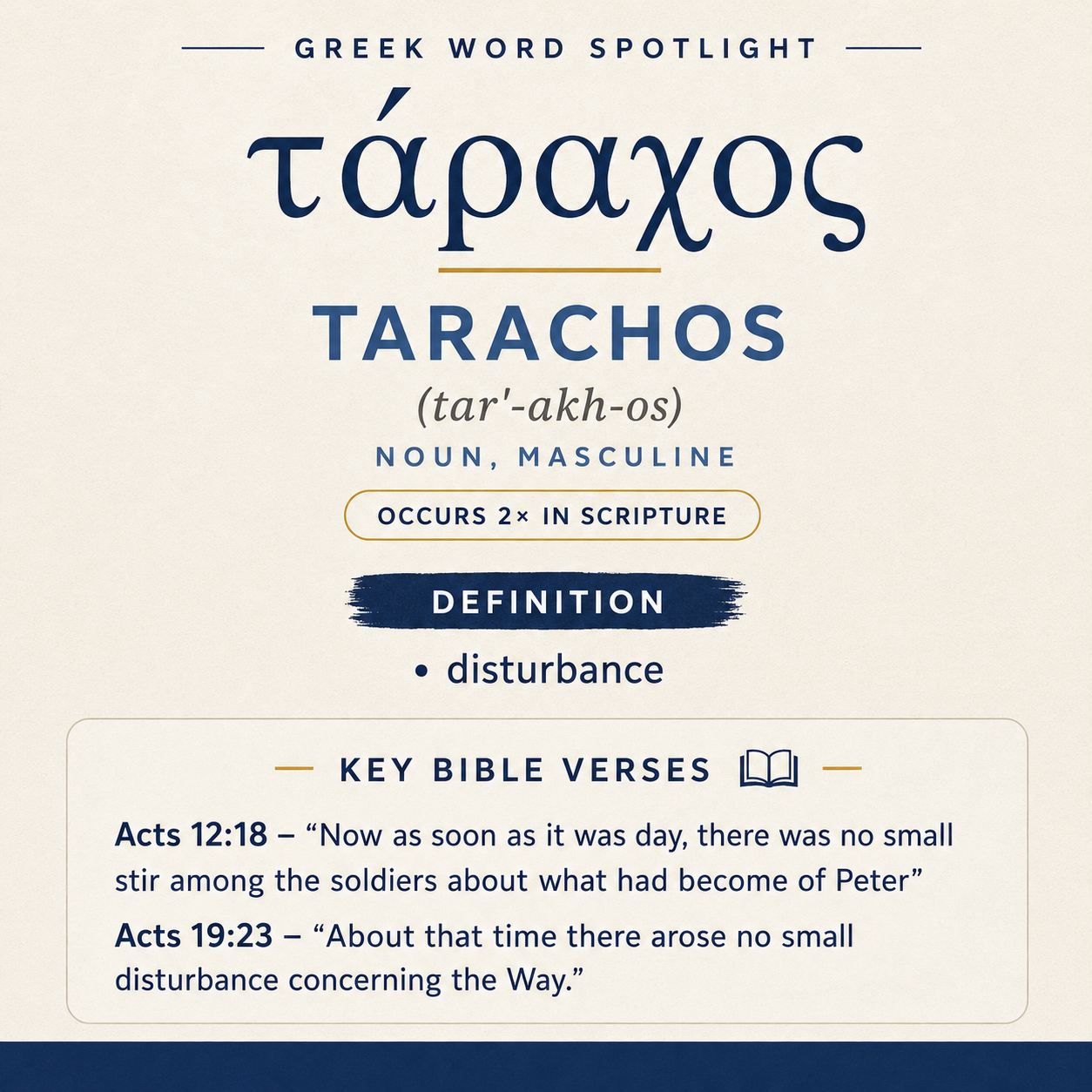
τάραχος means “disturbance” and appears twice in Scripture, in Acts 12:18 and Acts 19:23.
Context in Acts
In Acts 12:18 it describes “no small stir” among the soldiers about Peter. In Acts 19:23 it describes “no small disturbance” concerning the Way.
Learn More →τάραχος denotes a “disturbance” and appears in Acts in two scenes where public order is disrupted. In each passage it marks a commotion that becomes noticeable enough to be described as significant rather than trivial.
Root and Related Words
τάραχος is related to the verb tarassō (ταράσσω), “to trouble” (Strong’s G5015). The noun expresses the condition or event that corresponds to that troubling: the outcome as it is experienced in a setting where people are unsettled and normal order is thrown into confusion.
Occurrences
“Now as soon as it was day, there was no small stir among the soldiers about what had become of Peter.” (Acts 12:18)
Here τάραχος names the reaction within a confined group—“the soldiers”—as a new day begins and an urgent question spreads among them: “what had become of Peter.” The verse frames the disturbance as immediate (“as soon as it was day”) and communal (“among the soldiers”), indicating that the unsettling situation is not private worry but a shared agitation that ripples through the guard. The phrase “no small” intensifies the sense of scale: the narrator does not depict a mild whisper of concern but a substantial commotion, the kind of disturbance that makes itself evident in the group’s behavior and talk. Within the sentence, τάραχος functions as a label for the atmosphere that follows an unexplained absence—an ordered watch giving way to disordered uncertainty.
Because the verse specifies the topic of the stir (“about what had become of Peter”), the disturbance is not random noise; it is focused and investigative. τάραχος gathers up the soldiers’ questions, their spreading alarm, and the breakdown of routine into a single term that characterizes the moment: daybreak arrives, and with it a disturbance as the soldiers collectively register that something is wrong and must be accounted for.
“About that time there arose no small disturbance concerning the Way.” (Acts 19:23)
In Acts 19:23 τάραχος is again strengthened by “no small,” but the sphere expands beyond a small unit like a guard detail to a broader public situation: “there arose…disturbance concerning the Way.” The disturbance is presented as something that comes into being—“there arose”—suggesting escalation from a prior state into a recognizable outbreak of unrest. Unlike Acts 12:18, where the commotion is tied to a specific missing person, the disturbance here is tied to a matter of allegiance and identity (“concerning the Way”), implying that the unrest is generated by conflict over what that Way represents.
The verse’s wording also highlights how τάραχος can be described as an event with momentum. By saying it “arose,” the narrative points to disturbance as something that emerges and gathers force; it is not merely an inner feeling but a social phenomenon that becomes visible in the life of the community. As in the earlier occurrence, “no small” indicates that the disturbance is substantial—large enough to be noted as a defining feature of the time: “About that time” sets the commotion as a marker of the period’s public atmosphere.
Sense and Usage
Across both occurrences, τάραχος names a disturbance that is measurable in its effects: it is large enough to be called “no small,” and it is shared enough to be located “among the soldiers” or to arise “concerning the Way.” In Acts 12:18, disturbance appears as concentrated agitation within an official group tasked with order; the disappearance of Peter creates a breakdown in expected control, and τάραχος captures the resulting disorder in the soldiers’ collective state. In Acts 19:23, disturbance is outward-facing and issue-driven, attached to a contested subject and framed as an outbreak that arises in the public arena.
The two settings show τάραχος operating at different scales while remaining the same kind of phenomenon. One is an internal commotion within a defined body; the other is a wider civic unrest oriented around a movement. The noun thus fits moments when routine stability is disrupted and attention is pulled into a problem that demands explanation or response. In both verses the narrator treats τάραχος as more than background noise: it is significant enough to shape the scene, signaling that the situation has moved from normalcy into disorder.
The repeated intensifier “no small” also suggests how τάραχος functions rhetorically in Acts. It is not a neutral mention of activity; it highlights the conspicuousness of the disturbance. The term can cover a range of manifestations—restless questioning among soldiers at daybreak, or a broader upheaval tied to “the Way”—but in each case it points to disruption that is socially felt and plainly observable.
Imagery
In these two passages, τάραχος carries the imagery of order disturbed: guards at the start of day thrown into collective agitation, and a community in which a matter “concerning the Way” becomes the flashpoint for a rising commotion. The word evokes the audible and visible character of disruption—something “among” people, something that “arose,” and something too substantial to be dismissed as small.
Sources: Lexical data from Strong’s Exhaustive Concordance and the Translators Brief Lexicon of Extended Strongs for Greek (STEPBible, CC BY). Occurrence data from the Translators Amalgamated Greek New Testament (STEPBible, CC BY). Scripture quotations from the World English Bible (public domain).





