Exploring the Meaning of Talaiporeo in Greek
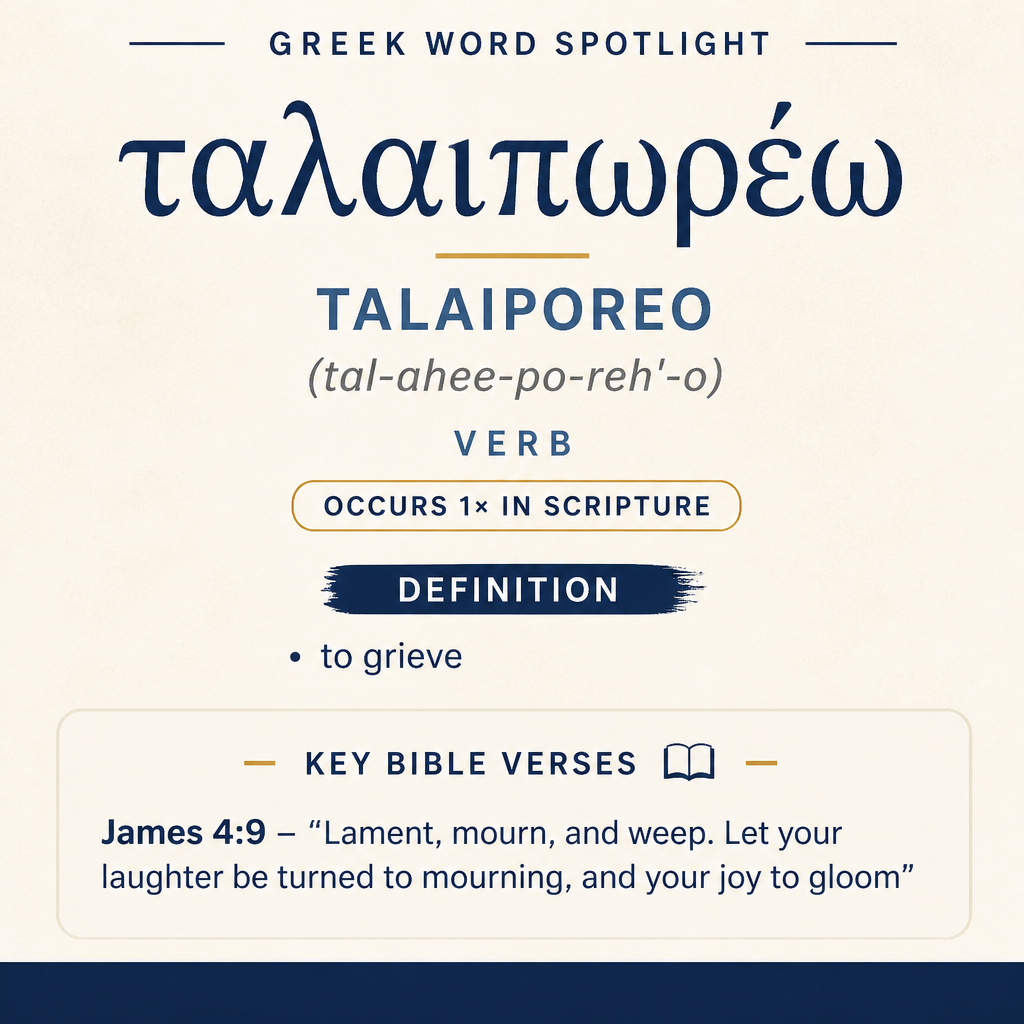
ταλαιπωρέω means “to grieve” and appears once in Scripture, in James 4:9.
Scripture Occurrence
This verb occurs 1 time in Scripture. Its single occurrence is in James 4:9.
Learn More →Context in James
In James 4:9 it appears alongside the commands, “Lament, mourn, and weep.” The verse calls for laughter to turn to mourning and joy to gloom.
Learn More →ταλαιπωρέω means “to grieve,” and it appears once in the Greek Scriptures in James 4:9. In that setting it stands among a cluster of imperatives calling for an outwardly expressed sorrow.
Root and Related Words
ταλαιπωρέω (Talaiporeo) is related to the adjective ταλαίπωρος (talaiporos), meaning “wretched” (Strong’s G5005). The relationship points to a word-family that can speak about a harshly felt condition and the distress that belongs to it, with the verb expressing the act of entering into such sorrow.

Occurrences
“Lament, mourn, and weep. Let your laughter be turned to mourning, and your joy to gloom.” (James 4:9)
In James 4:9, ταλαιπωρέω contributes to a forceful call for grief that is not private only, but publicly legible in behavior. The verse piles up commands—“Lament, mourn, and weep”—so that grieving is framed as a chosen posture rather than a fleeting feeling. Within that chain of imperatives, grieving functions as the first stroke in a progression: it begins the movement away from lightness (“laughter”) and toward a sober emotional register (“mourning … gloom”).
The immediate contrast in the second sentence shows the direction James intends. “Let your laughter be turned to mourning, and your joy to gloom” sets two pairs in opposition, and grieving belongs with the latter pair. The turning (“be turned”) depicts an exchange: an earlier mood is relinquished and replaced by sorrow. In this verse, grieving is not vague sadness; it is the deliberate embrace of a mournful stance that matches the other verbs in the line—mourning and weeping—each of which implies visible, embodied expression.
Because the verse is made of short, direct clauses, the command to grieve carries a blunt rhetorical weight. The three opening imperatives are not softened by explanations here; instead, the instruction is intensified through accumulation. Grieving thus functions as part of a coordinated response: lament, mourning, and weeping are presented as mutually reinforcing expressions of the same kind of sorrow. The parallel commands imply that the grief envisioned is deep enough to involve the whole person—voice (lament), inner heaviness (mourn), and tears (weep). The final clause then places that grief over against laughter and joy, indicating that the call is for a decisive shift rather than a token moment of regret.
Sense and Usage
As used in James 4:9, “to grieve” describes an intentional taking up of sorrow, expressed in ways others could recognize. The verse’s tight grouping of imperatives provides the contours of the word’s sense in this context: grieving stands alongside lamenting, mourning, and weeping as an appropriate response that includes both inward pain and outward manifestation. The term is therefore not presented as an uncontrolled emotional collapse, but as a commanded disposition with concrete signs.
The command also carries a comparative force created by the stated transformation: laughter is to be exchanged for mourning, joy for gloom. This does not merely add grief to existing happiness; it replaces a mood of levity with one of heaviness. Within the rhetoric of James 4:9, grieving is the beginning of that reversal. It marks the point where a person stops treating the situation as one that permits carefree mirth and instead adopts an attitude of sorrow that fits the moral seriousness James is pressing.
Because the verse itself supplies a sequence—lament → mourn → weep, followed by laughter → mourning and joy → gloom—grieving can be understood as encompassing both the initial recognition of sorrow and its carried-through expression. The commands are addressed to the hearers as a group, so the grief is not merely individual temperament; it is a communal summons to adopt a shared posture characterized by lament, mourning, and tears. The phrasing implies that such grief is meant to be thoroughgoing: laughter and joy are not left untouched, but are “turned” into their opposites.
The related adjective ταλαίπωρος (“wretched”) provides a nearby conceptual frame: the verb belongs to language that can describe the experience of distress and the appropriate response to it. In James 4:9, the response is foregrounded: grieving is placed on the lips of the author as a directive, shaping how the community is to carry itself. The verse does not treat grief as incidental; it is an element of proper conduct, enjoined with the same grammatical force as mourning and weeping.
Imagery
James 4:9 evokes the imagery of an emotional reversal made visible. Laughter gives way to mourning, joy to gloom; the sound and brightness of cheer are replaced by the quiet heaviness of grief. Within that picture, ταλαιπωρέω belongs to a scene of faces turned from mirth to sorrow, and of a community marked by lament and tears rather than celebration.
Sources: Lexical data from Strong’s Exhaustive Concordance and the Translators Brief Lexicon of Extended Strongs for Greek (STEPBible, CC BY). Occurrence data from the Translators Amalgamated Greek New Testament (STEPBible, CC BY). Scripture quotations from the World English Bible (public domain).