
Exploring the Meaning of Suneuocheo in Greek
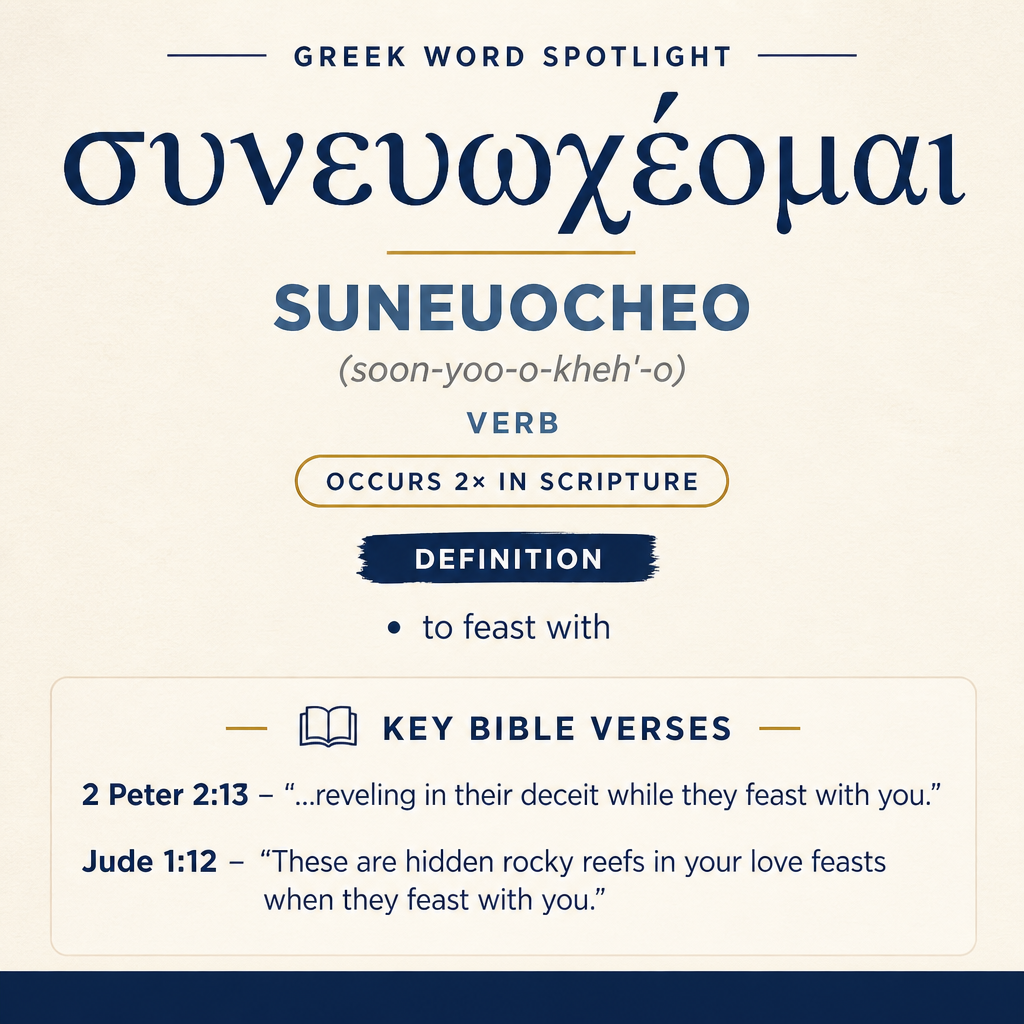
συνευωχέομαι means “to feast with” and appears in 2 Peter 2:13 and Jude 1:12.
Core Meaning
συνευωχέομαι is defined as “to feast with.” It describes sharing in a feast together.
Learn More →Scripture Occurrences
This word occurs 2 times in Scripture. Its references are 2 Peter 2:13 and Jude 1:12.
Learn More →Context Notes
In Jude 1:12 it is used of those who “feast with you” in love feasts. In 2 Peter 2:13 it appears in a context describing daytime reveling.
Learn More →συνευωχέομαι means “to feast with,” and it appears in two warnings about corrupt people who attach themselves to Christian communal meals. In both places, the verb marks their participation at the table as a setting where their character and conduct become visible.
Root and Related Words
συνευωχέομαι is connected with syn (σύν), “with,” eu (εὖ), “well / well done!,” and echo (ἔχω), “to have / be.” Together these elements point to the idea of being “with” others in a setting described with eu- language, expressed through a verb that belongs to the sphere of “having/being,” fitting the social reality of sharing a meal in company.

Occurrences
“receiving the wages of unrighteousness; people who count it pleasure to revel in the daytime, spots and defects, reveling in their deceit while they feast with you;” (2 Peter 2:13)
Here “feast with you” places the wrongdoing described in the verse inside the very ordinary, concrete act of eating in fellowship. The sentence piles up moral descriptors—“wages of unrighteousness,” “pleasure to revel,” “spots and defects,” “reveling in their deceit”—and then locates that deceit in the shared meal itself: their reveling happens “while they feast with you.” The verb therefore functions as a bridge between moral evaluation and communal setting. The people in view are not distant outsiders; they are close enough to join “you” at the table, and their participation becomes the occasion where their inner posture (“count it pleasure…”) and outward behavior (“reveling…”) collide with the community’s life together.

The timing implied by “while” is important to how the verb works in the sentence. The feast is not merely background information; it is the very moment in which the deceit is active. The table is portrayed as a place that should support fellowship, yet their presence at that meal is described as consistent with being “spots and defects,” imagery that makes their feasting feel contaminating rather than strengthening. The verb thus contributes a sharp social realism: the danger is not only what such people teach or do elsewhere, but what they do in the intimate proximity of shared food.
“These are hidden rocky reefs in your love feasts when they feast with you, shepherds who without fear feed themselves; clouds without water, carried along by winds; autumn trees without fruit, twice dead, plucked up by the roots;” (Jude 1:12)
Jude places “when they feast with you” inside an extended description that begins at the communal meal and then unfolds a chain of metaphors. The verb again situates the problem at the table, but Jude frames it more explicitly as a threat embedded within the community’s “love feasts.” Calling them “hidden rocky reefs” casts their presence at these meals as concealed danger, something that can wreck others while remaining unseen until harm is done. The verb’s simple idea—feasting together—therefore becomes the setting where hiddenness and peril are emphasized.
Immediately after the reference to feasting, Jude adds, “shepherds who without fear feed themselves,” so the meal scene becomes a moral picture: they take part in communal eating, yet the concern is self-feeding rather than care for others. The sequence keeps the reader’s attention on what their shared-meal participation reveals about their posture toward the group. Even as Jude moves to images—“clouds without water,” “autumn trees without fruit, twice dead, plucked up by the roots”—the starting point remains the love feast, and the verb anchors those vivid descriptions in the concrete, relational space where the community gathers.
In this verse the plural “love feasts” suggests repeated occasions, and “when they feast with you” implies a recurring pattern rather than a one-time intrusion. The verb therefore contributes to the sense of ongoing vulnerability: these people are not merely passing through; they repeatedly occupy a place at the table. In Jude’s warning, their shared participation is itself part of what makes them dangerous—close enough to be present, ordinary enough to seem at home, yet described in language that signals spiritual barrenness and instability.
Sense and Usage
Across both passages, “to feast with” is not presented as a neutral social detail but as a morally charged setting. The verb consistently portrays a communal meal as a place where belonging and trust are assumed, which is precisely why the presence of deceitful people is so alarming. In 2 Peter, the meal is paired with “deceit,” so the shared table becomes the arena where harm is practiced under the cover of fellowship. In Jude, the meal is the entry point into the imagery of “hidden rocky reefs,” emphasizing that the danger is embedded and hard to detect.
The direct object implied by “with you” in both occurrences makes the relational direction of the verb explicit: the feasting is shared with the addressed community. The verb thus carries an interpersonal closeness; the warning is not simply about observing corrupt behavior at a distance but about experiencing proximity to it. The repeated “with you” keeps the reader focused on the unsettling fact that such people participate alongside believers in community life.
Both writers also place the verb in a context of exposure. To feast together is to share space, time, and customary gestures of fellowship; in these verses, that ordinary intimacy becomes the scene where character shows itself. In 2 Peter the exposure is expressed by the clash between the respectable setting of a meal and the reality of “reveling in their deceit.” In Jude the exposure is expressed by the contrast between the expected nourishment and safety of a “love feast” and the metaphors of danger and emptiness that follow. The verb therefore contributes a consistent sense: shared feasting can be exploited, and communal meals can become moments when corruption is both present and active.
Imagery
The imagery attached to συνευωχέομαι in these passages is striking because it turns a recognizable picture—people eating together—into a test case for discernment. In 2 Peter the table is shadowed by “spots and defects,” as though the shared feast displays blemishes that mar what should be joyful fellowship. In Jude the table is set beside “hidden rocky reefs,” and the love feast becomes a place where danger hides in plain sight, followed by images of self-feeding, waterless clouds, and fruitless trees that deepen the sense that the problem is not merely social awkwardness but destructive emptiness lived out in the middle of community life.
Sources: Lexical data from Strong’s Exhaustive Concordance and the Translators Brief Lexicon of Extended Strongs for Greek (STEPBible, CC BY). Occurrence data from the Translators Amalgamated Greek New Testament (STEPBible, CC BY). Scripture quotations from the World English Bible (public domain).





