
Exploring the Meaning of Sundesmos in Greek
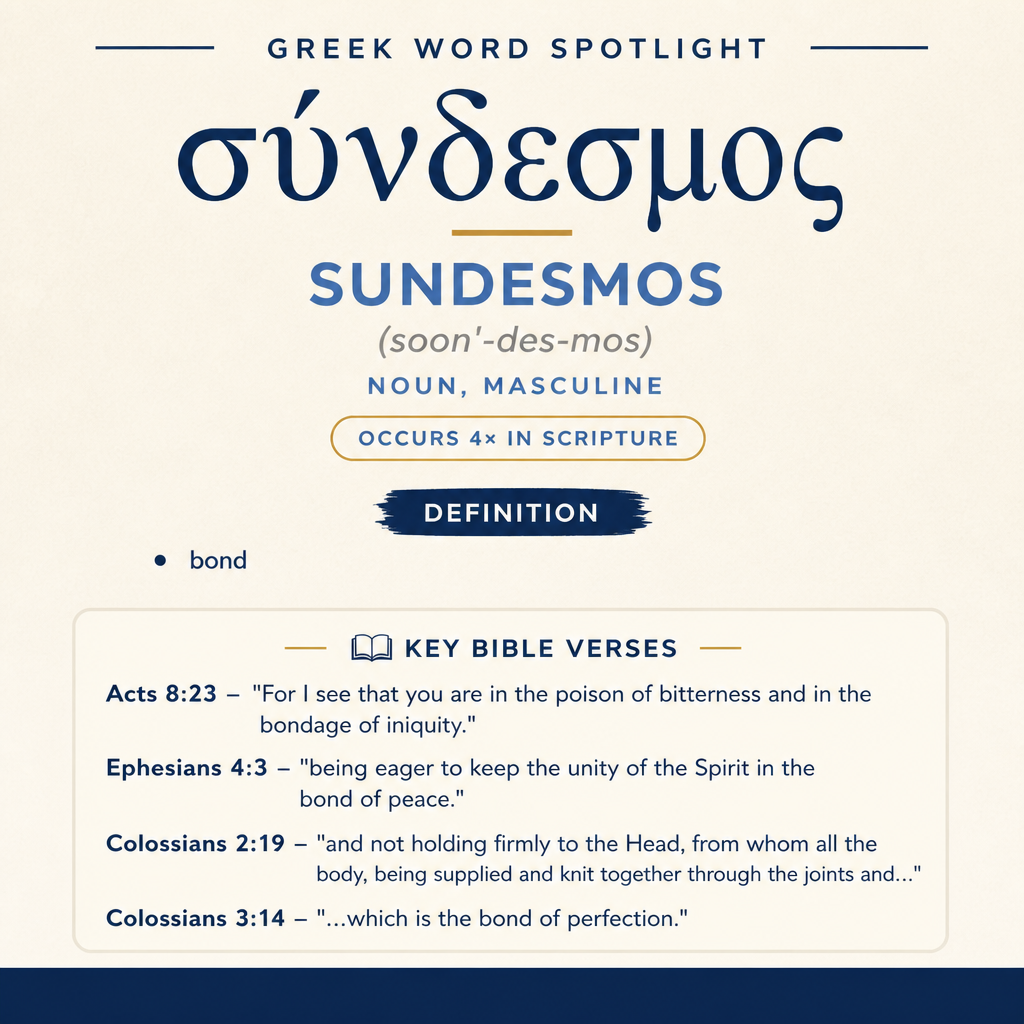
σύνδεσμος means “bond” and appears four times in Scripture: Acts 8:23; Ephesians 4:3; Colossians 2:19; Colossians 3:14.
Scripture Occurrences
It occurs four times in Scripture: Acts 8:23; Ephesians 4:3; Colossians 2:19; Colossians 3:14.
Learn More →Context Snapshots
It describes the “bond of peace” (Ephesians 4:3) and “the bond of perfection” in love (Colossians 3:14).
Learn More →σύνδεσμος speaks of a “bond,” a connecting tie that holds something or someone in a binding relationship. It appears in four passages, ranging from a negative “bondage” to positive bonds that safeguard unity and bring maturity.
Root and Related Words
σύνδεσμος is connected with δεσμός (desmon), “chain” (Strong’s G1199), and with σύν (syn), “with” (Strong’s G4862). Together these related elements frame the word’s imagery as something that binds and holds together in association.

Occurrences
“For I see that you are in the poison of bitterness and in the bondage of iniquity.” (Acts 8:23)
Here σύνδεσμος is rendered as “bondage,” paired with “iniquity.” The surrounding phrases are strongly evaluative: the speaker “sees” a condition described as “poison of bitterness” and as a binding situation tied to wrongdoing. The bond is not presented as protective or desirable; it is a constraining attachment that characterizes the person’s present state. In this scene, the word functions as a vivid image of being held fast in a damaging moral situation—an inward captivity expressed in relational terms (“in … the bondage”).
“being eager to keep the unity of the Spirit in the bond of peace.” (Ephesians 4:3)
In this line σύνδεσμος names the means or sphere in which “the unity of the Spirit” is kept: “in the bond of peace.” The emphasis falls on diligence (“being eager”) and preservation (“to keep”), and the bond is closely linked with “peace” as what secures and maintains unity. The imagery is not that unity exists by itself, but that it is held together by a binding tie characterized by peace. The phrase gives σύνδεσμος a constructive role: it is what makes unity durable rather than fragile.
“and not holding firmly to the Head, from whom all the body, being supplied and knit together through the joints and ligaments, grows with God’s growth.” (Colossians 2:19)
Although σύνδεσμος is not translated with the English word “bond” here, the verse’s description of “joints and ligaments” provides an embodied setting for the same idea of binding connection. The problem described is relational and structural: “not holding firmly to the Head.” In contrast, healthy connection is pictured as the whole body “being supplied and knit together” through the body’s connecting structures, resulting in growth. In this scene, σύνδεσμος contributes the sense of binding elements that make cohesion possible—connections that enable the body to function as one and to “grow with God’s growth.” The word’s contribution is felt in the mechanics of unity: attachment to the Head and linkage throughout the body belong together.
“Above all these things, walk in love, which is the bond of perfection.” (Colossians 3:14)
Here σύνδεσμος is explicitly “the bond” and is identified with love’s role: “walk in love, which is the bond of perfection.” The line places love “above all these things,” presenting it as the supreme virtue that binds the rest into a finished, integrated whole. The bond is not merely one virtue among others; it is what holds a way of life together so that it reaches “perfection.” In this immediate context, σύνδεσμος conveys the idea of a unifying tie that brings coherence and completeness to the community’s practice.
Sense and Usage
Across these passages σύνδεσμος consistently evokes the idea of a binding tie, but the moral and communal direction of that tie shifts with its companion terms. In Acts 8:23 it is joined to “iniquity,” and the bond is depicted as a constraining attachment: a person is “in” it, as though enclosed by it. The language of “poison” and “bondage” makes the bond feel restrictive and harmful—an image of being held in a condition that corrodes rather than stabilizes.
In Ephesians 4:3 the bond is not a trap but a safeguard. The clause “being eager to keep the unity of the Spirit” assumes that unity is a real good that must be actively maintained. “The bond of peace” presents peace as the binding condition that keeps unity from unraveling. The bond, then, is a relational reality: it is not simply an internal feeling but something strong enough to hold people together in “unity.”
Colossians 2:19 places the word within a body metaphor that shows what a bond does: it connects, supplies, and stabilizes so growth can occur. The verse’s movement is from loss of grip (“not holding firmly”) to the body’s coherence (“supplied and knit together”) and finally to organic development (“grows”). In this setting σύνδεσμος aligns with the idea that bonds are not only restraints; they are also the necessary connections that make coordinated life and growth possible.
Colossians 3:14 intensifies the constructive side by naming love as the binding tie that leads to “perfection.” The bond is portrayed as integrative: it gathers “all these things” into a unified practice. Love, as a bond, is not merely added; it binds together what would otherwise remain scattered virtues or disconnected behaviors. The effect is wholeness—“perfection” as the outcome of being held together.
These uses also show that σύνδεσμος can describe both an enslaving attachment and a preserving or maturing connection. The word itself supplies the image of binding; the surrounding nouns (“iniquity,” “peace,” “perfection”) specify the character of what is binding and the result of being bound. In every case, σύνδεσμος is relational and structural: it ties persons to a condition, or it ties a community together, or it ties the parts of a body into a coherent whole.
Imagery and Tone
The passages give σύνδεσμος a tangible feel. Acts speaks in the dark tone of captivity—bondage that encloses a person in bitterness and wrongdoing. Ephesians and Colossians speak in the constructive tone of cohesion—peace as a binding tie for unity, bodily connections that enable coordinated growth, and love as the bond that brings a community’s life into a perfected wholeness. Taken together, the word’s imagery ranges from fettering bonds to supportive ligaments: what binds can imprison, or it can hold together and strengthen.
Sources: Lexical data from Strong’s Exhaustive Concordance and the Translators Brief Lexicon of Extended Strongs for Greek (STEPBible, CC BY). Occurrence data from the Translators Amalgamated Greek New Testament (STEPBible, CC BY). Scripture quotations from the World English Bible (public domain).




