
Exploring the Meaning of Sunapollumi in Greek
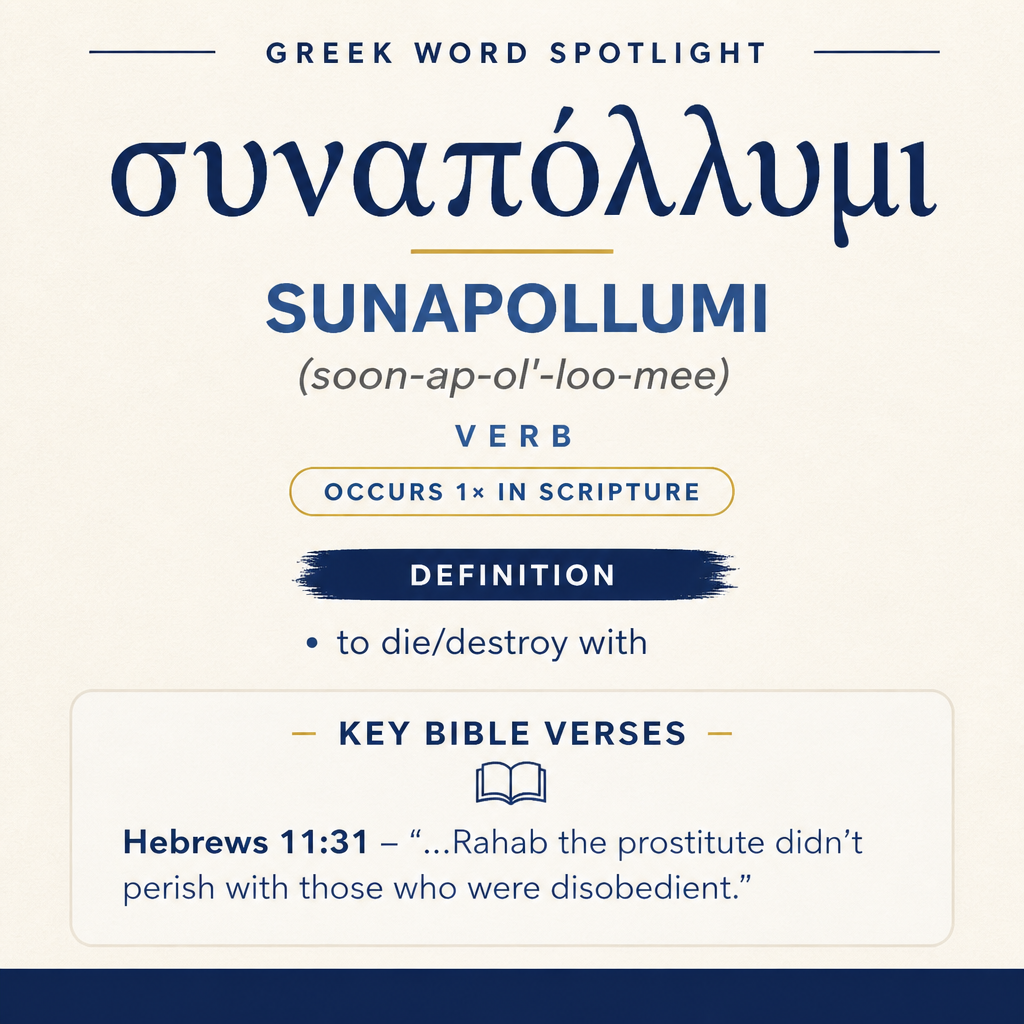
συναπόλλυμι means “to die/destroy with” and appears once in Scripture, in Hebrews 11:31.
Scripture Occurrence
It occurs one time in Scripture. This single occurrence is in Hebrews 11:31.
Learn More →Hebrews 11:31
Hebrews 11:31 says Rahab didn’t perish with those who were disobedient. The verb is used in that statement about not perishing together with them.
Learn More →συναπόλλυμι means “to die/destroy with,” expressing perishing in association with others rather than in isolation. It appears once, in Hebrews 11:31, where it marks the contrast between Rahab’s outcome and that of “those who were disobedient.”
Root and Related Words
συναπόλλυμι is built from syn (σύν), “with” (Strong’s G4862), joined to apollymi (ἀπολλύω), “to destroy” (Strong’s G622). The combination presses the idea of destruction or death into a shared setting: the subject is caught up in the fate of a group, “with” them, rather than merely experiencing destruction in a general sense.

Occurrences
“By faith, Rahab the prostitute didn’t perish with those who were disobedient, having received the spies in peace.” (Hebrews 11:31)
Here the verb serves to locate Rahab’s deliverance in relation to a wider judgment: she “didn’t perish with” a defined company, “those who were disobedient.” The sentence frames two outcomes side by side—perishing as a group-event on the one hand, and survival on the other—so that the reader hears more than the bare fact that Rahab lived. The expression makes the threatened destruction sound collective and encompassing: it is something that overtakes “those who were disobedient” together, as a body, and Rahab’s story is told by distinguishing her from that body at the decisive moment.

The surrounding phrasing tightens this relational force. Rahab is not described merely as escaping danger, but as not being counted among those whose end was destruction. The verb’s “with” element fits the logic of belonging and separation already present in the clause: a person may either perish “with” the disobedient or stand apart from them in outcome. The final participial phrase, “having received the spies in peace,” supplies the concrete action by which the narrative contrast is set up. Within the verse’s own presentation, her reception of the spies is the action placed alongside the negated perishing; the verb therefore works as the stated consequence she did not share, while the group (“those who were disobedient”) names the company whose consequence it was.
Sense and Usage
The definition “to die/destroy with” signals not only the event of perishing, but the social or corporate frame in which that perishing happens. In Hebrews 11:31, the point is not simply that destruction occurred somewhere in the background; rather, there existed a category of people for whom perishing was the common outcome, and Rahab’s situation is described in terms of not sharing that common outcome. The verb thus contributes a strong boundary line: it describes an end that is experienced “with” others, and therefore it naturally invites the reader to ask, “With whom?” The verse answers with an explicit group designation: “those who were disobedient.”
Because the verb combines “with” (syn) and “destroy” (apollymi), the reader is guided to hear perishing as something that can be participated in—something one may undergo as part of a collective fate. The negative in the verse (“didn’t perish with”) is especially significant: the word is used to deny shared destruction, not to assert it. That denial communicates that Rahab’s life was spared in a way that is best described as separation from the doomed group, rather than merely the avoidance of death in the abstract. The “with” element makes the verb well suited for describing moments when outcomes divide communities, households, or populations into those who share in an end and those who do not.
In the immediate sentence, the group is characterized morally (“disobedient”), while Rahab’s contrasting action is characterized relationally and practically (“received the spies in peace”). The verb thereby stands at the intersection of two descriptions: a group defined by disobedience experiences perishing together, while Rahab’s peaceful reception is presented as the circumstance alongside which her not-perishing is declared. Within the verse’s compact logic, συναπόλλυμι helps depict judgment as communal and sweeping—an outcome that can carry away “those” of a certain kind—while also allowing the text to speak of rescue as exemption from that shared end.
Imagery
The imagery carried by “perish with” is the image of a person standing at the edge of a crowd’s fate: close enough that the group’s end is the relevant comparison, yet set apart from it in outcome. Hebrews 11:31 paints Rahab’s deliverance not as an isolated miracle detached from the community around her, but as being spared from the destruction that overtook a disobedient company—an end she did not share.
Sources: Lexical data from Strong’s Exhaustive Concordance and the Translators Brief Lexicon of Extended Strongs for Greek (STEPBible, CC BY). Occurrence data from the Translators Amalgamated Greek New Testament (STEPBible, CC BY). Scripture quotations from the World English Bible (public domain).





