
Exploring the Meaning of Sunapago in Greek
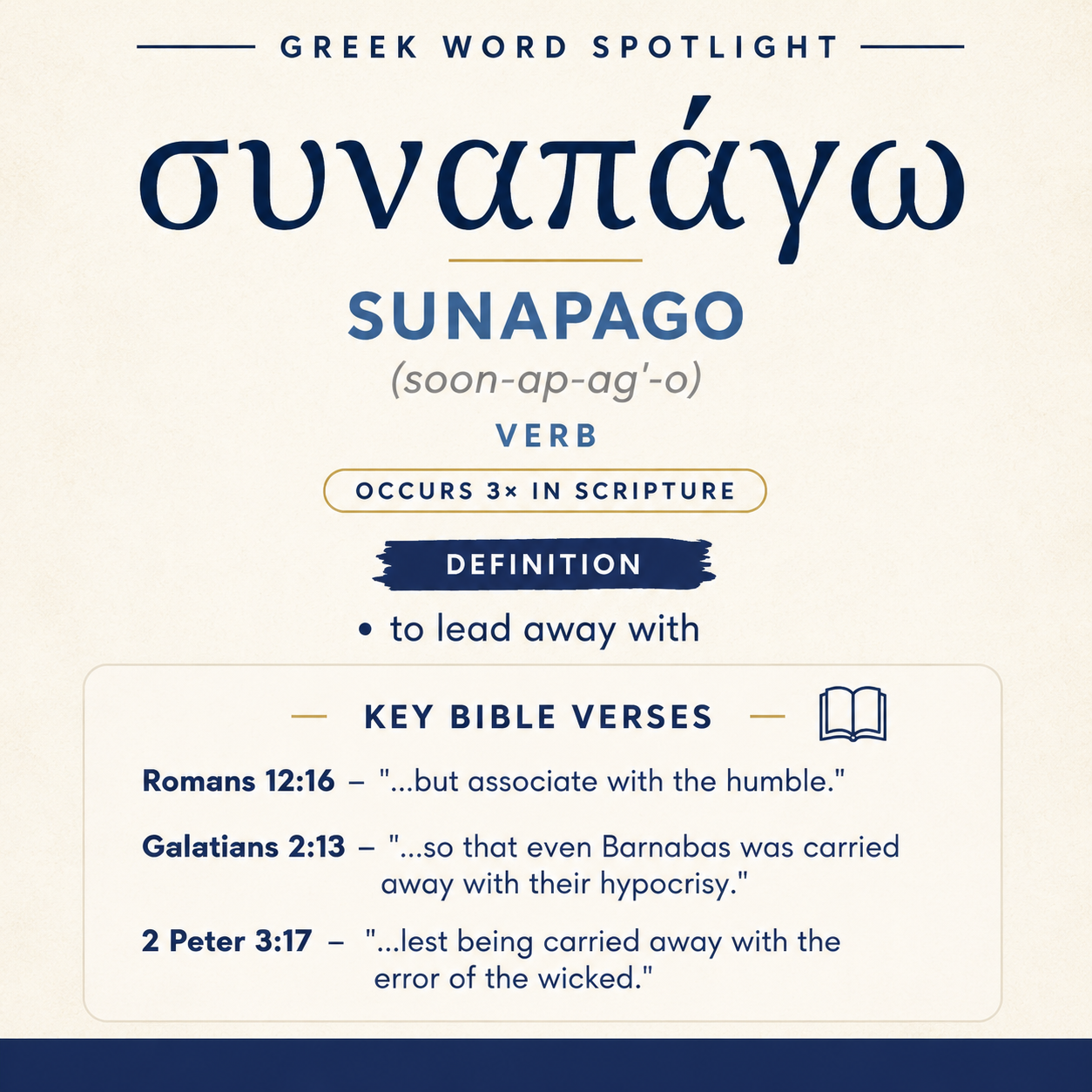
συναπάγω means “to lead away with” and occurs three times in Scripture: Romans 12:16, Galatians 2:13, and 2 Peter 3:17.
Scripture Occurrences
This verb appears three times in Scripture: Romans 12:16, Galatians 2:13, and 2 Peter 3:17.
Learn More →Context Snapshots
In Galatians 2:13, Barnabas was carried away with hypocrisy. In 2 Peter 3:17, believers are warned against being carried away with error.
Learn More →συναπάγω expresses the idea of being led away together with others. In the New Testament it appears in settings that range from social posture within the church to the moral and doctrinal danger of being swept along by a group.
Root and Related Words
συναπάγω is built from syn (σύν), “with,” and apago (ἀπάγω), “to lead away.” The combined form portrays motion or influence that carries someone along in company with others, not in isolation.

Occurrences
“Be of the same mind one toward another. Don’t set your mind on high things, but associate with the humble. Don’t be wise in your own conceits.” (Romans 12:16)
In this compact chain of imperatives, the verb sits among commands that shape communal life: shared-mindedness, refusal of social elevation, and a sober view of oneself. Within that flow, the idea of “being led away with” highlights the direction of one’s social attachment. The verse contrasts two trajectories: a mind set “on high things” versus a life that “associate[s] with the humble.” The word’s contribution is the sense of accompaniment that has a directional pull—one does not merely notice the humble from a distance but is brought into their company, moving alongside them rather than being drawn upward into status seeking. The final caution, “Don’t be wise in your own conceits,” frames this as a matter of humility: the path one is led into is not merely social but moral, because self-conceit can steer association toward “high things.”

“And the rest of the Jews joined him in his hypocrisy, so that even Barnabas was carried away with their hypocrisy.” (Galatians 2:13)
Here the verb describes a social contagion. The scene is dominated by group behavior: “the rest of the Jews joined him in his hypocrisy,” and that collective movement has such force that “even Barnabas” is included in its sweep. The word paints Barnabas not primarily as an instigator but as someone drawn along by the momentum of others—“carried away with their hypocrisy.” The object that exerts the pull is not neutral companionship but “hypocrisy,” and the verb’s “with-” element underscores that this hypocrisy operates as a shared practice, reinforced by group alignment. The outcome is not simply that individuals act similarly; the wording depicts a procession-like leading, where participation in the group’s posture becomes the path of least resistance.
“You therefore, beloved, knowing these things beforehand, beware, lest being carried away with the error of the wicked, you fall from your own steadfastness.” (2 Peter 3:17)
This occurrence places the verb in a warning framed by foresight and vigilance. The addressees are “beloved,” and because they know “these things beforehand,” they are told to “beware” of a specific danger: “lest being carried away with the error of the wicked.” The verb presents error as something that can lead a person off course by the force of association—being taken along “with” it, rather than merely making a private mistake. The verse then names the spiritual consequence: “you fall from your own steadfastness.” The movement implicit in the verb matches the fall described at the end: the one led away ends up displaced from a prior position of firmness. In this sentence, the verb is part of a moral-kinetic picture: error has direction, wickedness provides the current, and the threatened result is a loss of stability.
Sense and Usage
Across these passages, the verb’s basic notion of being “led away with” repeatedly intersects with communal influence. In Romans 12:16, the direction of being led is framed positively in terms of social nearness—entering the company of “the humble” rather than being pulled toward “high things.” The command assumes that association is never inert: the group one moves with can shape the mind (“Be of the same mind”) and can either feed conceit or restrain it.
In Galatians 2:13 and 2 Peter 3:17, the same leading-away motif is applied to negative pressure. In Galatians, hypocrisy operates as a shared pattern that draws others into alignment, and the verb emphasizes how easily an individual’s behavior can be redirected when a respected set (“the rest of the Jews”) moves in a single direction. In 2 Peter, error likewise functions as a force that sweeps a person along “with” the wicked, and the warning makes explicit that such movement is a departure from steadfastness rather than a harmless drift.
These uses show that the verb can describe both deliberate association and passive susceptibility, yet in each case the shared element—being carried along with others—remains central. The leading away is not portrayed as an abstract change of opinion detached from relationships. Whether the scene is a call to humble fellowship or a caution against corrupting influence, the verb depicts a person’s path as something shaped by the company they keep and the current they enter.
Imagery
The three occurrences combine to create a consistent picture of movement produced by attachment. Romans 12:16 envisions a chosen nearness to “the humble,” as though one’s steps and mindset are guided into their circle. Galatians 2:13 and 2 Peter 3:17 warn that the same kind of “with-ness” can become a conveyor of hypocrisy or error, carrying someone away from integrity and from “steadfastness.” The verb thus serves these writers as a vivid way to speak about moral direction: people are not only persuaded; they can be led along.
Sources: Lexical data from Strong’s Exhaustive Concordance and the Translators Brief Lexicon of Extended Strongs for Greek (STEPBible, CC BY). Occurrence data from the Translators Amalgamated Greek New Testament (STEPBible, CC BY). Scripture quotations from the World English Bible (public domain).





