
Exploring the Meaning of Sunanamignumi in Greek
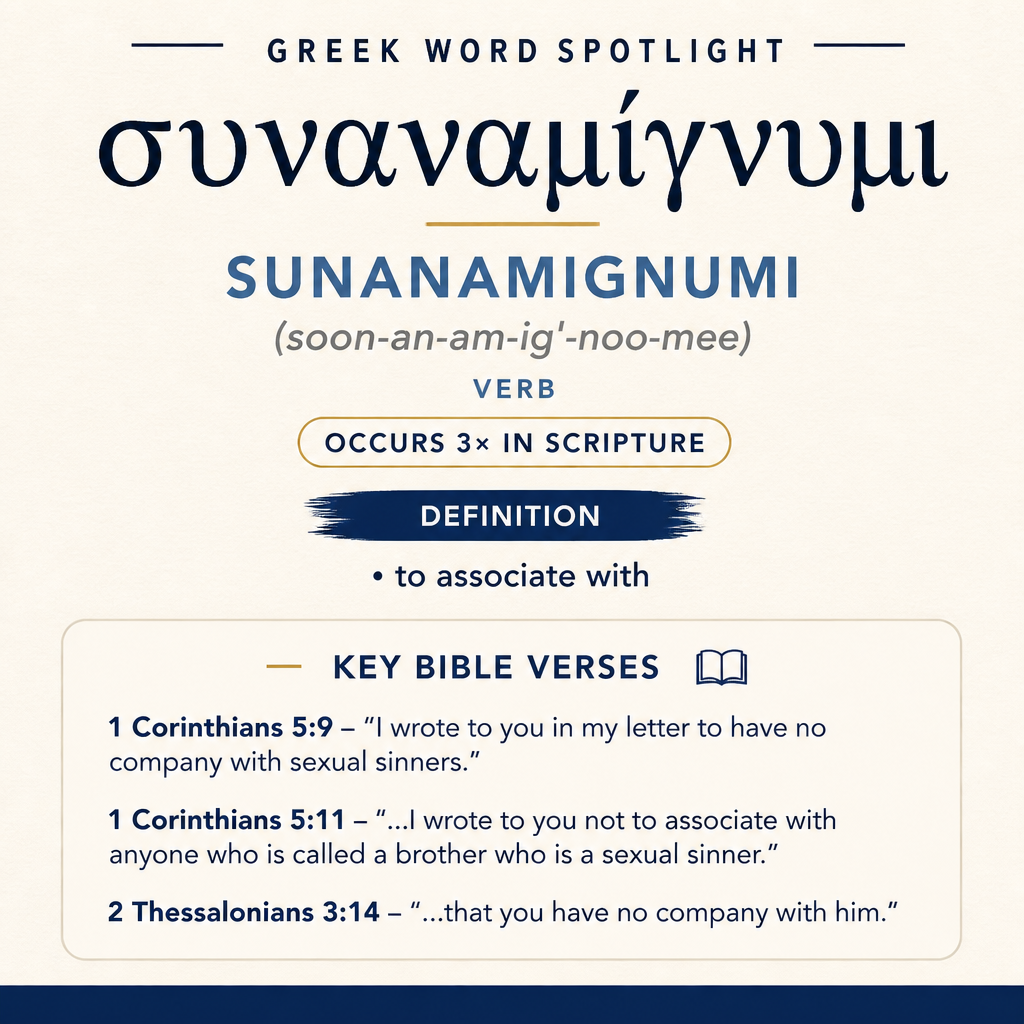
συναναμίγνυμι means “to associate with” and appears three times: 1 Corinthians 5:9, 1 Corinthians 5:11, and 2 Thessalonians 3:14.
Core Meaning
συναναμίγνυμι means “to associate with.” It can be expressed as “have no company with.”
Learn More →Paul’s Letters
It occurs in 1 Corinthians 5:9 and 5:11 in instructions not to associate with certain people. It also appears in 2 Thessalonians 3:14.
Learn More →Scripture Context
In 1 Corinthians 5:11, the command is not to associate with anyone called a brother who is a sexual sinner or covetous. In 2 Thessalonians 3:14, it applies to one who doesn’t obey the word in the letter.
Learn More →συναναμίγνυμι means “to associate with.” In the New Testament it appears in three passages, all in Paul’s instructions about how a church should relate to particular kinds of people.
Root and Related Words
συναναμίγνυμι is formed with syn (σύν), “with,” together with ana (ἀνά), “each,” and mignymi (μίγνυμι), “to mix.”

Occurrences
“I wrote to you in my letter to have no company with sexual sinners;” (1 Corinthians 5:9)
Here the word is framed as a directive arising from prior written instruction: “I wrote to you … to have no company.” The action described is not merely a private opinion but a regulated pattern of relationship. Within the sentence, the phrase “have no company with” places a boundary around association: the kind of closeness or shared social space that would normally be implied by “company” is excluded in relation to “sexual sinners.” The verse is terse, and that terseness adds weight: the instruction is stated as a straightforward policy of association.

“But as it is, I wrote to you not to associate with anyone who is called a brother who is a sexual sinner, or covetous, or an idolater, or a slanderer, or a drunkard, or an extortionist. Don’t even eat with such a person.” (1 Corinthians 5:11)
This occurrence restates the same instruction with sharper definition and an expanded list of cases. The object of association is “anyone who is called a brother” yet is characterized by a named pattern of behavior (“sexual sinner, or covetous, or an idolater, or a slanderer, or a drunkard, or an extortionist”). The phrase “not to associate with” makes the boundary interpersonal and communal: it is about who is allowed into the normal network of relationships implied by church life. The second sentence specifies a concrete expression of association: “Don’t even eat with such a person.” In this context, association includes ordinary table fellowship—sharing meals as an act of social connection. The word therefore functions as a practical instruction about relational proximity, not merely formal membership status.
“If any man doesn’t obey our word in this letter, note that man, that you have no company with him, to the end that he may be ashamed.” (2 Thessalonians 3:14)
In this verse, the instruction is tied to response to apostolic teaching: “doesn’t obey our word in this letter.” The community is told first to “note that man,” an action of recognition and identification, and then “have no company with him.” The association boundary is thus connected to an observed stance toward instruction (“doesn’t obey”), and it is presented as purposeful: “to the end that he may be ashamed.” The word here contributes the social mechanism by which a community’s disapproval is expressed—withdrawal of company—so that the person feels the relational consequences of refusing to obey. The focus remains relational and communal: the effect envisioned is not imposed by force but by the removal of normal companionship.
Sense and Usage
Across these three texts, “to associate with” is used in the negative, setting limits on togetherness. In 1 Corinthians, the instructions are framed as something already put in writing (“I wrote to you”), which emphasizes that association is not treated as a casual personal preference but as a deliberate practice. The word’s force lies in its social breadth: it points to the ordinary ways people “keep company” and share life, and then restricts those ways for particular cases.
The 1 Corinthians passages show that association can be defined by recognizable communal activities. The command “Don’t even eat with such a person” anchors the concept in a concrete expression of social acceptance and closeness: shared meals. This clarifies that the word is concerned with real-life contact and participation in normal patterns of interaction. The list of descriptors in 1 Corinthians 5:11 also shows that the restriction is applied on the basis of publicly knowable identity and conduct (“anyone who is called a brother” and who fits the listed categories). Association is thus described as something that can be withheld in a targeted way, directed toward a clearly specified person.
In 2 Thessalonians, the scope of the term is similar but the stated rationale is explicit: the aim is that the person “may be ashamed.” That purpose statement makes the social nature of association central. Keeping company is presented as a form of relational reinforcement; withdrawing it becomes a tool intended to produce an internal response. The instruction begins with “note that man,” which fits naturally with the idea of association as an identifiable social posture: the community must know whom it is refraining from keeping company with. The word therefore carries the idea of regulated togetherness—association that a community can extend or withhold as a meaningful act.
Imagery in Context
In these passages, the imagery is that of company and table: who is in one’s circle, and who is welcomed into shared life. “Don’t even eat with such a person” (1 Corinthians 5:11) evokes a setting where companionship is expressed by sitting together for a meal, and the command to refuse that fellowship illustrates what it looks like, in practice, to refuse association. Likewise, “have no company with him” (2 Thessalonians 3:14) imagines a recognizable social distance maintained within a community, a deliberate absence meant to be felt.
Sources: Lexical data from Strong’s Exhaustive Concordance and the Translators Brief Lexicon of Extended Strongs for Greek (STEPBible, CC BY). Occurrence data from the Translators Amalgamated Greek New Testament (STEPBible, CC BY). Scripture quotations from the World English Bible (public domain).





