Exploring the Meaning of Sumpascho in Greek
συμπάσχω means “to suffer with” and appears in Romans 8:17 and 1 Corinthians 12:26.
Core Meaning
συμπάσχω means “to suffer with.” It expresses shared suffering alongside another.
Learn More →Scripture Occurrences
This word occurs 2 times in Scripture. It appears in Romans 8:17 and 1 Corinthians 12:26.
Learn More →Context in Verses
In Romans 8:17, it describes suffering with Christ in connection with being heirs. In 1 Corinthians 12:26, it describes members suffering together when one suffers.
Learn More →συμπάσχω means “to suffer with,” expressing shared suffering rather than suffering in isolation. It appears in Romans 8:17 in connection with being “joint heirs with Christ,” and in 1 Corinthians 12:26 as the shared pain of a body whose members are interdependent.

Root and Related Words
συμπάσχω (Sumpascho) is built from συν (syn), meaning “with,” and πάσχω (pascho), meaning “to suffer.” The combination forms a verb that frames suffering as something experienced in company or alongside another.

Occurrences
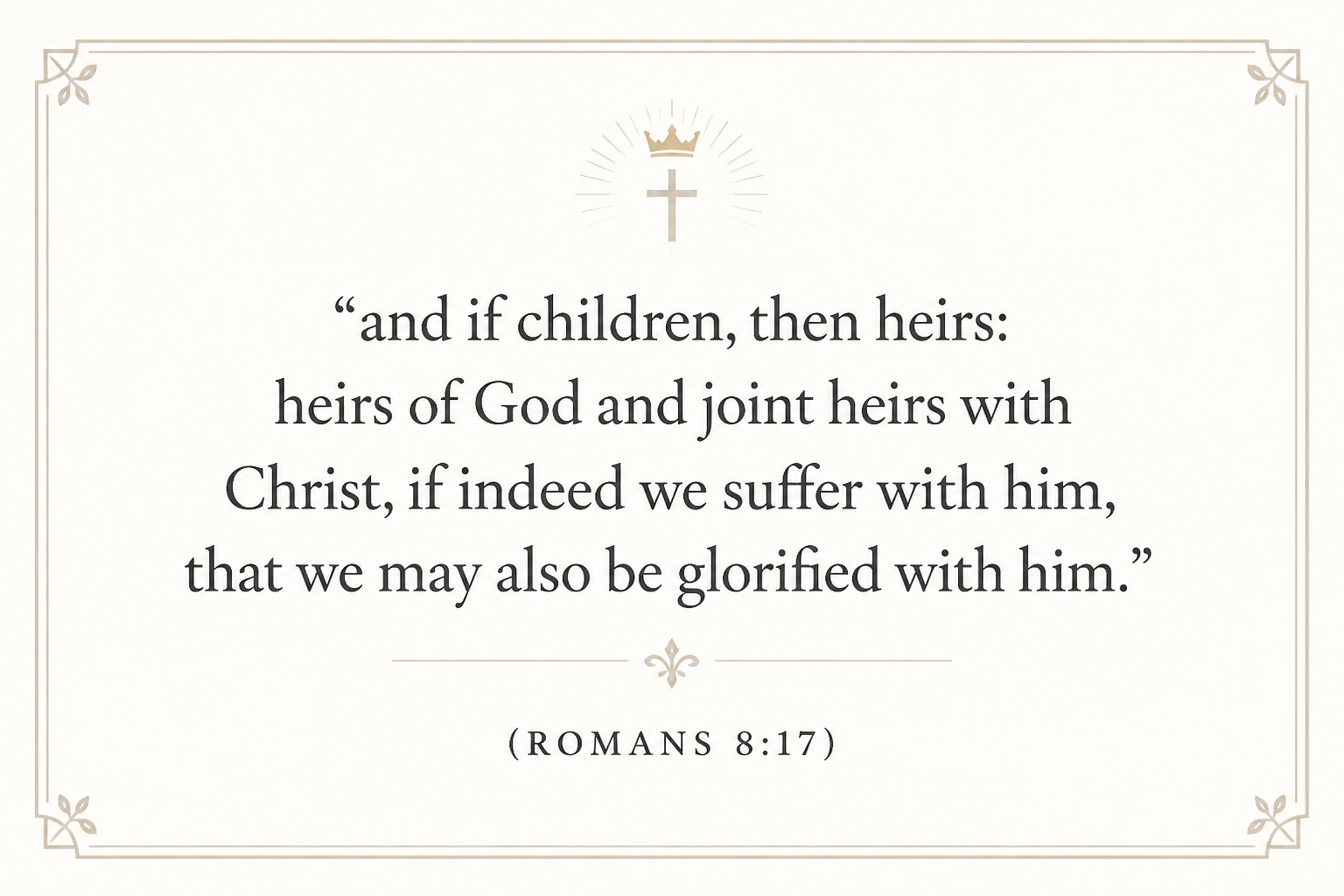
“and if children, then heirs: heirs of God and joint heirs with Christ, if indeed we suffer with him, that we may also be glorified with him.” (Romans 8:17)
In Romans 8:17, συμπάσχω sits inside a tightly linked set of family and inheritance terms: “children,” “heirs,” “heirs of God,” and “joint heirs with Christ.” The verb marks suffering as a condition bound up with that shared heirship—“if indeed we suffer with him.” The clause does not present suffering as an achievement that earns the inheritance already described; instead, it sets co-suffering as a lived accompaniment to being “joint heirs with Christ.” The same sentence holds together two parallel “with” relations: “joint heirs with Christ” and “glorified with him.” Between them, “we suffer with him” anchors the present experience of belonging to Christ to a future experience of glory. In that structure, συμπάσχω functions as the experiential bridge between identity (“children… heirs”) and destiny (“glorified with him”), keeping the focus on participation—sharing both the path and the outcome implied by union with Christ.
The immediate phrasing also shows that the “with” of συμπάσχω is personal and relational: it is “with him.” The suffering envisioned is not merely simultaneous suffering that happens to occur at the same time; it is suffering described as being alongside Christ, in a way that matches the earlier “joint heirs with Christ.” The verb therefore reinforces the idea that Christian suffering, in this verse’s frame, is not solitary hardship but a fellowship of experience connected to Christ’s own story and to the promised shared glorification.
“When one member suffers, all the members suffer with it. When one member is honored, all the members rejoice with it.” (1 Corinthians 12:26)
In 1 Corinthians 12:26, συμπάσχω appears in an illustration about a “member” and “all the members.” The scene is corporate and bodily: a single part experiences pain, and the rest do not stand apart as spectators; “all the members suffer with it.” The verb supplies the key idea that the suffering of one is not contained within that one. Instead, it spreads through the connected whole, describing a kind of solidarity that is expected within the body’s life.
The verse sets συμπάσχω in balanced parallel with shared joy: “When one member is honored, all the members rejoice with it.” The two halves mirror each other in structure, implying that the mutuality of the body works in both directions. συμπάσχω thus gains definition in contrast with “rejoice with it”: the body’s unity is not a sentimental claim but a practical sharing of experience. The suffering of a member becomes, by virtue of membership, something the whole bears together. The prepositional idea “with” is expressed not by naming a person (“with him,” as in Romans 8:17) but by pointing to the affected member (“with it”), keeping the emphasis on interconnectedness: the object of co-suffering is the member undergoing distress.
Notably, the verse describes the response as immediate and inclusive—“all the members.” συμπάσχω here is not limited to a few especially compassionate parts of the body; it is presented as the normal, whole-body reaction to pain in any one part. The verb therefore serves as a marker of how unity functions: suffering is shared because membership is shared.
Sense and Usage
Across these two passages, “to suffer with” operates on two relational axes. In Romans 8:17, co-suffering is vertical or Christ-directed: “we suffer with him,” in a context that ties shared suffering to shared heirship and to being “glorified with him.” The emphasis is participation with Christ in a path that leads to a shared end. In 1 Corinthians 12:26, co-suffering is horizontal or community-directed: the suffering of “one member” is felt by “all the members,” because the body is one interconnected life. Together these uses show that συμπάσχω describes suffering as something that binds persons together—either to Christ or to one another—rather than describing suffering as a purely private experience.
The two objects of co-suffering (“him” and “it”) also highlight how flexible the verb is within its single sense. In Romans, the “with” emphasizes companionship with a person, making the shared suffering part of a relationship with Christ and a shared inheritance. In Corinthians, the “with” emphasizes attachment to a member within a whole, making the shared suffering part of the body’s internal coherence. The verb therefore serves as language for solidarity: it names the act of bearing suffering in company, whether that company is a personal union (“with him”) or a communal interdependence (“with it”).
Both contexts place co-suffering beside a corresponding shared good. Romans sets “suffer with him” alongside being “glorified with him,” while Corinthians sets “suffer with it” alongside “rejoice with it” when one is honored. The pairing suggests that co-suffering is not an isolated theme but one side of a shared life that includes both hardship and honor. συμπάσχω, then, contributes the specific nuance that suffering can be a shared experience within a relationship defined by union and mutual belonging.
Imagery
Romans 8:17 casts co-suffering in familial and inheritance imagery: children who are “heirs” share not only a title but also a path, and their shared suffering belongs to their shared future “glorified with him.” 1 Corinthians 12:26 casts co-suffering in bodily imagery: the pain of one part is felt by the whole body, just as the honor of one part becomes the joy of all. In both, συμπάσχω evokes a life knit together strongly enough that suffering does not remain private—it is carried in fellowship.
Sources: Lexical data from Strong’s Exhaustive Concordance and the Translators Brief Lexicon of Extended Strongs for Greek (STEPBible, CC BY). Occurrence data from the Translators Amalgamated Greek New Testament (STEPBible, CC BY). Scripture quotations from the World English Bible (public domain).