Exploring the Meaning of Suzoopoieo in Greek
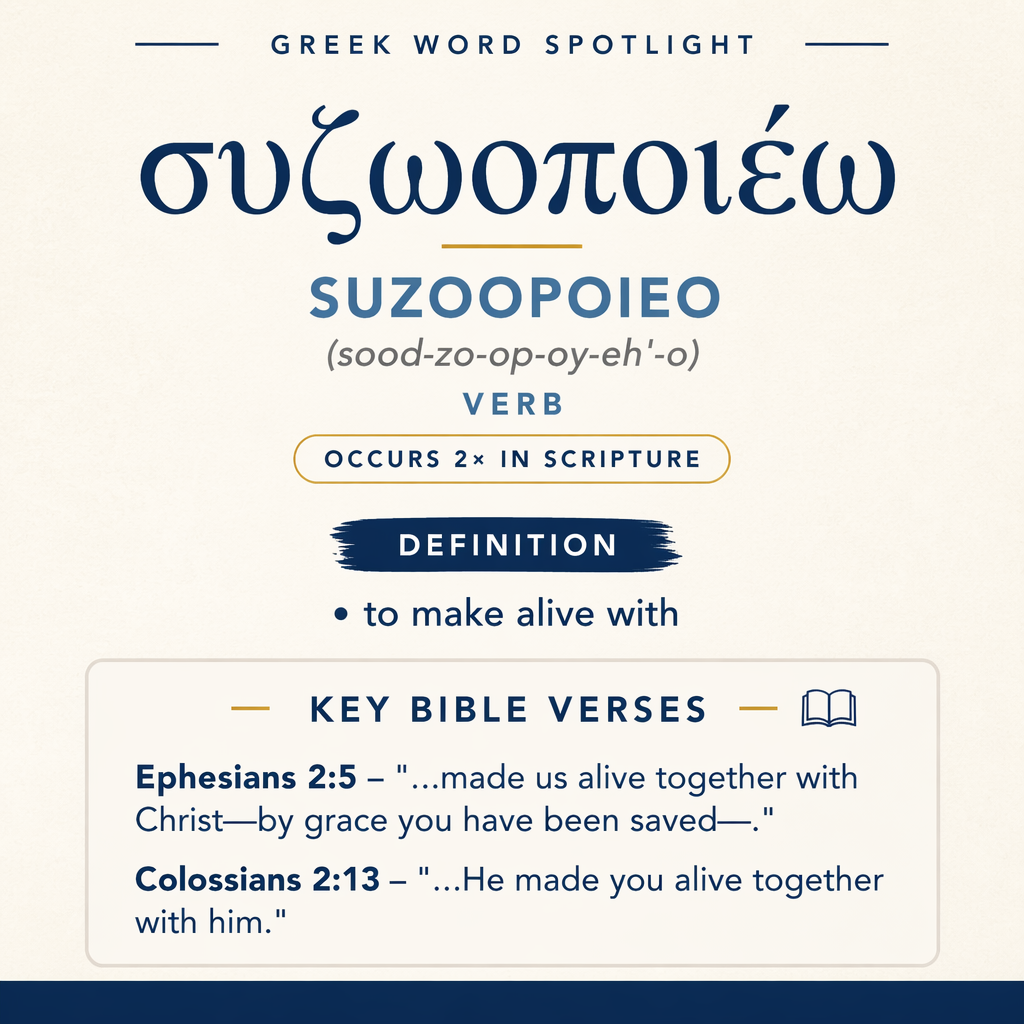
συζωοποιέω means “to make alive with” and appears twice in Scripture: Ephesians 2:5 and Colossians 2:13.
Scripture Occurrences
It occurs 2 times in Scripture: Ephesians 2:5 and Colossians 2:13.
Learn More →Context in Verses
In Ephesians 2:5, it describes being made alive together with Christ. In Colossians 2:13, it describes being made alive together with him.
Learn More →Suzoopoieo means “to make alive with” and is used of God’s action toward people described as dead in trespasses. It appears in two Pauline contexts that speak of new life granted in connection with Christ.
Root and Related Words
Suzoopoieo is formed from syn (σύν), “with” (Strong’s G4862), and zoopoieo (ζωοποιέω), “to make alive” (Strong’s G2227). The combined form expresses enlivening that is explicitly shared “with” another.

Occurrences
Ephesians 2:5
“even when we were dead through our trespasses, made us alive together with Christ—by grace you have been saved—”
Here the verb stands in sharp contrast to the prior condition: “dead through our trespasses.” The action described is not a gradual recovery but an act that reverses the state of death. The wording “made us alive together with Christ” places the enlivening in a shared relation: the life given is life “with” Christ rather than life in isolation. In the flow of the sentence, the statement “by grace you have been saved” anchors this enlivening in divine favor rather than in the prior condition described by “trespasses.” The verb therefore carries the weight of a decisive transition—deadness on account of trespasses giving way to life, in fellowship with Christ, framed as salvation by grace.
Colossians 2:13
“You were dead through your trespasses and the uncircumcision of your flesh. He made you alive together with him, having forgiven us all our trespasses,”
In Colossians the same movement from death to life is stated with a direct address: “You were dead.” Death is again connected to “trespasses,” and the description expands the condition with “the uncircumcision of your flesh,” portraying a state marked by alienation and wrongdoing. The enlivening is attributed to “He,” and is again expressed as shared life: “made you alive together with him.” The immediate participial phrase, “having forgiven us all our trespasses,” places forgiveness alongside enlivening as part of the same divine act as it is described here. The verb thus contributes the core claim that life is granted in conjunction with God’s dealing with trespasses—life “together with him,” in a context where the removal of guilt (“forgiven”) is placed right next to the gift of life.
Sense and Usage
Across both occurrences, Suzoopoieo operates in a consistent pattern: (1) a prior state described as “dead,” (2) the cause or accompanying markers of that death tied to “trespasses,” and (3) God’s act of enlivening that is explicitly relational—life granted “together with” another. The repeated pairing of death language with trespasses sets the background against which the verb’s force is felt; the readers are not pictured as merely weakened but as dead, and the verb names the action that overcomes that condition.
The “with” element is not incidental. In Ephesians the comparison point is explicitly “with Christ,” and in Colossians the phrase is “together with him.” In both, the life given is described as shared life—life in association with a person already identified in the sentence (Christ in Ephesians; “him” in Colossians). This framing keeps the verb from being reduced to a bare statement that life exists; it is life bestowed in connection and fellowship, with the relationship itself stated as part of the enlivening.
In addition, the two contexts show how this enlivening relates to other saving descriptions without changing the verb’s core sense. Ephesians places the statement alongside “by grace you have been saved,” presenting the enlivening as an act of grace and as part of salvation. Colossians sets the enlivening next to “having forgiven us all our trespasses,” presenting forgiveness as the accompanying divine action. In both passages, the verb stands at the center of a cluster of saving realities: grace, salvation, and forgiveness are mentioned, but the verb names the specific move from death to life, with the relational “together with” as a defining feature.
Imagery
The imagery carried by Suzoopoieo in these passages is stark and concrete: deadness contrasted with being made alive. Yet the life is never presented as solitary vitality; it is life given “together with” Christ or “with him.” The word therefore evokes a scene of transfer from one condition to another—out of death linked with trespasses and into a shared life that is inseparable from the one “with” whom the life is given.
Sources: Lexical data from Strong’s Exhaustive Concordance and the Translators Brief Lexicon of Extended Strongs for Greek (STEPBible, CC BY). Occurrence data from the Translators Amalgamated Greek New Testament (STEPBible, CC BY). Scripture quotations from the World English Bible (public domain).