
Exploring the Meaning of Sporimos in Greek
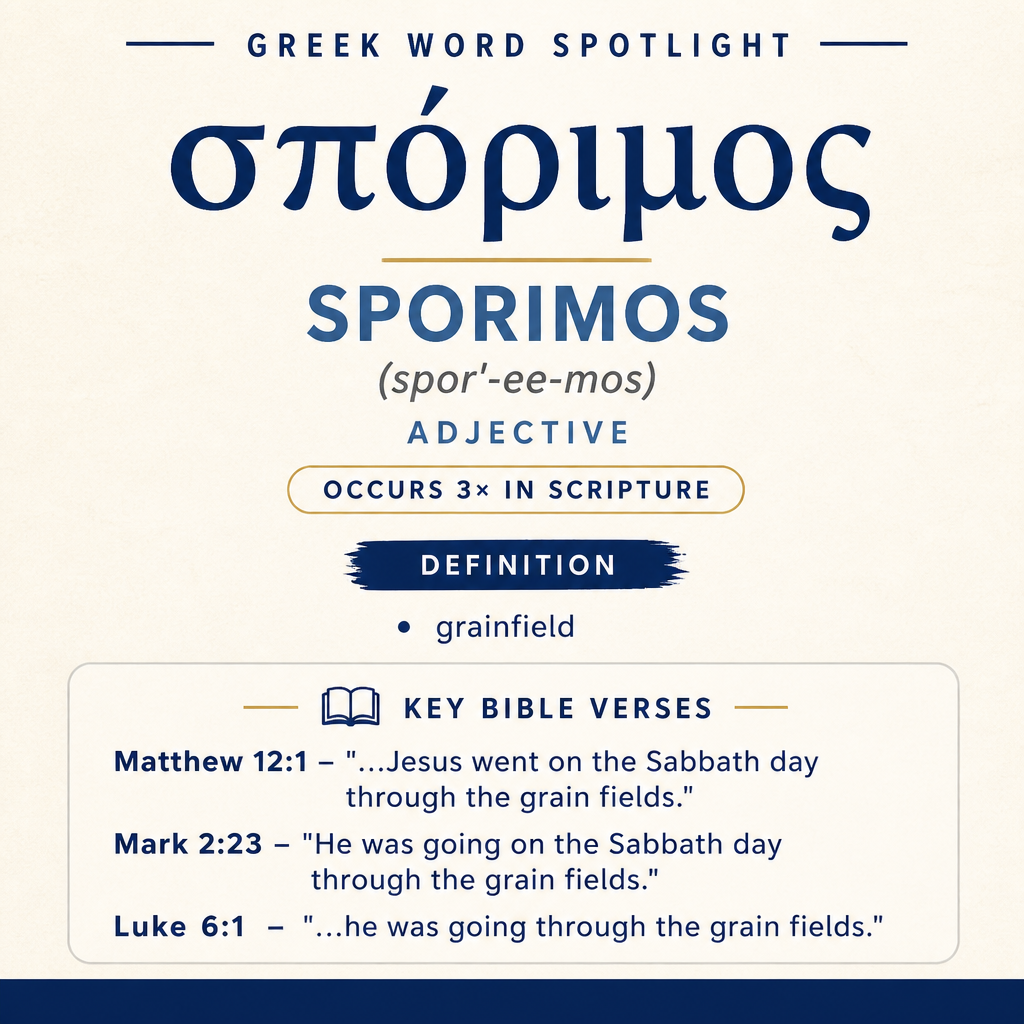
σπόριμος means “grainfield” and appears in Matthew 12:1, Mark 2:23, and Luke 6:1.
Core Meaning
σπόριμος is defined as “grainfield.” It refers to the fields Jesus and His disciples walked through.
Learn More →Gospel Occurrences
This word occurs three times in Scripture. Each occurrence is in the Gospels: Matthew 12:1, Mark 2:23, and Luke 6:1.
Learn More →Sabbath Setting
In all three verses, Jesus was going through the grain fields on the Sabbath day. His disciples plucked heads or ears of grain while going.
Learn More →σπόριμος designates a “grainfield,” the cultivated setting where standing grain can be plucked and eaten. It appears in three Gospel scenes that all place Jesus and His disciples walking “through the grain fields” on a Sabbath.
Root and Related Words
σπόριμος is related to sporos (σπόρος), “seed” (Strong’s G4703), which supplies the lexical link to sowing and the growth of grain.

Occurrences
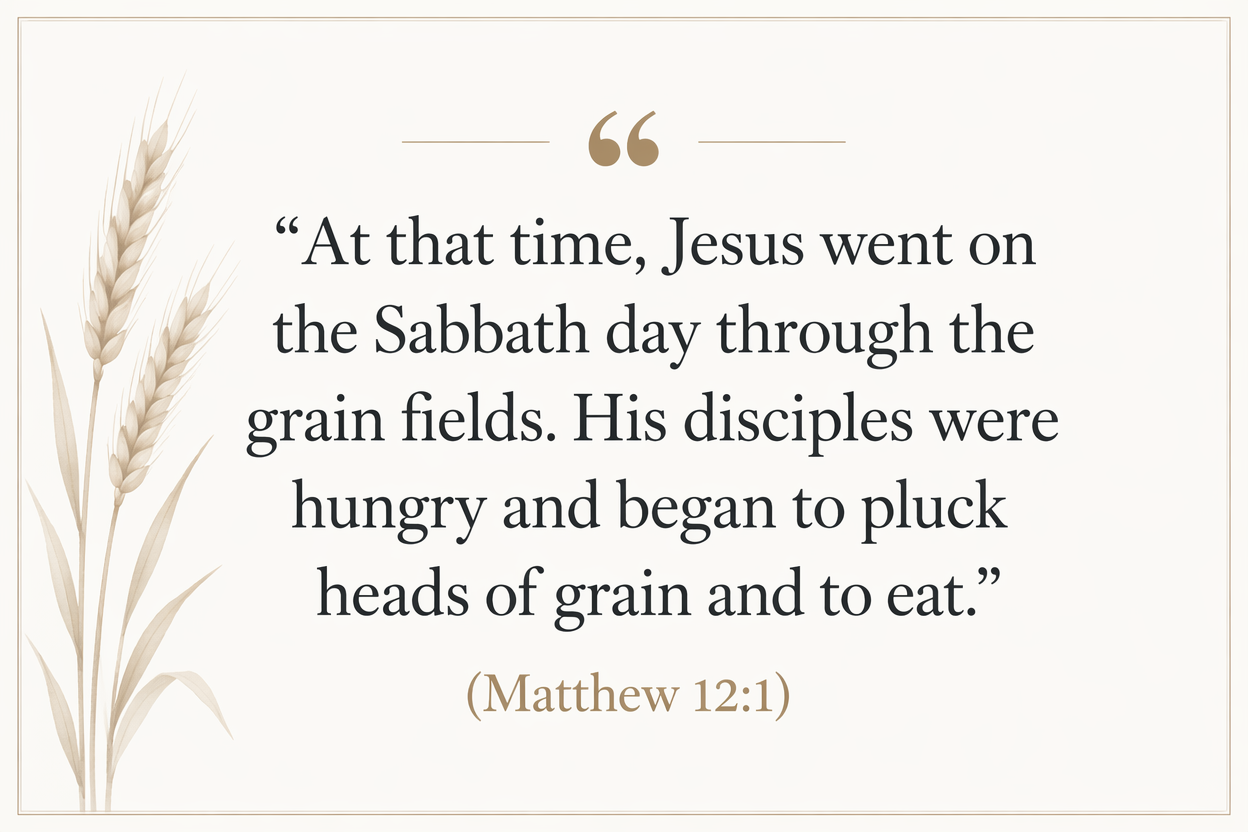
“At that time, Jesus went on the Sabbath day through the grain fields. His disciples were hungry and began to pluck heads of grain and to eat.” (Matthew 12:1)
Here σπόριμος frames the immediate, practical problem stated in the verse: “His disciples were hungry.” The grainfield is not a backdrop in general; it is the place that supplies what can be taken “heads of grain” at hand and eaten on the spot. Because the action happens “on the Sabbath day,” the grainfield becomes the concrete location where an ordinary act of obtaining food—“began to pluck… and to eat”—is set within the time-marker that will matter for the ensuing controversy. The word keeps the scene grounded in an agricultural corridor that Jesus and His disciples can walk through, where edible grain is accessible without preparation or purchase.
“He was going on the Sabbath day through the grain fields, and his disciples began, as they went, to pluck the ears of grain.” (Mark 2:23)
In Mark, σπόριμος again anchors the narrative in a field of grain, but the verse highlights movement: “as they went.” The grainfield is portrayed as a stretch of cultivated land that lies along their path, allowing repeated, incidental plucking while walking. The disciples’ action is described as a process begun during travel rather than a single isolated gesture. This makes the grainfield a place where the availability of grain accompanies the journey: they do not stop to harvest; they pass through and take “the ears of grain” as they go. With the Sabbath explicitly named, the grainfield functions as the setting where a commonplace field-side action can be observed and evaluated.
“Now on the second Sabbath after the first, he was going through the grain fields. His disciples plucked the heads of grain and ate, rubbing them in their hands.” (Luke 6:1)
Luke’s occurrence retains the same basic setting—going “through the grain fields”—but adds a fuller depiction of how food is obtained and consumed. The grainfield provides “heads of grain,” and the disciples not only pluck them but also “ate, rubbing them in their hands.” The word therefore contributes to a scene with tangible textures and actions: standing grain, the physical act of plucking, and the hand-rubbing that readies the grain for eating. The verse’s time reference, “on the second Sabbath after the first,” keeps the focus on Sabbath timing, while the grainfield supplies the material environment in which the disciples’ hunger is met by what the field yields.
Sense and Usage
Across all three occurrences, σπόριμος consistently names a cultivated expanse of standing grain through which people can travel. In each passage the grainfield is not merely mentioned as countryside scenery; it is the immediate source of what the disciples take into their hands. The paired actions—walking “through” the grainfields and plucking grain—depend on the field’s character as planted land where grain stands in reachable form. Thus the term carries a strongly situational force: it identifies the kind of place where hunger can be relieved directly from the plants present.
Because each instance explicitly places the scene on a Sabbath, σπόριμος also carries the narrative weight of being a public, accessible location. A grainfield is open enough to be walked through; it is not described as an enclosed pantry but as a tract along which Jesus and the disciples move. This openness is significant for how the action is portrayed: in Matthew, the disciples “began to pluck… and to eat”; in Mark, they pluck “as they went”; in Luke, they pluck, prepare, and eat in a sequence. The grainfield makes these actions plausible by providing an environment where grain can be reached immediately and handled without tools.
The word’s repeated association with “heads of grain” and “ears of grain” shows that σπόριμος is understood in these contexts as a place where the grain is still on the stalk, not already processed. The disciples’ contact with the grain is direct: plucking, rubbing, eating. Luke’s added detail of “rubbing them in their hands” underscores the grainfield’s role in supplying raw produce that must be readied in the simplest possible way. Even without extended description of the landscape, σπόριμος evokes a field at the stage of growth when grain can be gathered by hand and consumed immediately.
Although the three verses vary slightly in wording, they share a consistent narrative function for σπόριμος: it locates Jesus’ Sabbath travel in an agricultural setting where the disciples’ behavior is both ordinary and visible. The word thereby supports the tension implicit in all three scenes: a moment of need (“hungry”), a ready supply (standing grain), and an action taken in time-marked circumstances (“on the Sabbath day”). By naming the place as a grainfield, σπόριμος keeps the focus on the concrete setting where questions about the disciples’ conduct can arise.
Imagery
In these passages, σπόριμος carries the imagery of a path bordered by ripe grain—an environment where movement and provision meet. The repeated picture is of travelers passing through standing grain and reaching out to pluck what is needed for food, with hands serving both for gathering and, in Luke, for preparing what is eaten.
Sources: Lexical data from Strong’s Exhaustive Concordance and the Translators Brief Lexicon of Extended Strongs for Greek (STEPBible, CC BY). Occurrence data from the Translators Amalgamated Greek New Testament (STEPBible, CC BY). Scripture quotations from the World English Bible (public domain).





