
Exploring the Meaning of Sousanna in Greek
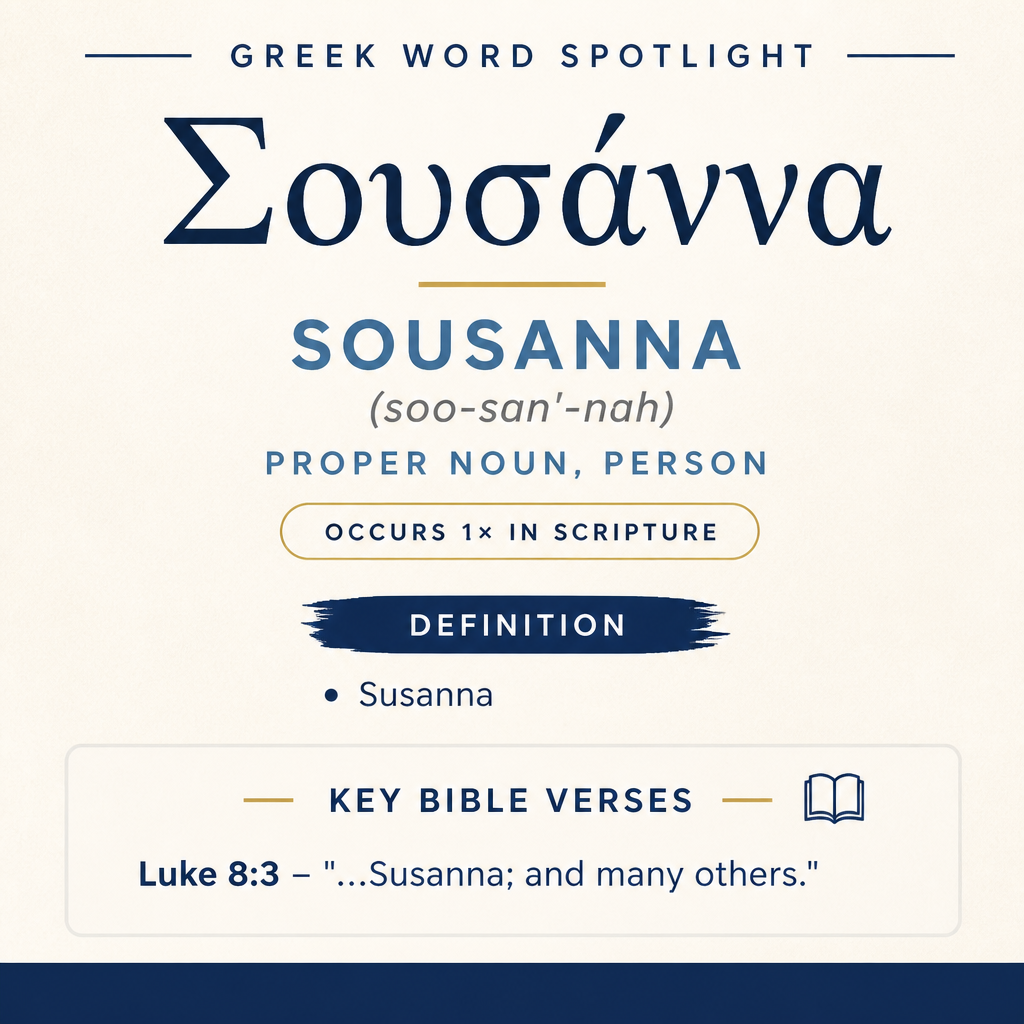
Σουσάννα means Susanna and appears once in Scripture, in Luke 8:3.
Context in Luke
In Luke 8:3, Susanna is listed with Joanna and many others who served them from their possessions.
Learn More →Sousanna is the personal name “Susanna.” It appears in Luke 8:3 within a list of women associated with Jesus’ ministry and support.
Occurrences
Luke 8:3
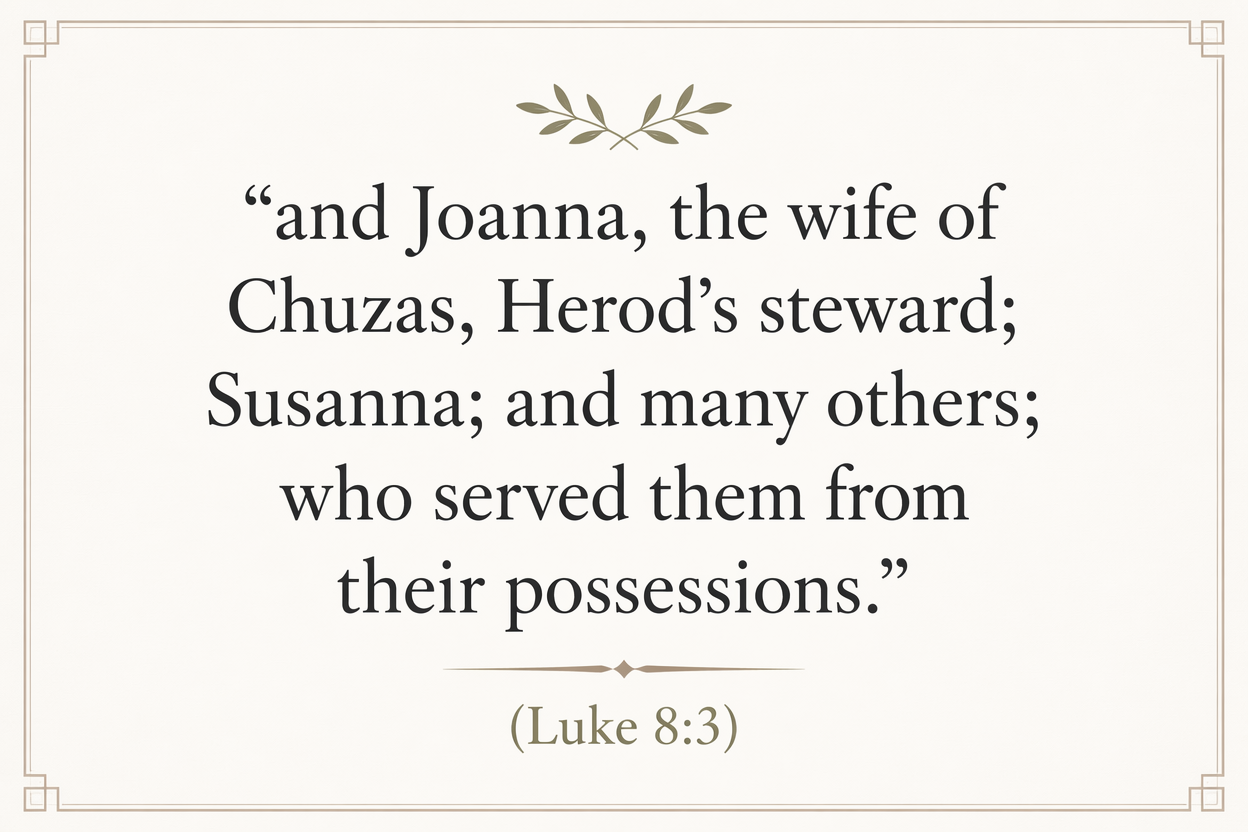
“and Joanna, the wife of Chuzas, Herod’s steward; Susanna; and many others; who served them from their possessions.” (Luke 8:3)
Here Susanna is named succinctly, without family identification or a descriptive phrase attached to her name in the sentence itself. The structure of the line places her alongside “Joanna, the wife of Chuzas, Herod’s steward,” followed by the broader group “and many others,” forming a catalogue of women connected with the same action: “who served them from their possessions.” In this context, the name functions as a concrete marker that the service being described is not an abstract idea but something carried by identifiable individuals. Susanna stands as one of the specific persons included among those who materially supported the group referred to as “them.”
The placement of her name between an individual introduced with social connections (Joanna, linked to Chuzas and to Herod’s steward) and the open-ended phrase “many others” gives Susanna a distinct literary role. She is neither absorbed into anonymity nor framed by explicit relational status within this line; instead, her mention reinforces that the ministry’s support network included persons whose significance in the narrative is carried simply by their inclusion and participation. The semicolons in the English text segment the list into discrete entries, and Susanna’s name occupies one of those entries: the verse treats her as a standalone referent, a member of the serving group, without further elaboration at this point.

Sense and Usage
As a proper name, Susanna’s lexical “sense” in this passage is realized through reference: the word points to a particular woman within the narrative world. Luke 8:3 uses the naming of individuals to anchor an otherwise general statement about service—“who served them from their possessions”—in the lives of real participants. Susanna’s name, therefore, is not employed to convey a quality or attribute but to designate a person whose presence in the list supplies specificity and witness: the service described was undertaken by named women as well as “many others.”
The verse pairs proper names with brief identifying details in a selective way. Joanna is introduced with relational and occupational connections (“the wife of Chuzas, Herod’s steward”), whereas Susanna appears with no appended descriptor. This unevenness is itself meaningful at the level of usage: it shows that within the same supportive circle, some individuals are introduced with clarifying information while others are introduced simply by name. Susanna’s designation by name alone allows her to function as a clear, memorable member of the group without making her identity dependent on a stated relationship in the sentence. In a list that includes both the prominent (“Herod’s steward” being explicitly mentioned) and the numerous (“many others”), Susanna contributes to the portrayal of a broad coalition unified by one shared activity: serving “them” with their resources.
Because the statement “who served them from their possessions” grammatically reaches back over the preceding series, Susanna’s name is bound to that shared action. The name is thus embedded in a depiction of practical support: possessions are the stated means, and service is the stated outcome. Within Luke 8:3, the function of Susanna is to be one of the human subjects implied by “who served,” even though the relative clause is expressed once for the whole list. The verse’s economy of expression—one clause covering several names—makes each named individual, including Susanna, a representative instance of the larger group’s commitment.
Imagery
Luke 8:3 evokes the quiet, concrete imagery of people sustaining a traveling ministry “from their possessions.” Susanna’s name belongs to that scene of material provision: resources being used in service, support offered in ordinary and tangible ways. Within the single line where she appears, Susanna’s lasting imprint is the picture of a named person participating in that shared service alongside others—some introduced with social detail, and many left unnamed—yet all joined by the same act described in the verse.
Sources: Lexical data from Strong’s Exhaustive Concordance and the Translators Brief Lexicon of Extended Strongs for Greek (STEPBible, CC BY). Occurrence data from the Translators Amalgamated Greek New Testament (STEPBible, CC BY). Scripture quotations from the World English Bible (public domain).




