
Exploring the Meaning of Soudarion in Greek
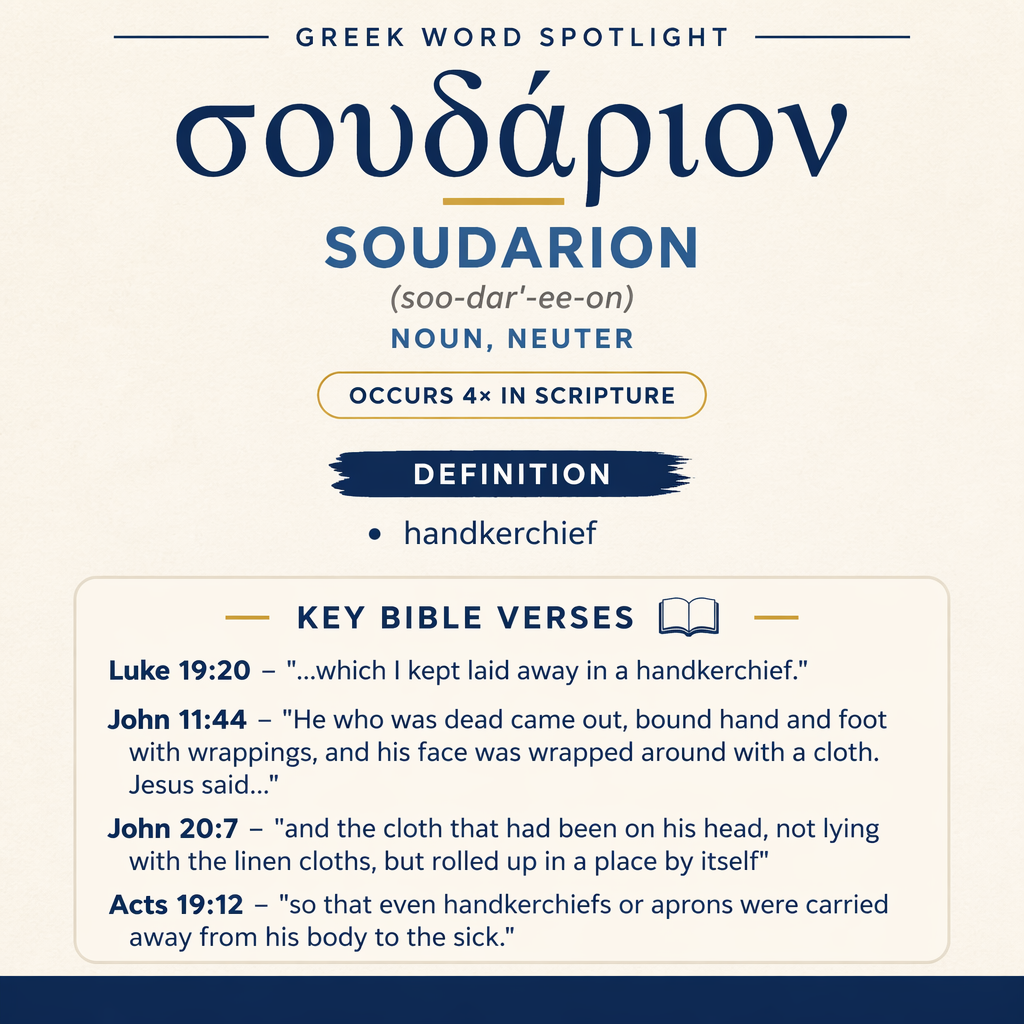
σουδάριον means “handkerchief” and appears four times in Scripture: Luke 19:20; John 11:44; John 20:7; Acts 19:12.
Gospel Contexts
In Luke 19:20 it is where a mina was kept laid away. In John 11:44 and John 20:7 it refers to a cloth associated with Jesus’ burial scenes.
Learn More →Acts Usage
In Acts 19:12, handkerchiefs or aprons were carried away from Paul’s body to the sick.
Learn More →σουδάριον names a small cloth described as a “handkerchief,” appearing in narratives and teaching where such a cloth functions as a place of keeping, a wrapping, or an item carried from one person to another. Its four appearances span a parable, two resurrection scenes, and a report of extraordinary healings.
Occurrences
“Another came, saying, ‘Lord, behold, your mina, which I kept laid away in a handkerchief,” (Luke 19:20)
Here σουδάριον marks the chosen means of storage: the mina is not invested or put to work but “kept laid away” in a cloth. The noun helps the scene feel ordinary and tactile; the servant presents the money as something wrapped up and put aside, not something actively circulating. Because the speaker calls the mina “your mina,” the handkerchief becomes part of his explanation for how he handled what belonged to his lord—kept safe, but kept inactive. The word therefore supports the contrast in the parable between what is preserved and what is productive, without changing the object (the mina) itself.

“He who was dead came out, bound hand and foot with wrappings, and his face was wrapped around with a cloth. Jesus said to them, “Free him, and let him go.”” (John 11:44)
In this account the cloth is associated with a face-covering. The man comes out “bound hand and foot with wrappings,” and in addition “his face was wrapped around with a cloth.” The noun gives specificity to the description: not only are there “wrappings,” but there is a distinct piece used around the face. That detail heightens the realism of the moment—he is alive and moving, yet still constrained and covered—so the command “Free him, and let him go” directly answers the condition the cloth helps portray. The word’s contribution is to locate the impediment and concealment at the face, making the freeing action concrete rather than abstract.
“and the cloth that had been on his head, not lying with the linen cloths, but rolled up in a place by itself.” (John 20:7)
In the tomb scene the same kind of item is identified by its prior position and its present placement: it “had been on his head,” and now it is “rolled up in a place by itself.” The verse distinguishes it from “the linen cloths” by how it lies: it is “not lying with” them. The noun thus carries evidentiary weight in the narrative’s visual inventory of the burial materials. The cloth is not merely present; it is arranged in a particular way—“rolled up”—and separated from the other cloths, making it a distinct object that can be noticed and described. The word anchors that distinction, directing attention to a head-cloth as a separate item within the larger set of burial wrappings.
“so that even handkerchiefs or aprons were carried away from his body to the sick, and the diseases departed from them, and the evil spirits went out.” (Acts 19:12)
In Acts, σουδάριον appears in the plural and is paired with “aprons” as items “carried away from his body to the sick.” The clause “so that even” places emphasis on how ordinary objects became involved in what followed: “the diseases departed from them, and the evil spirits went out.” The noun helps depict the chain of contact implied by the sentence: from a person’s body, to a cloth, to those who are sick. Within that description, the handkerchief is a portable, personal item, small enough to be transported and applied, and it functions as the object moved between locations and people. The verse’s interest is not the cloth’s craftsmanship but its role as a carried item in a sequence that ends with deliverance and healing.

Sense and Usage
Across these passages, the “handkerchief” sense of σουδάριον consistently stays within the realm of a practical cloth, yet the contexts show how such an object can bear very different narrative loads. In Luke 19:20 it is a container: the mina is enclosed and kept, and the cloth’s simplicity underscores the minimal action taken with what was entrusted. In John 11:44 and John 20:7 it is a bodily cloth associated with the head/face area, used in connection with death and burial, and then seen in connection with release and the empty tomb. In Acts 19:12 it is an article that can be taken up and carried, moving from one person to another as part of the reported events.
Two features stand out in the way the word operates in these settings. First, it is consistently described through placement: “laid away in a handkerchief” (Luke 19:20), “his face was wrapped around with a cloth” (John 11:44), “had been on his head” and then “rolled up in a place by itself” (John 20:7), “carried away from his body to the sick” (Acts 19:12). The noun therefore often receives its narrative definition from where it is and what it touches—money hidden, a face covered, a head previously covered, a body-associated item transported. Second, the cloth repeatedly signals the movement from one state to another: from stored to presented (Luke), from bound and covered to freed (John 11), from a head once wrapped to a cloth left behind and set apart (John 20), and from contact with one body to the departure of disease and evil spirits in others (Acts). The word remains literal, but it participates in transitions that the surrounding verbs highlight.
Within John’s two occurrences, the noun contributes to careful differentiation among cloths. John 11:44 distinguishes “wrappings” for hands and feet from a separate cloth at the face, showing that the face-covering is an additional element of the bound condition. John 20:7 then distinguishes a head-cloth from “the linen cloths” by separation (“not lying with”) and by arrangement (“rolled up”). This gives the reader a structured picture: multiple cloth items exist, and this particular cloth is singled out by function (on the head) and by the way it is found (rolled and separate). By contrast, Luke and Acts lean on the cloth’s everyday character: it is something one might naturally use to keep an item tucked away, and something one might naturally carry from place to place.
Imagery in Context
σουδάριον repeatedly draws attention to what can be done with a small piece of cloth: it can conceal and preserve (Luke 19:20), it can cover a face and contribute to a person’s restraint until others act (John 11:44), it can remain as a quiet, orderly object within an otherwise stark scene (John 20:7), and it can be carried outward from a single body to many in need (Acts 19:12). The word’s imagery is domestic and bodily—storage, covering, rolling up, carrying—yet the scenes in which it appears are anything but trivial, ranging from accountability to liberation and healing.
Sources: Lexical data from Strong’s Exhaustive Concordance and the Translators Brief Lexicon of Extended Strongs for Greek (STEPBible, CC BY). Occurrence data from the Translators Amalgamated Greek New Testament (STEPBible, CC BY). Scripture quotations from the World English Bible (public domain).





