
Exploring the Meaning of Sindon in Greek
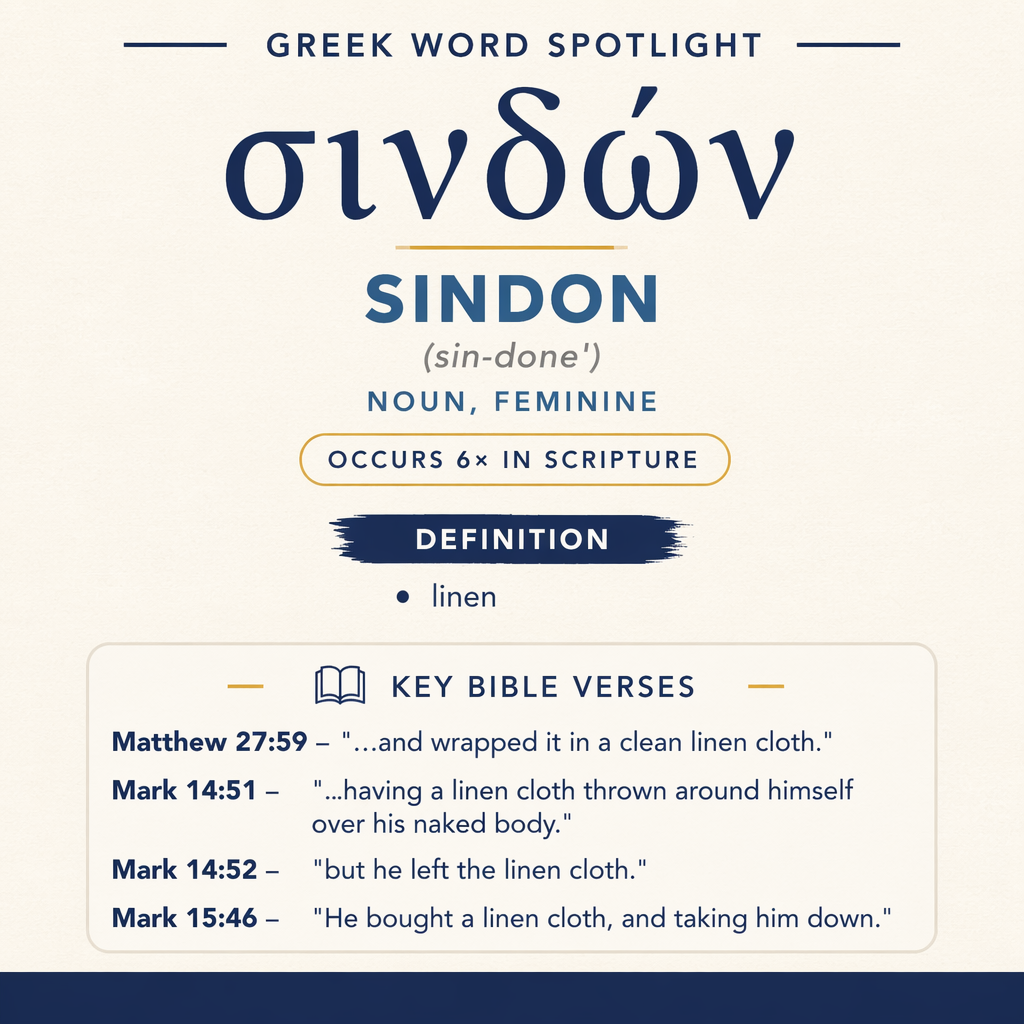
σινδών means “linen” and appears six times in Scripture, notably in the burial and arrest narratives in the Gospels.
Core Meaning
σινδών is defined as “linen.” In the Gospels, it refers to a linen cloth used as a garment or wrapping.
Learn More →Burial Wrapping
In Matthew 27:59, Mark 15:46, and Luke 23:53, the body is wrapped in a linen cloth. These texts describe the linen cloth used when laying the body in a tomb.
Learn More →Arrest Scene
In Mark 14:51–52, a certain young man has a linen cloth thrown around him. When seized, he leaves the linen cloth and flees naked.
Learn More →σινδών refers to “linen” in the Gospel narratives surrounding Jesus’ arrest and burial. In these passages it names a tangible cloth—either worn as a covering in the chaos of the arrest or used deliberately to wrap a body for burial.
Occurrences
Matthew 27:59: “Joseph took the body, and wrapped it in a clean linen cloth,”
Here σινδών designates the specific material used to enclose Jesus’ body. The description “clean” frames the linen cloth as fit for its purpose: Joseph’s action is careful and preparatory, moving the body from exposure to being contained and covered. The linen cloth functions as the immediate means by which Joseph can “wrap” the body—an act that both handles the body respectfully and makes it possible to place it in a tomb as a complete, enclosed deposit rather than as an exposed corpse.
Mark 14:51: “A certain young man followed him, having a linen cloth thrown around himself over his naked body. The young men grabbed him,”
In this arrest scene, σινδών is a makeshift garment: “a linen cloth thrown around himself over his naked body.” The wording depicts the cloth as something draped rather than carefully worn, emphasizing haste and vulnerability. The young man’s minimal covering highlights the abruptness of the moment—he “followed him” and is immediately seized. The linen cloth becomes the young man’s only barrier between nakedness and public exposure, so its presence sharpens the tension when he is grabbed.
Mark 14:52: “but he left the linen cloth, and fled from them naked.”
σινδών in the next verse carries the action forward: it is the object abandoned in order to escape. The narrative contrast turns on the cloth—retaining it would mean remaining in the grasp of the pursuers, but leaving it enables flight. By naming the cloth again, the verse keeps the reader’s attention on the cost of escape: the young man’s departure is not merely a retreat but a sudden stripping, from a linen covering to nakedness. The linen cloth thus marks the boundary between being partially covered and being fully exposed.
Mark 15:46: “He bought a linen cloth, and taking him down, wound him in the linen cloth, and laid him in a tomb which had been cut out of a rock. He rolled a stone against the door of the tomb.”
σινδών is central to the sequence of burial acts. The linen cloth is first obtained—“He bought a linen cloth”—then used repeatedly in the description: “wound him in the linen cloth.” The repetition underscores that the linen is not incidental but essential to the procedure: it is the material medium by which the body is handled, wrapped, and made ready to be “laid…in a tomb.” The cloth links “taking him down” to “laid him in a tomb,” bridging removal and interment. In the same breath, the tomb is sealed—“He rolled a stone against the door of the tomb”—so the linen cloth belongs to a set of concrete, finalizing actions that close the burial.
Luke 23:53: “He took it down, and wrapped it in a linen cloth, and laid him in a tomb that was cut in stone, where no one had ever been laid.”
Luke’s account uses σινδών in a streamlined narration: the body is taken down, wrapped, and laid in a tomb. The linen cloth is the key instrument in the transition from crucifixion to entombment, serving the immediate practical purpose of wrapping what has been “took…down.” The mention of a tomb “where no one had ever been laid” places the linen cloth within a setting marked as unused and singular; the cloth accompanies an act of first placement, where the wrapped body is the first occupant of that cut-stone space.

Sense and Usage
Across these passages, σινδών consistently names “linen” as a piece of cloth with direct physical contact to the human body. The word’s usage divides naturally into two contexts.
First, in Mark 14:51–52, the linen cloth is a personal covering in an urgent situation. It is described as “thrown around” the young man “over his naked body,” a phrasing that emphasizes drape and immediacy rather than tailored clothing. In that context, linen functions as a fragile layer of modesty and protection that can be lost in an instant. The narrative significance is carried by the cloth’s precariousness: it is easy to seize, easy to leave behind, and its loss results in immediate exposure (“fled…naked”). σινδών therefore operates as a concrete marker of vulnerability in the arrest scene—something that can be grasped, dropped, and forfeited in the scramble of pursuit.
Second, in the burial accounts (Matthew 27:59; Mark 15:46; Luke 23:53), σινδών becomes a burial linen, an object used deliberately and with care. The verbs paired with it—“wrapped,” “wound”—present the linen cloth as the means by which a body is enclosed and prepared for placement in a tomb. In Mark 15:46 it is purchased, highlighting intentional provision; in Matthew 27:59 it is qualified as “clean,” emphasizing suitability for the act; in Luke 23:53 it appears in a swift chain of actions, serving the practical needs of removal and interment. In all three, linen functions as an interface between the dead body and the burial space: it contains, covers, and allows handling and placement.
Notably, the same material term can frame opposite outcomes depending on the scene. During the arrest, linen is left behind and the result is nakedness; during burial, linen is applied and the result is a body respectfully enclosed. Thus σινδών can signal both loss of covering (as part of flight) and provision of covering (as part of burial). The word’s concreteness anchors these narratives in material reality: a cloth that can be thrown around someone, seized, abandoned, bought, wrapped, and used to wind a body.
The recurrence of linen in the burial narratives also shapes the pacing: each account slows to name the cloth as a distinct step in the process. That repeated attention keeps burial from being a vague conclusion; it is presented as a sequence of embodied actions—taking down, wrapping in linen, laying in a rock- or stone-cut tomb, and (in Mark) sealing the entrance with a stone. σινδών is the item that stays close to the body within that sequence, emphasizing the immediate, tactile aspect of burial work.
Imagery
These passages invest σινδών with vivid sensory imagery: linen as something draped around bare skin in a nighttime scramble, and linen as something cleanly wrapped around a body before it is laid in stone. The same kind of cloth appears in scenes of pursuit and in scenes of careful closure, so the word carries a consistent physical reference while the narratives place it in sharply different moments—panic and escape on one side, purchase and burial preparation on the other.
Sources: Lexical data from Strong’s Exhaustive Concordance and the Translators Brief Lexicon of Extended Strongs for Greek (STEPBible, CC BY). Occurrence data from the Translators Amalgamated Greek New Testament (STEPBible, CC BY). Scripture quotations from the World English Bible (public domain).




