Exploring the Meaning of Sinapi in Greek
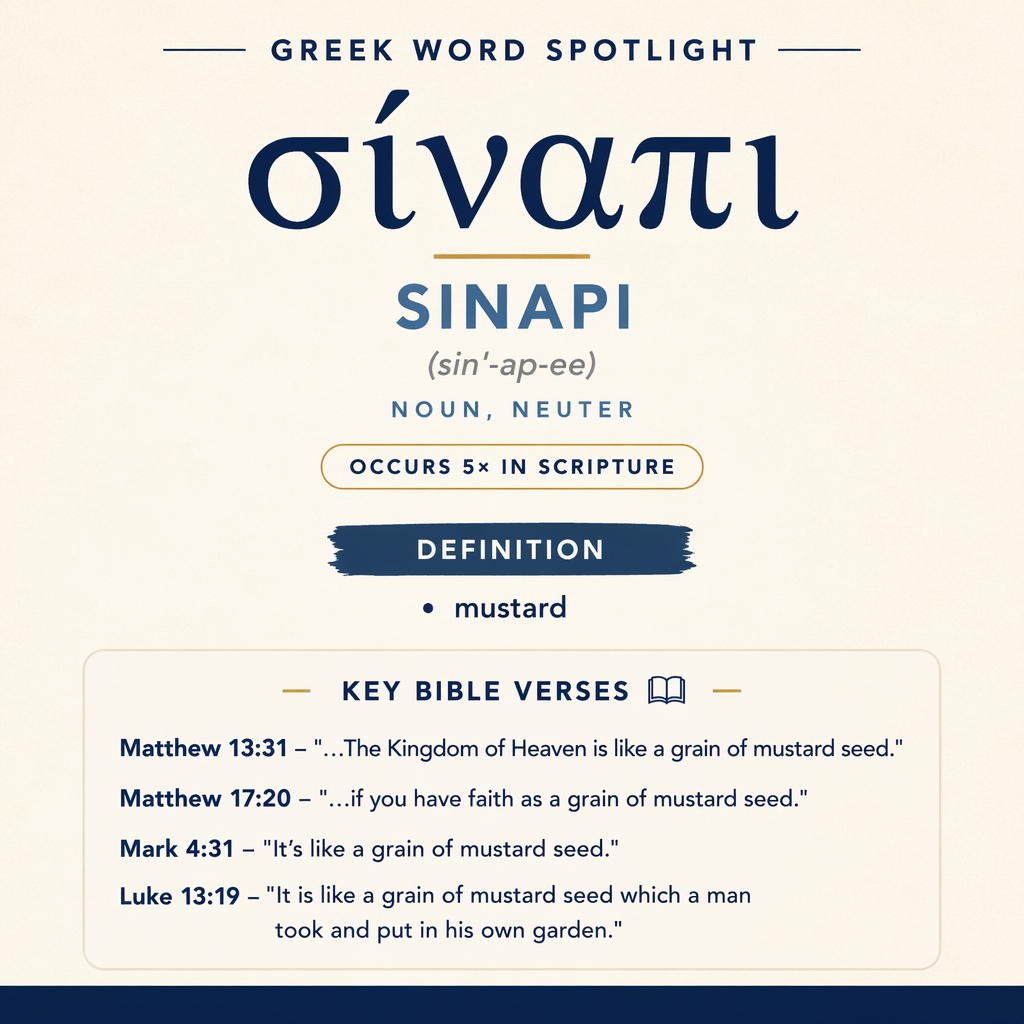
σίναπι means “mustard” and appears five times in Scripture in Matthew, Mark, and Luke.
Gospel Occurrences
It occurs five times: Matthew 13:31; Matthew 17:20; Mark 4:31; Luke 13:19; Luke 17:6.
Learn More →In the Text
In each cited verse, σίναπι appears in the phrase “grain of mustard seed.”
Learn More →σίναπι refers to mustard. In the Gospels it appears in sayings and parables that focus on a “grain of mustard seed,” using that small, familiar item as a point of comparison for growth and for effective power.
Occurrences
“He set another parable before them, saying, “The Kingdom of Heaven is like a grain of mustard seed, which a man took, and sowed in his field;”” (Matthew 13:31)
Here σίναπι belongs to a parable that compares “The Kingdom of Heaven” to “a grain of mustard seed.” The scene is concrete: a man takes the seed and “sowed in his field.” The word anchors the comparison in ordinary agricultural practice—something handled, carried, and placed into the soil. The stress in the wording falls on the seed as a small unit (“a grain”), and on the deliberate act of sowing. In this setting, σίναπι supplies the image of a real seed whose significance will be seen not in what it looks like at the moment it is sown, but in what follows from it.
“He said to them, “Because of your unbelief. For most certainly I tell you, if you have faith as a grain of mustard seed, you will tell this mountain, ‘Move from here to there,’ and it will move; and nothing will be impossible for you.”” (Matthew 17:20)
In this saying σίναπι functions as the measure for a comparison: “faith as a grain of mustard seed.” The context highlights a contrast between “unbelief” and even a very small quantity of faith. The image is not about sowing but about speech and effect: a mountain is addressed with a command—“Move from here to there”—and the result is movement. The mustard seed, named by σίναπι, supplies the scale: something tiny is set beside an action that is massive. Within the sentence, the mustard seed is the point of reference that makes the stated outcome (“nothing will be impossible for you”) rhetorically vivid.
“It’s like a grain of mustard seed, which, when it is sown in the earth, though it is less than all the seeds that are on the earth,” (Mark 4:31)
Mark’s line keeps the focus tightly on the seed itself and the act of sowing. σίναπι appears in a comparison introduced by “It’s like,” and the seed is described in relation to other seeds: “though it is less than all the seeds that are on the earth.” The word thus carries a strong emphasis on smallness, framed as an observation about relative size. The clause “when it is sown in the earth” places the mustard seed into a broader pattern: a seed’s initial insignificance is seen at the moment it is put into the ground, before any later development is described. σίναπι here supports an argument by contrast: what is “less” at the start can still be the basis for what follows.
“It is like a grain of mustard seed which a man took and put in his own garden. It grew and became a large tree, and the birds of the sky live in its branches.”” (Luke 13:19)
In Luke’s parabolic description, σίναπι is again “a grain of mustard seed,” but the setting is more personal and localized: the man “put in his own garden.” The narrative then traces a sequence: placement, growth, and a final state that affects other creatures. The mustard seed “grew and became a large tree,” and its branches become a habitat: “the birds of the sky live in its branches.” σίναπι therefore participates in imagery of transformation from small beginning to large, stable form. The word is tied to the start of that development—the grain placed in the garden—yet the verse’s wording invites the reader to hold the starting point (seed) and the outcome (tree with branches) together in one picture.
“The Lord said, “If you had faith like a grain of mustard seed, you would tell this sycamore tree, ‘Be uprooted, and be planted in the sea,’ and it would obey you.”” (Luke 17:6)
Here σίναπι again supplies the comparison for “faith,” and, as in Matthew 17:20, the emphasis is on what such faith can accomplish through a spoken command. The object commanded is not a mountain but “this sycamore tree,” and the instruction is extreme: “Be uprooted, and be planted in the sea.” The response is personified as obedience: “it would obey you.” The mustard seed image sets the scale of faith required: the comparison points to something minimal in size, yet associated with decisive effect over something firmly established (a tree with roots) and with relocation to an unlikely place (the sea). σίναπι thus intensifies the contrast between the smallness implied by “a grain” and the magnitude of the commanded outcome.

Sense and Usage
Across these passages σίναπι is consistently paired with “a grain” and with “seed,” so the word’s sense is not abstract but embedded in a specific, tangible object that can be taken in hand, sown, or used as a benchmark for comparison. Two uses stand out.
First, σίναπι supports parabolic teaching by linking a beginning to an outcome. Matthew 13:31 presents the seed in the moment of sowing—“a man took, and sowed in his field”—so the word helps fix the listener’s attention on an unremarkable starting point. Mark 4:31 sharpens this by emphasizing relative smallness (“less than all the seeds that are on the earth”), making the initial state the key feature. Luke 13:19 then extends the image beyond the act of sowing to the result: what begins as a “grain of mustard seed” becomes “a large tree,” a place where “the birds of the sky live in its branches.” In these parables, σίναπι is chosen precisely because it can bear the weight of that contrast between start and finish; the seed is a fitting vehicle for describing developments that are not predicted by initial appearances.
Second, σίναπι provides a scale for talking about faith in a way that is simultaneously modest and forceful. In Matthew 17:20 the comparison appears directly after a diagnosis—“Because of your unbelief”—so mustard-seed faith is positioned as the opposite of that lack. The seed does not represent a complicated inner state; it represents a very small measure, presented as sufficient to issue a command that changes what seems immovable (“this mountain”). Luke 17:6 uses the same comparison but changes the illustration to a “sycamore tree,” whose uprooting and replanting in the sea is commanded. In both sayings the seed functions as a unit of measurement and a rhetorical minimum: the comparison implies that even the smallest faith, if present, is effective enough to be spoken into action that elicits obedience from what is addressed.
In all five occurrences, then, σίναπι works because it names something ordinary and small that can be pictured instantly. Whether the focus is on sowing (“sowed in his field,” “sown in the earth,” “put in his own garden”) or on comparison (“faith as a grain of mustard seed,” “faith like a grain of mustard seed”), the word keeps the teaching grounded in a concrete item that bridges everyday experience and large claims about what follows from a small beginning.
Imagery
The imagery tied to σίναπι in these verses is consistently a tension between smallness and scope. In the parables, the mustard seed sits in a person’s hand and then in the soil, yet Luke describes an endpoint expansive enough for “the birds of the sky” to live among its branches (Luke 13:19). In the sayings about faith, the same “grain” becomes a way to speak about commands directed at a mountain or a rooted tree, with outcomes that match the command (“it will move,” “it would obey you”; Matthew 17:20; Luke 17:6). σίναπι therefore serves these texts as a stable, concrete reference point that makes the contrast—small beginnings, large effects—memorable and sharply drawn.
Sources: Lexical data from Strong’s Exhaustive Concordance and the Translators Brief Lexicon of Extended Strongs for Greek (STEPBible, CC BY). Occurrence data from the Translators Amalgamated Greek New Testament (STEPBible, CC BY). Scripture quotations from the World English Bible (public domain).