Exploring the Meaning of Sidereos in Greek
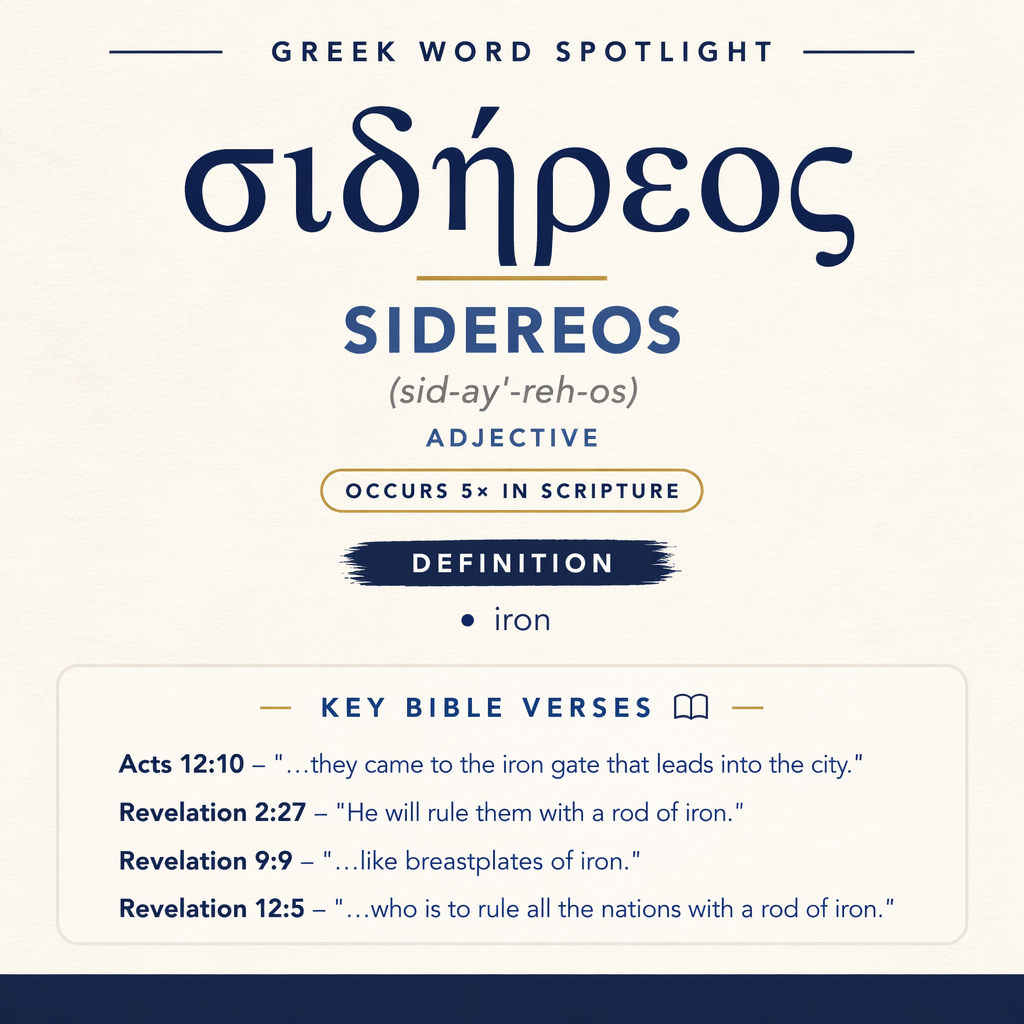
σιδήρεος means “iron” and appears 5 times in Scripture: Acts 12:10 and Revelation 2:27; 9:9; 12:5; 19:15.
Core Meaning
σιδήρεος is defined as “iron.” It describes objects characterized by iron.
Learn More →Where It Appears
It occurs once in Acts (12:10) and four times in Revelation (2:27; 9:9; 12:5; 19:15). The total is five occurrences.
Learn More →Usage in Context
In Acts 12:10 it describes an iron gate leading into the city. In Revelation it describes a rod of iron and breastplates of iron.
Learn More →σιδήρεος is a Greek adjective meaning “iron.” It appears in Acts in a narrative description of a prison escape, and in Revelation in vivid depictions of gates, armor, and a “rod” connected with ruling and judgment.
Root and Related Words
σιδήρεος (Sidereos) is related to σίδηρος (sideros), “iron” (Strong’s G4604).

Occurrences
“When they were past the first and the second guard, they came to the iron gate that leads into the city, which opened to them by itself. They went out, and went down one street, and immediately the angel departed from him.” (Acts 12:10)
Here the adjective marks a city gate by its material: an “iron gate.” In the scene, the gate stands as the final barrier between guarded confinement and the open city. The detail that it “opened to them by itself” heightens the contrast between the gate’s normal strength and resistance and the ease with which passage is granted in this moment; the narrative lingers on concrete obstacles—guards, gates, streets—and σιδήρεος anchors that obstacle in the hard, worked material associated with secure closure.
“He will rule them with a rod of iron, shattering them like clay pots; as I also have received of my Father:” (Revelation 2:27)
In this saying, “rod of iron” frames the instrument of rule as unyielding and forceful. The following line, “shattering them like clay pots,” develops the image: what is wielded is fit not merely for guidance but for breaking resistance. σιδήρεος contributes by specifying the rod’s substance, shaping how the act of “rule” is to be imagined—firm, decisive, and able to crush what is fragile in comparison.
“They had breastplates, like breastplates of iron. The sound of their wings was like the sound of chariots, or of many horses rushing to war.” (Revelation 9:9)
Within a description built from comparisons (“like breastplates of iron,” “like the sound of chariots”), the adjective strengthens the portrayal of invulnerability and intimidation. A breastplate covers the chest; calling it “of iron” makes the protection feel heavy and impenetrable, fitting the martial soundscape that follows—wings roaring with the noise of massed forces “rushing to war.” σιδήρεος functions as a material cue that supports the wider sensory effect of the verse: hard armor matched with overwhelming, advancing power.
“She gave birth to a son, a male child, who is to rule all the nations with a rod of iron. Her child was caught up to God, and to his throne.” (Revelation 12:5)
The phrase “rod of iron” returns, now tied to a destined scope: “rule all the nations.” The adjective again shapes the manner of rule envisioned—one associated with hardness and strength rather than flexibility. In the immediate context, the child’s being “caught up to God, and to his throne” places the iron-rod imagery alongside exaltation and authority; σιδήρεος reinforces the portrayal of rule as something firmly established and not easily opposed.
“Out of his mouth proceeds a sharp, double-edged sword, that with it he should strike the nations. He will rule them with an iron rod. He treads the wine press of the fierceness of the wrath of God, the Almighty.” (Revelation 19:15)
Here σιδήρεος is part of a cluster of forceful images: a “sharp, double-edged sword,” striking “the nations,” ruling “with an iron rod,” and treading “the wine press of the fierceness of the wrath of God.” The iron rod stands as the implement of rule within an explicitly punitive setting. By naming the rod as iron, the text intensifies the sense of unbending authority aligned with decisive action; the adjective supports the portrayal of rule as something executed with strength consistent with the surrounding weapons and judgment imagery.
Sense and Usage
Across these passages, σιδήρεος consistently serves as a concrete material descriptor, and the material carries interpretive weight in each setting. In Acts 12:10 it qualifies an everyday object—an urban gate—yet the choice of iron makes the gate feel like a real security measure, suitable for containing a prisoner even after passing “the first and the second guard.” The story’s emphasis on movement through barriers makes the material detail more than decorative: an iron gate suggests a final, serious threshold, and its effortless opening underscores the extraordinary character of the escape.
In Revelation, σιδήρεος appears in two main collocations: armor (“breastplates…of iron”) and an instrument of rule (“rod of iron / an iron rod”). In Revelation 9:9 the adjective strengthens the threat by stressing protection: iron breastplates belong to a battle scene where sound and motion suggest charge and conflict. The emphasis is not on craftsmanship but on the felt hardness of the protective layer, matching the auditory imagery of chariots and horses.
The repeated “rod of iron” in Revelation 2:27 and 12:5 and the “iron rod” in Revelation 19:15 show σιδήρεος working in a more symbolic register while still staying within the concrete meaning of material. A rod can represent authority; calling it iron colors that authority as firm and resistant to challenge. The immediate contexts push the image toward coercive strength: “shattering them like clay pots” (2:27) and the combination of striking, ruling, and wrath (19:15) depict rule that breaks opposition rather than negotiating with it. Even where the context is more narrative (12:5), the phrase sets expectations for the kind of global rule announced—one characterized by the hardness implied by iron.
Taken together, these uses show σιδήρεος marking objects whose function depends on strength: gates that block passage, armor that resists harm, and a rod associated with rulership that overpowers what is compared to brittle clay. The adjective’s contribution is to make the scenes tactile: readers are invited to picture weight, hardness, and the decisive effect of contact between iron and weaker materials.
Imagery
The word’s imagery moves from physical confinement to eschatological authority. The “iron gate” in Acts 12:10 stands at the boundary of captivity and freedom, while Revelation repeatedly places iron alongside ruling and warfare—rods that shatter and breastplates that withstand. In these texts, iron is the material that makes barriers real, protection formidable, and rule unyielding.
Sources: Lexical data from Strong’s Exhaustive Concordance and the Translators Brief Lexicon of Extended Strongs for Greek (STEPBible, CC BY). Occurrence data from the Translators Amalgamated Greek New Testament (STEPBible, CC BY). Scripture quotations from the World English Bible (public domain).