Exploring the Meaning of Siagon in Greek
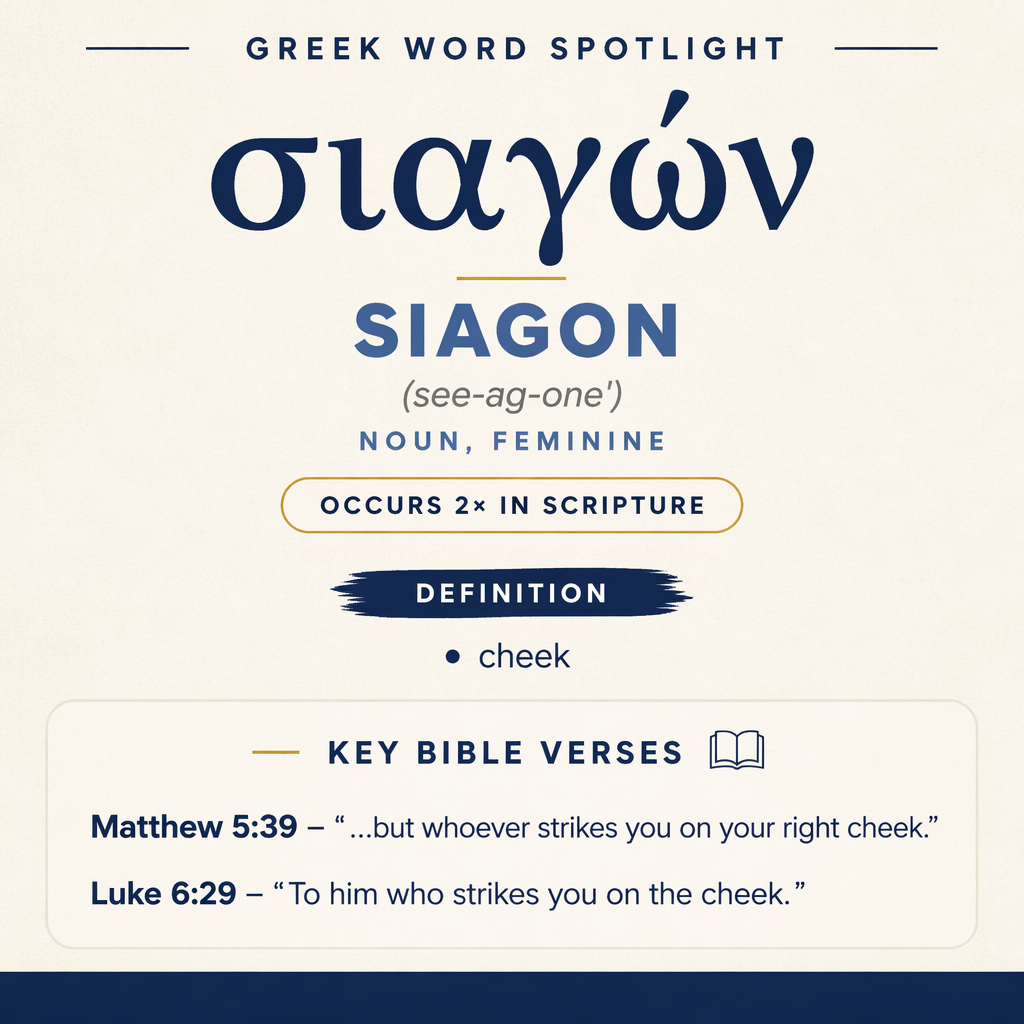
σιαγών means “cheek” and appears twice in Scripture, in Matthew 5:39 and Luke 6:29.
Context of Use
In both verses, it appears in teaching about responding when struck on the cheek by offering the other cheek also.
Learn More →The noun σιαγών refers to the “cheek” and appears in Jesus’ teaching in Matthew and Luke. In both settings it belongs to instructions about responding to being struck.
Occurrences
“But I tell you, don’t resist him who is evil; but whoever strikes you on your right cheek, turn to him the other also.” (Matthew 5:39)
Here σιαγών supplies the concrete point of contact in an act of violence: a strike lands on the “right cheek.” The wording keeps the command from remaining a vague ideal by anchoring it to a specific, bodily insult. A cheek is part of the face, and in this scene the strike is personal and public in a way that a blow to an arm or garment would not be; the instruction addresses an affront that reaches the level of one’s visible identity. The detail “right” also makes the scenario vivid and particular: the teaching is not about abstract injury but about a recognizable kind of slap-like aggression that targets a person’s face.
The command that follows uses the cheek as the locus of the response: “turn to him the other also.” The “other” is understood relative to the cheek already mentioned; σιαγών sets up a deliberate contrast between the cheek that was struck and the cheek that is offered. This puts emphasis on the choice involved. The teaching does not depict passivity as mere endurance; it describes a controlled action (“turn”) that takes the site of the injury and presents the corresponding side. In this way, σιαγών functions as more than a body-part label: it structures the scene into two moments—an initial attack and a subsequent, intentional repositioning—both centered on the face.
“To him who strikes you on the cheek, offer also the other; and from him who takes away your cloak, don’t withhold your coat also.” (Luke 6:29)
Luke’s wording places σιαγών in a paired set of examples. The first is bodily (“strikes you on the cheek”), and the second concerns possessions (“takes away your cloak”). The cheek, as the first example, sets the tone: the instruction begins with an immediate personal assault before moving to material loss. σιαγών therefore marks the kind of harm that cannot be kept at arm’s length; it is close, physical, and directed at the face. The command answers that harm with a corresponding gesture: “offer also the other.” Again the “other” is intelligible only because σιαγών has already located the blow on one side of the face and implies a second cheek available to be offered.
Because Luke explicitly continues with clothing imagery, the cheek episode reads as one instance within a broader pattern of non-retaliatory generosity. The cheek is not interchangeable with the cloak; it is the bodily counterpart to the material example that follows. By choosing the cheek as the illustration of being struck, the saying focuses on a kind of offense that is at once physical and humiliating, then places alongside it the surrender of goods. In that arrangement, σιαγών highlights the personal dimension: what is done to one’s face is met with an “offer,” a word that frames the response as a gift rather than a counterblow.

Sense and Usage
Across these two teachings, σιαγών names the cheek as the immediate target of a strike. The cheek is a small, specific part of the body, and the sayings depend on that specificity. A strike “on your right cheek” is not merely “harm”; it is harm directed at the face. That makes the instruction concrete: it deals with what happens when a person is treated with contempt at close range. The cheek is also an exposed surface; in ordinary experience it is not protected like the torso might be, and it is associated with the recognizable front of a person. The sayings make use of that exposure: the wrong is not distant or hidden, and the response is likewise visible.
The word also carries an inherent bilateral frame. A cheek comes as one of a pair, and both passages rely on that. The sayings do not say “offer yourself again” in general terms; they say “offer also the other.” That phrase presumes the paired structure of the face: one cheek has been struck, and the other cheek can be presented. σιαγών, therefore, makes the response measurable. It depicts not an undefined submission, but a specific second presentation, one that corresponds to the first injury.
In Matthew, the cheek illustration stands within a direct prohibition: “don’t resist him who is evil.” The cheek provides a test case for what that looks like at the sharp end of mistreatment. The scenario presses the teaching into a moment when resistance might be instinctive. The cheek is chosen as the site where the impulse to retaliate would be strongest because the blow is degrading and immediate; the instruction instead directs a deliberate turning. The word σιαγών, by naming where the blow lands, underlines the kind of provocation the teaching addresses.
In Luke, σιαγών functions in a sequence that moves from bodily violence to seizure of clothing. The cheek example is set first, so the saying begins with injury before property. This ordering makes the cheek the opening image of the ethic being taught: what one does when struck becomes the model for what one does when wronged in other ways. Within that progression, σιαγών keeps the focus on an affront that is both painful and shaming, and the response is cast as “offer.” The cheek is thus the point where the instruction converts an attack into an occasion for voluntary giving.
Both occurrences treat the cheek as something that can be “turned” or “offered.” That is, σιαγών is not only a passive object receiving a strike; it becomes the object of an intentional action by the person struck. The sayings imagine the victim as able to act—turning or offering—without denying the reality of the blow. The cheek remains the same physical feature in both moments, but the agency shifts: first, the cheek is acted upon; then, the cheek is presented. This interplay is essential to the imagery, and it is built on the simple concreteness of σιαγών.
Imagery
The cheek, in these passages, carries the imagery of insult at the level of the face and the surprising decision to respond without returning the strike. Matthew’s “right cheek” and both texts’ “the other” focus attention on the visible front of a person and on the turning of the face itself. Luke sets the cheek beside the taking of a cloak, so the image of a face struck and a garment taken becomes a paired picture of wrongs met not with retaliation but with an offered counterpart.
Sources: Lexical data from Strong’s Exhaustive Concordance and the Translators Brief Lexicon of Extended Strongs for Greek (STEPBible, CC BY). Occurrence data from the Translators Amalgamated Greek New Testament (STEPBible, CC BY). Scripture quotations from the World English Bible (public domain).