Exploring the Meaning of Selene in Greek
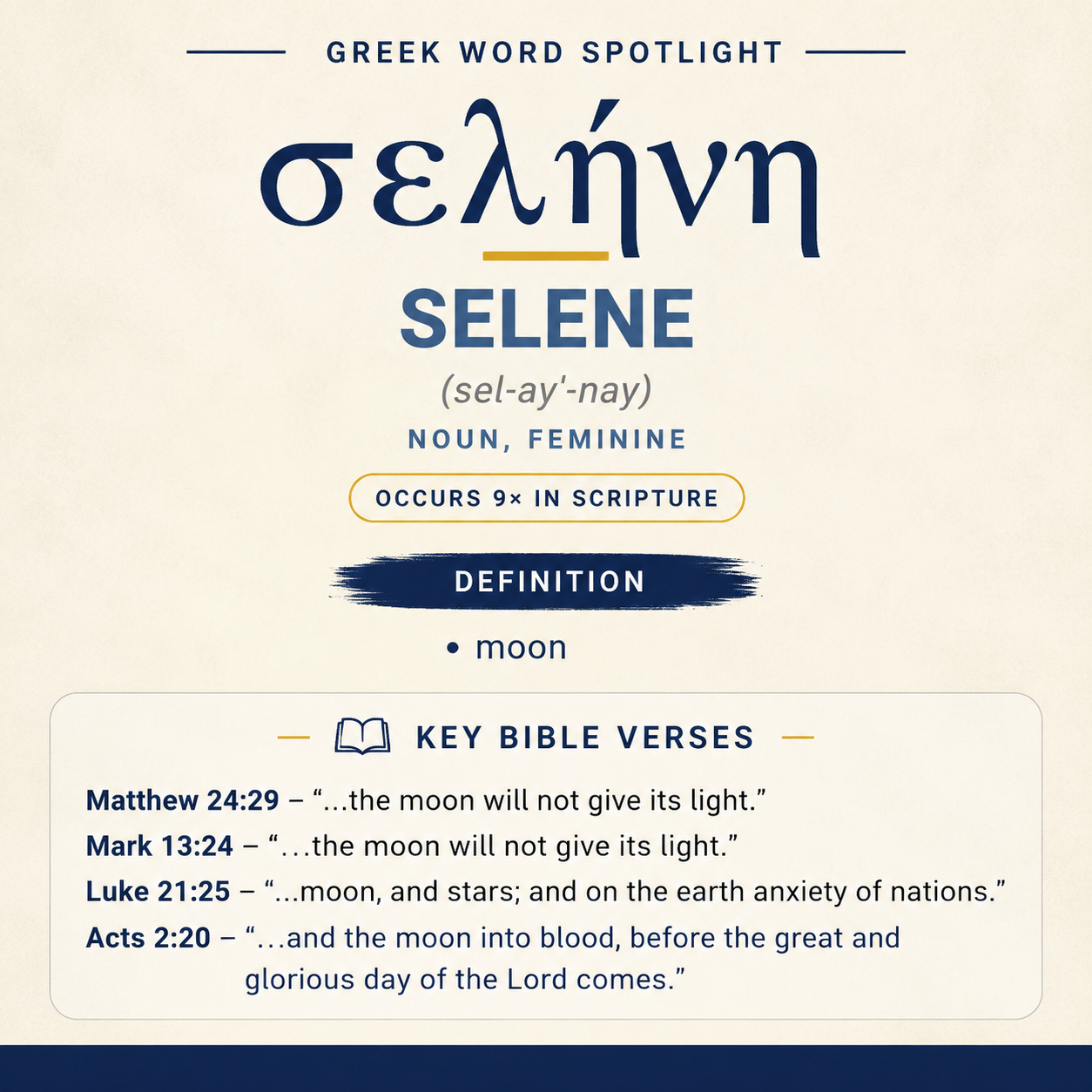
σελήνη means “moon” and appears in Matthew, Mark, Luke, Acts, 1 Corinthians, and Revelation (9 total occurrences).
Prophetic Signs
In Matthew 24:29 and Mark 13:24, the moon does not give its light. Luke 21:25 includes the moon among signs in the heavens, and Acts 2:20 speaks of the moon turned into blood.
Learn More →Revelation Imagery
Revelation 6:12 includes the moon in a sequence of cosmic upheaval. Revelation 8:12 and 12:1 also mention the moon in symbolic visions.
Learn More →σελήνη refers to the moon, the prominent heavenly light seen in the night sky. In the New Testament it appears in sayings about cosmic signs, in prophetic and apocalyptic imagery, and in a comparison of differing kinds of glory.
Occurrences
“But immediately after the suffering of those days, the sun will be darkened, the moon will not give its light, the stars will fall from the sky, and the powers of the heavens will be shaken;” (Matthew 24:29)
Here σελήνη stands alongside “the sun” and “the stars” as part of a coordinated description of upheaval in the heavens. The moon’s usual function—“give its light”—is specifically negated, making its darkness one element in a wider disturbance that includes falling stars and shaken heavenly powers. The wording treats the moon as a familiar, regular source of light whose failure would be unmistakable.
“But in those days, after that oppression, the sun will be darkened, the moon will not give its light,” (Mark 13:24)
Mark presents the same basic image with compressed phrasing: after “that oppression,” both sun and moon fail in their ordinary shining. σελήνη contributes the nocturnal counterpart to the darkened sun, depicting a comprehensive dimming of the sky’s lights rather than an isolated phenomenon.
“There will be signs in the sun, moon, and stars; and on the earth anxiety of nations, in perplexity for the roaring of the sea and the waves;” (Luke 21:25)
Luke uses σελήνη as part of a triad—“sun, moon, and stars”—framing the moon as one of the heavenly bodies that can function as “signs.” The verse links these celestial signs with terrestrial reaction: “anxiety of nations” and “perplexity” amid the sea’s “roaring.” The moon is thus included in a set of visible phenomena that correspond with widespread human disturbance.
“The sun will be turned into darkness, and the moon into blood, before the great and glorious day of the Lord comes.” (Acts 2:20)
In this quotation, σελήνη appears in a stark transformation: “the moon into blood.” The moon is not merely failing to shine; it becomes a sign with altered appearance, paired with the sun’s turning “into darkness.” The timing clause, “before the great and glorious day of the Lord comes,” places the moon’s changed aspect within an eschatological sequence of portents.
“There is one glory of the sun, another glory of the moon, and another glory of the stars; for one star differs from another star in glory.” (1 Corinthians 15:41)
Paul employs σελήνη in a comparative statement about “glory.” The moon’s “glory” is distinguished from that of the sun and of the stars, and even among stars there are differences. In this context the moon serves as an example of a recognizable, distinct kind of radiance within the created order—its brightness is real, yet not identical to the sun’s, and it belongs in a spectrum of differing splendors.
“I saw when he opened the sixth seal, and there was a great earthquake. The sun became black as sackcloth made of hair, and the whole moon became as blood.” (Revelation 6:12)
In the sixth seal scene, σελήνη participates in a cascade of cosmic disturbance that follows the opening of the seal and accompanies “a great earthquake.” The description intensifies the moon’s transformation by adding “the whole moon became as blood,” presenting a total, not partial, alteration. Set against the sun becoming “black,” the moon’s bloodlike appearance contributes to the terror and magnitude of the event.
“The fourth angel sounded, and one third of the sun was struck, and one third of the moon, and one third of the stars; so that one third of them would be darkened, and the day wouldn’t shine for one third of it, and the night in the same way.” (Revelation 8:12)
Here σελήνη is included among the heavenly lights affected by a targeted judgment: “one third of the moon” is struck. The effect is explained as a proportional dimming—“one third of them would be darkened”—with consequences for both “the day” and “the night.” The moon’s role as the night’s chief light is implied by the closing clause, “and the night in the same way”: diminished heavenly light results in diminished nocturnal brightness as well.
“A great sign was seen in heaven: a woman clothed with the sun, and the moon under her feet, and on her head a crown of twelve stars.” (Revelation 12:1)
In this “great sign,” σελήνη functions spatially: “the moon under her feet.” Unlike the earlier passages where the moon is darkened or altered, here it is part of a tableau, positioned beneath the woman, while the sun and stars also appear in relation to her. The moon contributes to the scene’s scale and heavenly setting, grounding the vision in the language of celestial bodies arranged in a striking configuration.
“The city has no need for the sun or moon to shine, for the very glory of God illuminated it, and its lamp is the Lamb.” (Revelation 21:23)
In the description of the city, σελήνη is mentioned to be set aside: the city “has no need for the sun or moon to shine.” The moon is treated as a normal and expected source of light that a city would otherwise rely on. The reason given is that the city is illuminated by “the very glory of God,” and its lamp is “the Lamb,” so the moon’s ordinary function as a light-bearer is rendered unnecessary.

Sense and Usage
Across these passages, σελήνη consistently denotes the moon as a concrete component of the heavens, understood in relation to light and visibility. Several texts highlight the moon’s ordinary contribution as a giver of light—either by directly stating its failure (“the moon will not give its light”) or by treating moonlight as something cities and nights typically “need” (Revelation 21:23; Revelation 8:12). This makes the moon a natural benchmark for describing darkness: when the moon does not shine, nighttime is altered in a way that can be imagined without technical explanation.
At the same time, the moon is repeatedly used as an instrument of “signs” and of apocalyptic display. Luke explicitly calls the phenomena “signs in the sun, moon, and stars,” and Acts and Revelation develop the moon’s appearance as an alarming portent: “the moon into blood” and “the whole moon became as blood.” The shift from “not give its light” to “became as blood” shows two ways the moon functions in prophetic imagery: either by absence of expected illumination or by a startling change in appearance. In both, the moon remains the familiar celestial object; the force of the image depends on recognition of how it normally looks and what it normally does.
Not every use is ominous. In 1 Corinthians, the moon’s “glory” is invoked as a stable point of comparison within a broader argument about differentiated glory. There the moon exemplifies distinctiveness without catastrophe: it has its own splendor, distinguishable from the sun and from the stars. Revelation 12 likewise uses the moon not as a darkened lamp but as a placed element—“under her feet”—within a “great sign… in heaven.” Even in these non-catastrophic settings, the moon’s prominence and recognizability make it effective imagery for scale, order, and distinction.
Imagery
The passages together present the moon as a created light that can be darkened, struck, transformed, positioned, and ultimately surpassed. When the moon “will not give its light,” the heavens are described as shaken; when it becomes “as blood,” the scene is charged with dread; when it is “under her feet,” it contributes to a vast heavenly sign; and when a city has “no need” of it, the moon is implicitly honored as a standard light that is only set aside by a greater illumination.
Sources: Lexical data from Strong’s Exhaustive Concordance and the Translators Brief Lexicon of Extended Strongs for Greek (STEPBible, CC BY). Occurrence data from the Translators Amalgamated Greek New Testament (STEPBible, CC BY). Scripture quotations from the World English Bible (public domain).