
Exploring the Meaning of Seio in Greek
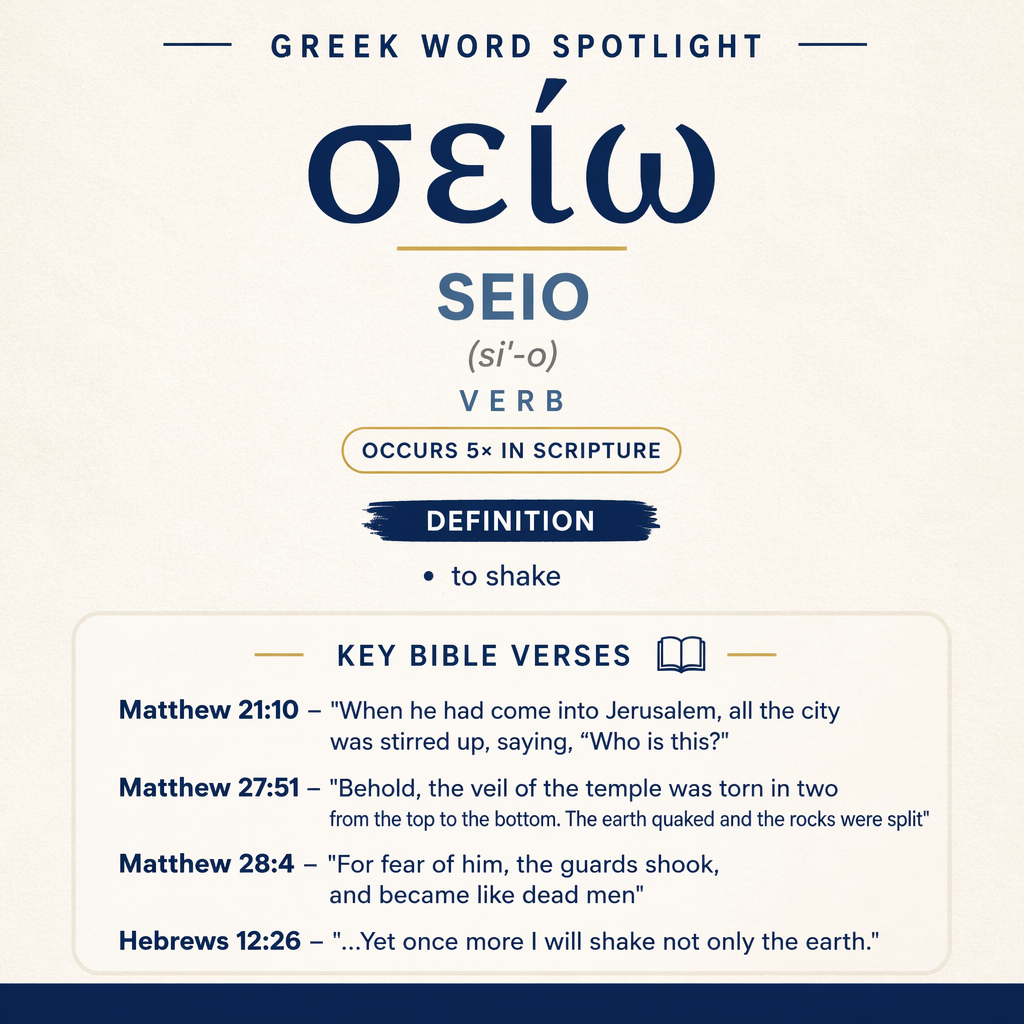
σείω means “to shake” and occurs five times in Scripture (Matthew 21:10; 27:51; 28:4; Hebrews 12:26; Revelation 6:13).
Core Meaning
σείω means “to shake.” In Matthew, it describes both people trembling and the earth quaking.
Learn More →Scripture Occurrences
It appears in Matthew 21:10; 27:51; 28:4; Hebrews 12:26; and Revelation 6:13. The contexts include a city stirred, rocks split, guards shaking, and a fig tree shaken by wind.
Learn More →Shaking Imagery
Hebrews 12:26 uses σείω for God’s voice shaking the earth and a promise to shake again. Revelation 6:13 uses it for a tree shaken so its unripe figs fall.
Learn More →σείω expresses the action “to shake,” appearing in scenes that range from a city’s public agitation to cosmic upheaval. In these passages it marks movement that is forceful enough to disturb people, structures, and the created order itself.
Occurrences
Matthew 21:10: “When he had come into Jerusalem, all the city was stirred up, saying, “Who is this?””
Here the shaking is social rather than geological: the whole city is described as being “stirred up,” and the immediate result is a burst of questioning—“Who is this?” The verb frames Jerusalem as a unified public space thrown into motion by an arrival. The emphasis lies on the breadth (“all the city”) and on the ripple-effect of the disturbance: the shaking shows itself in collective speech and uncertainty, not in physical damage.
Matthew 27:51: “Behold, the veil of the temple was torn in two from the top to the bottom. The earth quaked and the rocks were split.”
In this scene, shaking names a physical convulsion of the earth, paired with visible consequences: rocks are split. The quake stands alongside the tearing of the temple veil, so the verb participates in an account where the environment responds with disruptive motion. The description is concrete and bodily—earth and rocks—so the shaking is not mild vibration but movement capable of fracturing what seems stable.
Matthew 28:4: “For fear of him, the guards shook, and became like dead men.”
The verb shifts from earth and stone to human bodies. The guards’ shaking is directly linked to fear—“For fear of him”—and the outcome is paralysis-like collapse: “became like dead men.” The action of shaking here functions as an outward sign of terror overwhelming control; it is movement produced by dread that ends in stillness, as the guards’ condition is described in deathlike terms.
Hebrews 12:26: “whose voice shook the earth then, but now he has promised, saying, “Yet once more I will shake not only the earth, but also the heavens.””
This occurrence explicitly attributes shaking to a divine voice. The verse contrasts a past shaking of “the earth” with a promised future shaking extending to “not only the earth, but also the heavens.” The verb therefore carries scope: it can describe an event remembered (“shook the earth then”) and an event pledged (“I will shake”). The widening of objects—from earth to earth-and-heavens—presents shaking as an action that reaches beyond the ground beneath human feet into the wider frame of the cosmos.
Revelation 6:13: “The stars of the sky fell to the earth, like a fig tree dropping its unripe figs when it is shaken by a great wind.”
Here shaking appears within a simile that explains startling falling: stars fall “like” unripe figs dropping when a fig tree “is shaken by a great wind.” The verb is applied to the tree, and the comparison highlights a mechanism: shaking produces shedding. The mention of a “great wind” specifies the force that drives the movement, and the image of “unripe figs” underscores sudden, premature loss. The shaking is not an incidental tremor; it is a strong external agitation that strips what is attached.

Sense and Usage
Across these five texts, “to shake” consistently signals destabilization—an action that disturbs a settled state and makes the effects visible. The objects that undergo shaking vary, and that variation shows the verb’s flexibility in describing how disruption plays out in different domains.
In Matthew 21:10, the shaking is experienced at the level of a community. The city’s being “stirred up” is recognizable through shared reaction, especially through questions and unsettled attention. The verb can thus depict a collective agitation without specifying physical trembling; the “shaking” is measured by social motion—voices, inquiries, and the city’s unified sense of disturbance.
In Matthew 27:51, the same verb sits in a plain physical frame: “The earth quaked and the rocks were split.” Shaking is the kind of movement that can fracture and tear, matching the tearing of the veil described just before it. Here the verb evokes the ground itself as responsive and unstable, conveying a shock that reaches into the material world.
Matthew 28:4 demonstrates that shaking can be the body’s involuntary response to fear. The guards shake “for fear,” and the narrative immediately interprets the intensity by stating that they “became like dead men.” In this setting, shaking functions as a threshold experience: it marks the moment where fear breaks composure and leaves the fearful person incapacitated.
Hebrews 12:26 expands the verb’s horizon by anchoring shaking in a voice and by extending the object of shaking beyond the earth to include “the heavens.” The contrast between “then” and “now… promised” also places shaking in time: it can describe remembered action and anticipated action. The emphasis is not on the mechanics of shaking but on its reach and authority—shaking as an effect produced by a commanding utterance.
Revelation 6:13 uses shaking to clarify how a fall can happen: a tree shaken by wind drops what it holds. This is shaking as a cause that leads to release and descent. By selecting a fig tree shedding “unripe figs,” the verse pictures shaking as something that forces an untimely separation—what is attached does not simply loosen; it is driven off by an external force.
Taken together, these passages present shaking as an action that can be social (a city in commotion), geological (earthquake splitting rocks), physiological (fear-induced trembling), cosmic (earth and heavens affected), and illustrative (a wind-shaken tree shedding fruit). The common thread is that shaking exposes instability: it draws attention, produces rupture or collapse, and results in change that observers can register—questions in a city, split rocks, guards rendered like dead men, a promise reaching to the heavens, and a tree’s loss under a great wind.
Imagery
The imagery of σείω in these verses often pairs shaking with what follows from it: agitation leads to questioning (Matthew 21:10), quaking accompanies splitting (Matthew 27:51), trembling leads to stunned immobility (Matthew 28:4), a voice leads to earth-and-heavens being shaken (Hebrews 12:26), and shaking leads to falling (Revelation 6:13). In each case, shaking is not merely movement; it is movement that reveals power by its aftermath.
Sources: Lexical data from Strong’s Exhaustive Concordance and the Translators Brief Lexicon of Extended Strongs for Greek (STEPBible, CC BY). Occurrence data from the Translators Amalgamated Greek New Testament (STEPBible, CC BY). Scripture quotations from the World English Bible (public domain).




