
Exploring the Meaning of Seira in Greek
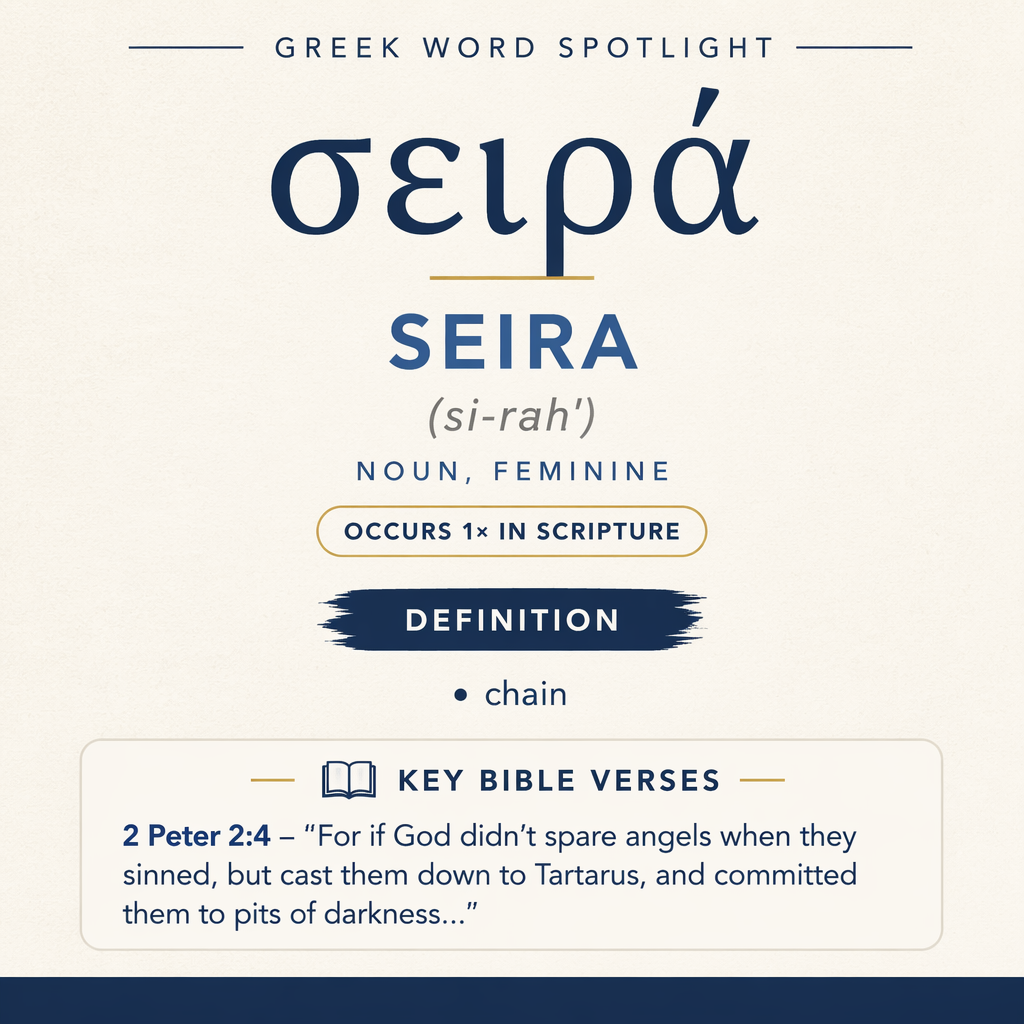
σειρά means “chain” and appears once in Scripture, in 2 Peter 2:4.
Scripture Occurrence
σειρά occurs 1 time in Scripture. Its single occurrence is in 2 Peter 2:4.
Learn More →Context Note
In 2 Peter 2:4, the verse describes God casting sinful angels down to Tartarus. It also mentions committing them to pits of darkness.
Learn More →σειρά refers to a “chain” and is used in a single New Testament setting where God restrains sinful angels for future judgment. The word appears in a description of confinement in darkness, stressing the held, secured condition of those under punishment.
Root and Related Words
σειρά is connected with the verb syro (σύρω), “to drag” (Strong’s G4951). In contexts of restraint, that relationship naturally evokes the idea of being forcibly handled or carried off under compulsion, fitting the scene where offenders are placed under secure custody.

Occurrences
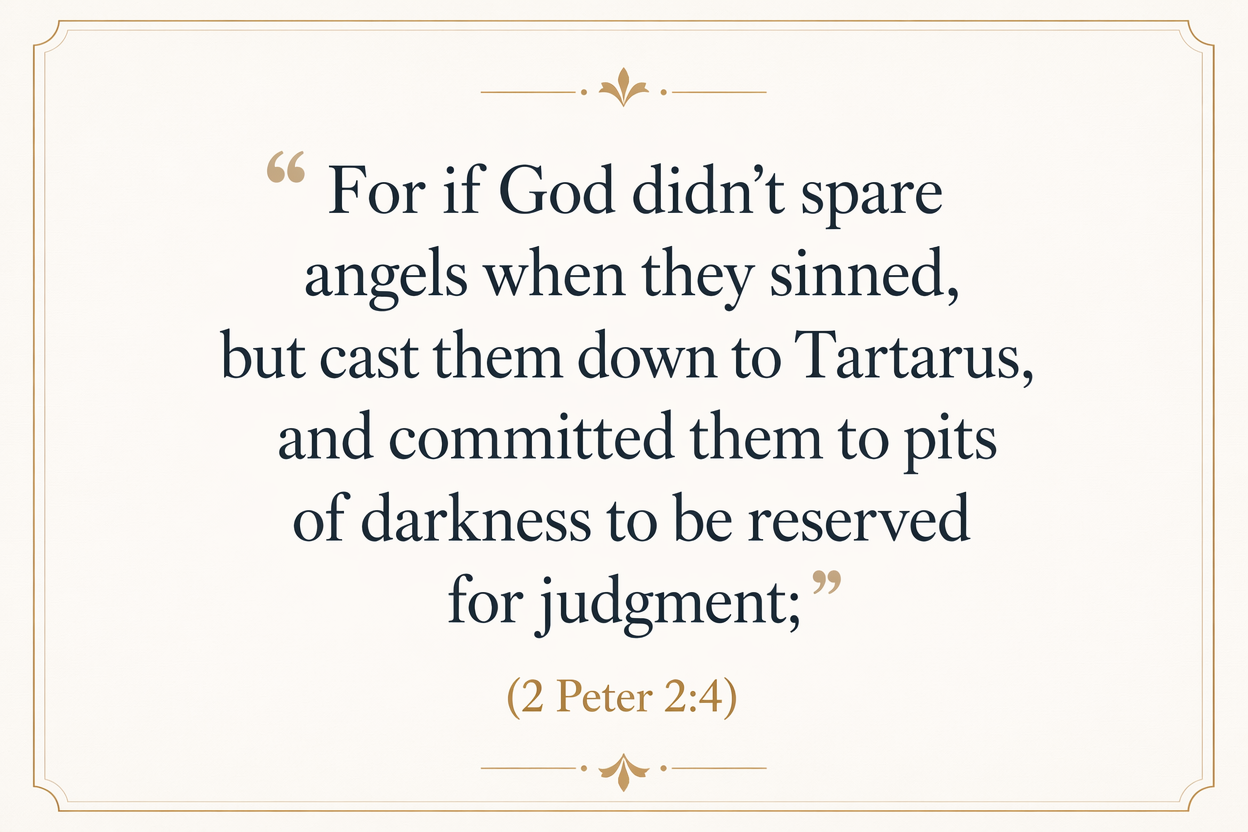
“For if God didn’t spare angels when they sinned, but cast them down to Tartarus, and committed them to pits of darkness to be reserved for judgment;” (2 Peter 2:4)
In this verse, σειρά functions within a tightly packed account of divine action against sin: God “didn’t spare,” “cast them down,” and “committed them” to a place characterized as “pits of darkness,” with a specific purpose clause—“to be reserved for judgment.” The chain imagery contributes to that sequence by sharpening what “committed” entails. The verse is not simply describing a change of location; it is describing a binding custody in which the offenders are placed beyond self-determination.
The immediate setting reinforces the force of this imagery. The beings in view are “angels” who “sinned,” and the response is a decisive confinement: they are “cast…down to Tartarus.” Within that downward movement, the chain concept marks the difference between falling and being held. A fall, even into a punitive realm, could be imagined as momentary or merely spatial; chains depict constraint that continues. The phrase “to be reserved for judgment” points to ongoing duration: restraint is maintained until an appointed judicial outcome. In such a framework, σειρά aligns with the logic of reservation and custody—an enforced holding pattern under darkness until judgment arrives.
The location also matters for the word’s contribution. The angels are committed “to pits of darkness,” an expression that already conveys enclosure, depth, and lack of light. Chains intensify that enclosure: they make the “pits” not just a place they occupy but a state they cannot leave. The darkness is not merely atmospheric; it becomes part of a controlled detention. Within the verse’s rhetoric, the chain imagery supports the author’s argument by presenting divine judgment as both active (“cast…down”) and secure (“committed…to be reserved”).
Sense and Usage
The sense “chain” is concrete, but in this passage it operates as a legal and custodial image rather than an item of everyday equipment. It belongs to the vocabulary of restraint and detention: a chain is the sort of thing that makes a commitment irreversible and a reservation effective. In 2 Peter 2:4, the word serves the verse’s emphasis on control—God’s control over offenders and their future. The syntax moves from offense (“when they sinned”) to sentence (“cast…down”) to secure custody (“committed…to pits of darkness”) to awaited outcome (“reserved for judgment”). The chain idea fits the middle of that progression: it is the mechanism (imagistically) by which reservation is ensured.
Because this is the word’s only occurrence here, its semantic footprint is shaped by this one scene. The chain is not presented as a neutral object; it is bound up with punitive confinement. It belongs to a setting where freedom has been removed in response to wrongdoing. The verse’s diction also distinguishes between God’s immediate act and the future event: the confinement happens now, but it aims at judgment later. Chains, as an image, are particularly suited to that temporal gap. They imply that the present state is not the final act of judgment itself, but a holding under authority until the final adjudication. Thus the word’s force is not merely physical restriction; it is restriction serving a judicial timetable: reserved, kept, held.
The association with syro (σύρω), “to drag,” adds a further shade to the picture without changing the basic meaning. Dragging is action imposed on someone by a stronger agent; it suggests movement under compulsion. Chains are commonly the kind of device by which such compelled movement is effected and by which the compelled person is kept from resisting. In the verse, the angels are acted upon throughout: they are not agents but objects of divine action (“didn’t spare…cast…committed”). The chain image coheres with that grammar of imposed restraint and underscores that the confinement is not self-chosen, temporary, or negotiable.
Imagery
Within 2 Peter 2:4, σειρά carries stark imagery: beings in darkness, held for a coming court. The pits are dark, the custody is deliberate, and the future judgment is certain enough to shape the present confinement. The chain, as part of that picture, conveys restraint that is both severe and orderly—restraint directed toward a final reckoning rather than random destruction.
Sources: Lexical data from Strong’s Exhaustive Concordance and the Translators Brief Lexicon of Extended Strongs for Greek (STEPBible, CC BY). Occurrence data from the Translators Amalgamated Greek New Testament (STEPBible, CC BY). Scripture quotations from the World English Bible (public domain).





