
Exploring the Meaning of Sebasma in Greek
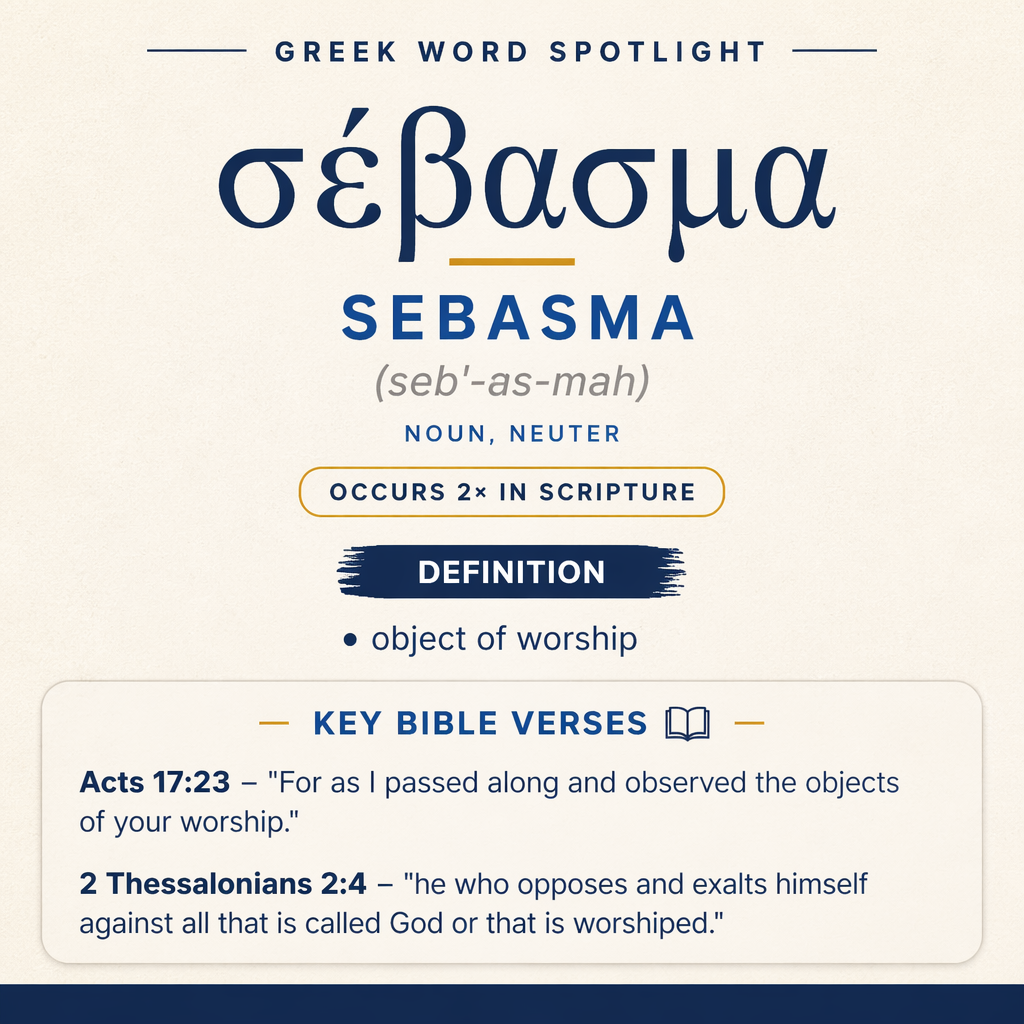
σέβασμα means “object of worship” and appears twice in Scripture, in Acts 17:23 and 2 Thessalonians 2:4.
Scripture Occurrences
It occurs 2 times in Scripture: Acts 17:23 and 2 Thessalonians 2:4.
Learn More →Context Snapshots
In Acts 17:23 it appears in the phrase “objects of your worship.” In 2 Thessalonians 2:4 it appears in “that is worshiped.”
Learn More →σέβασμα refers to an “object of worship,” and it appears in two New Testament settings: Paul’s public address in Athens and a warning about a figure who exalts himself in relation to what people revere. In both places it helps name the concrete focus of religious devotion within the scene being described.
Root and Related Words
σεβάζομαι (sebazomai), “to worship” (Strong’s G4573), stands behind σέβασμα as the related verb, placing the noun in the orbit of reverence expressed as worship directed toward something.

Occurrences
“For as I passed along and observed the objects of your worship, I also found an altar with this inscription: ‘TO AN UNKNOWN GOD.’ What therefore you worship in ignorance, I announce to you.” (Acts 17:23)
In Athens, σέβασμα belongs to Paul’s description of what he has personally “observed” while moving through the city. The term works with the plural phrasing (“the objects of your worship”) to present devotion as something that has visible, identifiable targets—items in the environment that can be noticed, assessed, and even counted as distinct objects. Within the quoted lines, Paul’s observation leads directly to a specific instance: “an altar with this inscription.” The altar functions as an example of such an object, and it anchors the discussion in the public, material setting of the city’s religious life.
The word also supports Paul’s rhetorical movement from observation to proclamation. He begins with what he has seen (“I passed along and observed”), then narrows to what he has found (“I also found an altar”), and then transitions to interpretation: “What therefore you worship in ignorance, I announce to you.” σέβασμα thus serves as a bridge between external evidence and the claim he is about to make. By naming the worship focus as an “object,” the scene highlights that worship is not merely an inner attitude; it is directed toward something that, in this case, is represented by a dedicated altar and an identifying inscription.
Finally, the expression “TO AN UNKNOWN GOD” is placed on the object itself, and Paul treats that inscription as a doorway into speech about the content of their worship: “What therefore you worship in ignorance.” Without turning the scene into an inventory of Athenian religion, σέβασμα keeps attention on the fact that the city’s devotion has tangible focal points. Paul’s announcement is framed as addressing what their worship already points toward, even while he characterizes it as “in ignorance.”
“he who opposes and exalts himself against all that is called God or that is worshiped, so that he sits as God in the temple of God, setting himself up as God.” (2 Thessalonians 2:4)
In 2 Thessalonians, σέβασμα appears in a more compressed and confrontational description: it is paired with “all that is called God” as one of the categories against which the described person “opposes and exalts himself.” Here the word does not point to an altar in the street but to whatever people treat as worthy of worship. The phrase “all that is … worshiped” casts a wide net, presenting σέβασμα as a label for the range of worship-targets recognized in the community’s world—objects that draw reverence, whether that reverence is properly directed or not.
The immediate function of the term is to intensify the scope of the arrogance being depicted. The person is not said to challenge one specific object; he exalts himself “against all” that falls into the categories named. By coupling what is “called God” with what is “worshiped,” the verse sketches a field of rivals—anything that bears divine naming or receives divine-like reverence. σέβασμα marks one side of that field: the things that occupy the role of worship’s object.

The remainder of the verse moves from opposition to imitation and usurpation: “so that he sits as God in the temple of God, setting himself up as God.” In that progression, σέβασμα helps set the stage for the climax. If worship has objects—targets of reverence—this figure aims to displace them by placing himself where such reverence would culminate. The phrase “in the temple of God” introduces a specific setting, and the repeated “as God” language underscores the attempted substitution. σέβασμα, within this argument, belongs to a warning about the reorientation of worship: from accepted objects of reverence to a self-installed object.
Sense and Usage
Across these two passages, σέβασμα functions as a concrete descriptor for the target or focus of worship. In Acts 17:23 it appears in a context that foregrounds visibility and public presence: worship has “objects” that can be “observed,” and the discussion can proceed from the physical existence of an altar to the question of what, in fact, is being worshiped. The noun’s value in that scene lies in how it lets Paul speak about devotion as directed toward identifiable things in the city’s religious landscape, culminating in his mention of an altar and its inscription.
In 2 Thessalonians 2:4, the same noun is deployed in a more abstract, sweeping way: it is not tied to one visible item but to the entire category of what receives worship. Yet even there it still carries the force of “object”—that is, worship is portrayed as having a definable object that can be opposed, displaced, or claimed. The verse’s logic assumes that worship is oriented: people direct reverence toward something, and the described opponent seeks to elevate himself over every such thing.
Taken together, these uses show σέβασμα working on two levels without changing its basic reference. It can point to worship’s tangible expressions in the built environment (as in an altar that can be found and read), and it can also summarize the class of all worship-recipients that people recognize. In both cases the noun helps describe worship not merely as an activity but as a relationship between worshipers and a particular focus—an “object” that stands at the receiving end of reverence.
Because σέβασμα is placed in contexts of evaluation and warning, it also has rhetorical weight. In Acts 17:23 it supports a move from observation to announcement: the “objects” become evidence within an argument. In 2 Thessalonians 2:4 it supports a warning by defining the scale of what the arrogant figure contests: not a single rival, but everything that functions as an object of worship.
Imagery
The imagery attached to σέβασμα in these passages is dominated by the idea that worship takes shape around a focus that can be pointed to. In Acts 17:23 that focus is pictured on the street in the form of an altar bearing an inscription, an object that can be encountered in passing and then brought into speech. In 2 Thessalonians 2:4 the imagery shifts to the temple setting and the audacity of someone who would place himself where worship’s object belongs, elevating himself over everything that receives reverence and “setting himself up as God.”
Sources: Lexical data from Strong’s Exhaustive Concordance and the Translators Brief Lexicon of Extended Strongs for Greek (STEPBible, CC BY). Occurrence data from the Translators Amalgamated Greek New Testament (STEPBible, CC BY). Scripture quotations from the World English Bible (public domain).





