Exploring the Meaning of Samothrake in Greek
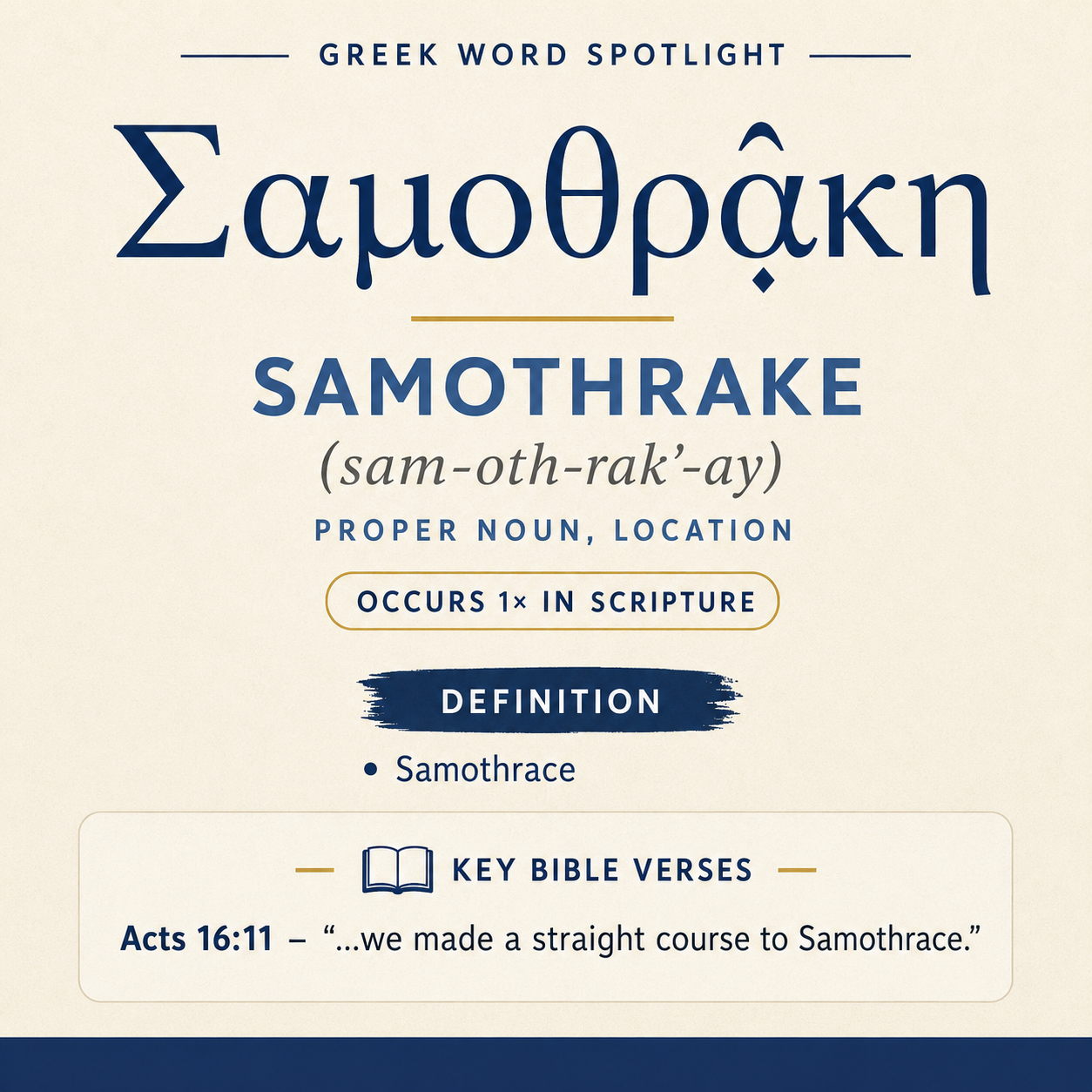
Σαμοθρᾴκη means Samothrace and appears in Acts 16:11 during Paul’s voyage from Troas toward Neapolis.
Narrative Setting
In Acts 16:11, the travelers sail from Troas and make a straight course to Samothrace.
Learn More →Σαμοθρᾴκη means “Samothrace” and appears in the travel narrative of Acts 16. In that single mention it marks a specific stop in a sea voyage described with brisk, itinerary-like precision.
Root and Related Words
Samothrake is related to Samos (Σάμος), “Samos” (transliteration: Samos; Strong’s G4544).

Occurrences
“Setting sail therefore from Troas, we made a straight course to Samothrace, and the day following to Neapolis;” (Acts 16:11)
Here Σαμοθρᾴκη functions as a place-name within a sequence of departures and arrivals. The sentence is shaped by movement: “Setting sail… from Troas,” then a direct passage, then another destination “the day following.” Within that rhythm, “Samothrace” anchors the midpoint between the initial embarkation and the next day’s progress. It is not presented as a topic of extended description but as a concrete waypoint that helps the reader track the party’s route and timing.
The verse also highlights manner and tempo. The phrasing “we made a straight course to Samothrace” portrays the leg to Σαμοθρᾴκη as a direct run rather than a wandering coastal hop, and the quick transition “and the day following to Neapolis” places Samothrace in the narrative as the first stage of an efficient crossing. The name’s contribution, then, is geographical specificity: it marks where the “straight course” lands before the next day’s onward movement.
Because the clause is cast in first-person plural (“we made a straight course”), Σαμοθρᾴκη also sits inside a lived itinerary rather than a detached report. The name is part of what makes the travel notice feel measurable: a ship leaves one known point (“Troas”), reaches Σαμοθρᾴκη by a direct run, and proceeds to another named landing (“Neapolis”) on the next day. In this compressed travel note, Samothrace is the named point that divides the voyage into distinct segments.
Sense and Usage
As “Samothrace,” Σαμοθρᾴκη is used as a straightforward geographic designation. The surrounding syntax treats it as a destination governed by the motion of sailing: the travelers “made a straight course to” it. That usage places the name in a common narrative role for locations in travel accounts: a point reached by deliberate movement, serving as a marker that organizes the story’s spatial and temporal flow.
The verse sets Σαμοθρᾴκη alongside other toponyms in a tightly linked chain: “from Troas… to Samothrace… to Neapolis.” This chaining gives the name its narrative weight. It is less a setting for events than a coordinate in a route, and its primary force is to make the movement legible—where the group went, in what order, and with what pace (“the day following”). In that way Σαμοθρᾴκη works as an index of progress: it signals that the party has successfully embarked from one port and is already advancing toward the next stage.
The collocation “straight course” particularly frames the sense in which the name is heard. It suggests purposeful travel in a defined direction, and Σαμοθρᾴκη is the endpoint of that purposeful line for the first day’s sailing. Within the verse’s compact itinerary, the name helps the reader feel the structure of the journey: departure, direct passage, intermediate stop, then continued travel after a night’s interval implied by “the day following.”
Imagery and Setting
Acts 16:11 evokes maritime motion more than local scenery: a vessel setting sail from Troas, running directly to Σαμοθρᾴκη, and then continuing the next day. The imagery carried by the name is therefore that of a visible landfall after a “straight course”—a destination that punctuates open-water travel and signals the next step in a swift, sequential journey.
Sources: Lexical data from Strong’s Exhaustive Concordance and the Translators Brief Lexicon of Extended Strongs for Greek (STEPBible, CC BY). Occurrence data from the Translators Amalgamated Greek New Testament (STEPBible, CC BY). Scripture quotations from the World English Bible (public domain).