
Exploring the Meaning of Sagene in Greek
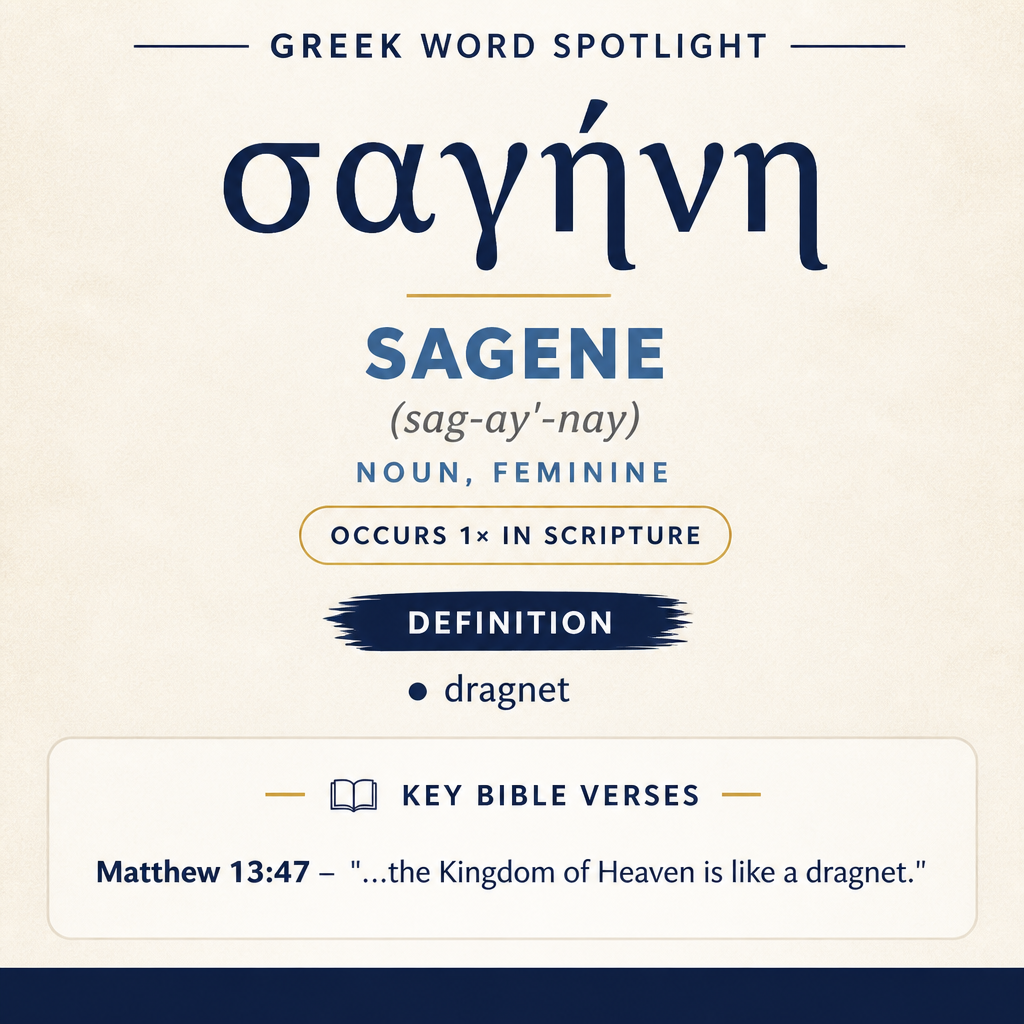
σαγήνη means “dragnet” and appears once in Scripture, in Matthew 13:47.
Parable Context
In Matthew 13:47, a dragnet is cast into the sea and gathers fish of every kind.
Learn More →σαγήνη refers to a “dragnet,” and it appears in the parable imagery of Matthew 13:47. There it serves as the central comparison for how the Kingdom of Heaven is pictured in relation to what is taken in from the sea.
Occurrences
“Again, the Kingdom of Heaven is like a dragnet, that was cast into the sea, and gathered some fish of every kind,” (Matthew 13:47)
In this sentence the dragnet is the controlling image by which the Kingdom of Heaven is compared (“is like a dragnet”). The scene is explicitly maritime: the net “was cast into the sea,” and its action is defined by what follows—its capacity to “gathered some fish of every kind.” The word therefore contributes a picture of an instrument whose defining feature, in the logic of the comparison, is its gathering function once it enters the water. The net is not merely present in the background; it is the means by which a wide assortment is collected from the same environment (“the sea”) into one take. The phrase “of every kind” is anchored to what the dragnet has gathered, so the word carries the idea of a single collecting implement producing a mixed catch.

Sense and Usage
The definition “dragnet” situates σαγήνη as a specific kind of net, and the lone occurrence supplies enough narrative detail to show how the term works in discourse. A dragnet, in this parable statement, is characterized by three linked movements: (1) it is “cast” (placed decisively into the sea), (2) it gathers, and (3) the gathering reaches broadly enough to include fish “of every kind.” The word’s sense is therefore activated not by description of its materials or construction, but by its role as a collecting device whose effectiveness is visible in the diversity of what it brings together.
The comparison is framed as a fresh restatement (“Again”), and σαγήνη is introduced as the key noun that carries the analogy forward. By placing the dragnet at the center—rather than the fishermen, the shoreline, or any later processing—the saying focuses attention on the net as an inclusive gathering mechanism. The sea is the setting from which the net gathers; the fish are the result of the net’s action; and the phrase “of every kind” interprets the breadth of that action. In this way, the definition “dragnet” is not merely a label but a functional image: what matters in the verse is what a dragnet does when it is cast, and what sort of catch it yields.
The immediate wording also suggests a single event with an accumulating outcome: once cast, the net “gathered” fish, and the gathering is described in comprehensive terms. This gives σαγήνη a conceptual weight beyond an incidental fishing tool; it becomes a picture of collection that is large enough to represent a kingdom reality. The term therefore conveys, within the parable’s logic, the idea of an all-encompassing sweep that results in a gathered mixture, rather than a targeted selection at the point of capture.
Imagery
Because σαγήνη is placed into a direct comparison with “the Kingdom of Heaven,” its imagery is meant to be grasped quickly: a net thrown into open water and drawing in a wide variety of fish. The verse paints the dragnet’s impact in a single clause—cast into the sea, gathering a diverse catch—and that compact picture supplies the force of the illustration. The dragnet image thus carries an ordinary, concrete realism (sea, net, fish) that supports a larger point through the simple visibility of gathering many kinds together.
Sources: Lexical data from Strong’s Exhaustive Concordance and the Translators Brief Lexicon of Extended Strongs for Greek (STEPBible, CC BY). Occurrence data from the Translators Amalgamated Greek New Testament (STEPBible, CC BY). Scripture quotations from the World English Bible (public domain).




