Exploring the Meaning of Rhesa in Greek
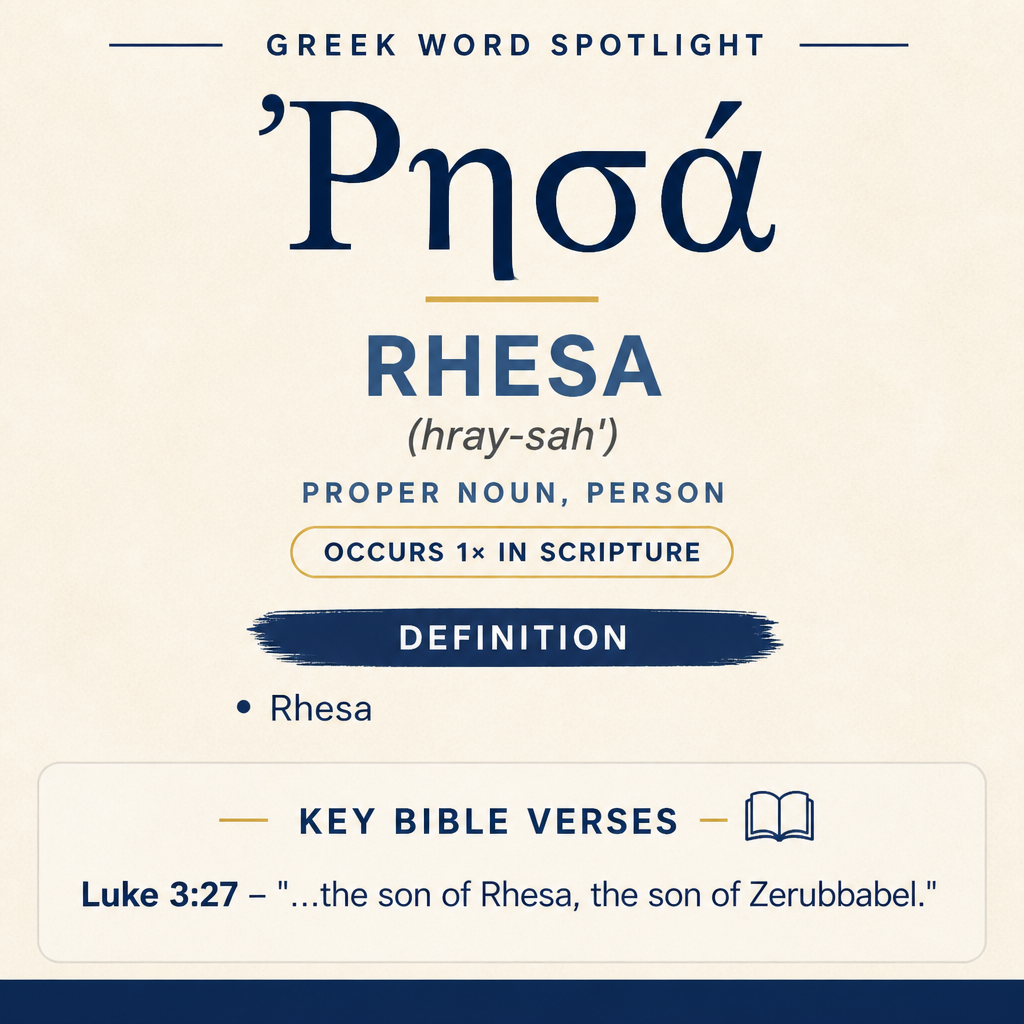
Ῥησά (Rhesa) means “Rhesa” and appears in Luke 3:27 within Jesus’ genealogy.
Genealogy Context
In Luke 3:27, Rhesa is listed as the son of Joanan and the father of Zerubbabel.
Learn More →Ῥησά means “Rhesa” and appears within a genealogical sequence in Luke. In that list it serves as a personal name that marks one link in a chain of descent.
Occurrences
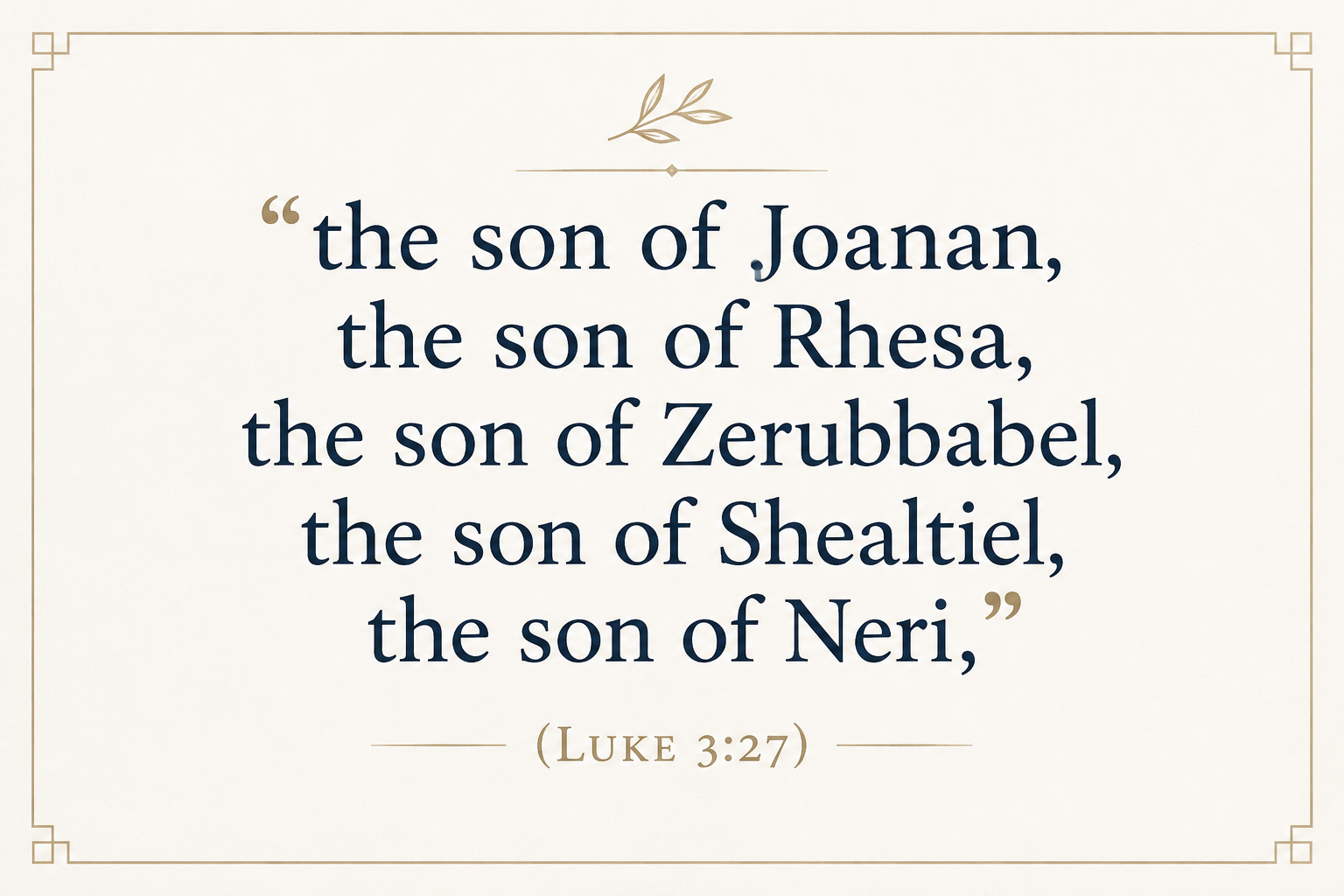
“the son of Joanan, the son of Rhesa, the son of Zerubbabel, the son of Shealtiel, the son of Neri,” (Luke 3:27)
Here Ῥησά functions as a single node in a tightly structured lineage. The repeated phrasing “the son of …, the son of …” gives the line its cadence and logic, and “Rhesa” anchors one step in that sequence: Joanan is placed in relation to Rhesa, and Rhesa in relation to Zerubbabel. Because each name is introduced in the same way, the force of Ῥησά is not descriptive but identificatory: it identifies which “son of” relationship is being traced at this point in the list, allowing the reader to follow the succession from Joanan backward through Rhesa to Zerubbabel, Shealtiel, and Neri. The name therefore carries the weight of continuity—without adding narrative detail, it keeps the chain intact by naming the person through whom the lineage passes at this precise juncture.

Sense and Usage
As a proper name, Ῥησά (“Rhesa”) is used to designate an individual rather than to describe a quality, role, or action. In Luke 3:27 it appears in a form that is governed by the surrounding kinship formula. The line does not present “Rhesa” in isolation; it embeds the name between two other names under the recurring relationship marker “the son of.” That placement gives the name a relational profile: Rhesa is defined in the text by being the referent of Joanan’s “son of” relationship and by standing as the one who is himself “the son of Zerubbabel.” The name’s contribution is therefore to specify identity within a sequence of ancestry, preserving a particular link that the genealogy intends to record.
The immediate context also shows how the genealogy uses names as connective points rather than as miniature biographies. The verse segment quoted supplies no personal deeds, locations, or titles for Rhesa; instead, it uses the name to maintain a consistent pattern of descent. This uniformity matters for how a reader processes the list. Each name functions like a hinge between two generational statements, and Ῥησά is one such hinge. The reader’s attention is guided away from individual characterization and toward ordered succession: one person is connected to the next by the same succinct expression. Within that pattern, the appearance of Ῥησά is part of the genealogy’s precision. It keeps the chain from collapsing into vagueness by naming a distinct person at a distinct step, even when the text offers no additional narrative frame for that individual.
Because the surrounding clause names several people in a single breath—Joanan, Rhesa, Zerubbabel, Shealtiel, Neri—the name Ῥησά also participates in the genealogy’s compression. The list proceeds by quick enumeration, and the name’s role is to be immediately intelligible as a personal identifier that readers can place in sequence. In other words, its “meaning” in use is not something the text explains through a description; it is carried by the function of naming itself, by which the lineage is tracked accurately from one generation to the next.
The structure of Luke 3:27 further suggests a particular kind of reading: the reader is meant to move through the names as parts of a whole rather than pausing on each as an independent unit. In that flow, Ῥησά marks one transition point. It draws a boundary between “the son of Joanan” and “the son of Zerubbabel,” showing that the list is not merely a set of associated names but a chain in which each relationship is mediated by a named person. Thus the usage of Ῥησά is tightly bound to the genealogical formula: the name is placed where it can do its work of linkage, ensuring that the sequence of descent remains explicit.
Imagery
The verse offers the imagery of lineage conveyed through a simple, repeated family relation. In Luke 3:27, “Rhesa” stands within a spoken pattern that evokes a continuous line of descent—each name connected to the next by “the son of.” The picture is not of a single scene or event but of an ordered succession, with Ῥησά occupying one necessary place in that progression.
Sources: Lexical data from Strong’s Exhaustive Concordance and the Translators Brief Lexicon of Extended Strongs for Greek (STEPBible, CC BY). Occurrence data from the Translators Amalgamated Greek New Testament (STEPBible, CC BY). Scripture quotations from the World English Bible (public domain).