Exploring the Meaning of Rhaphis in Greek
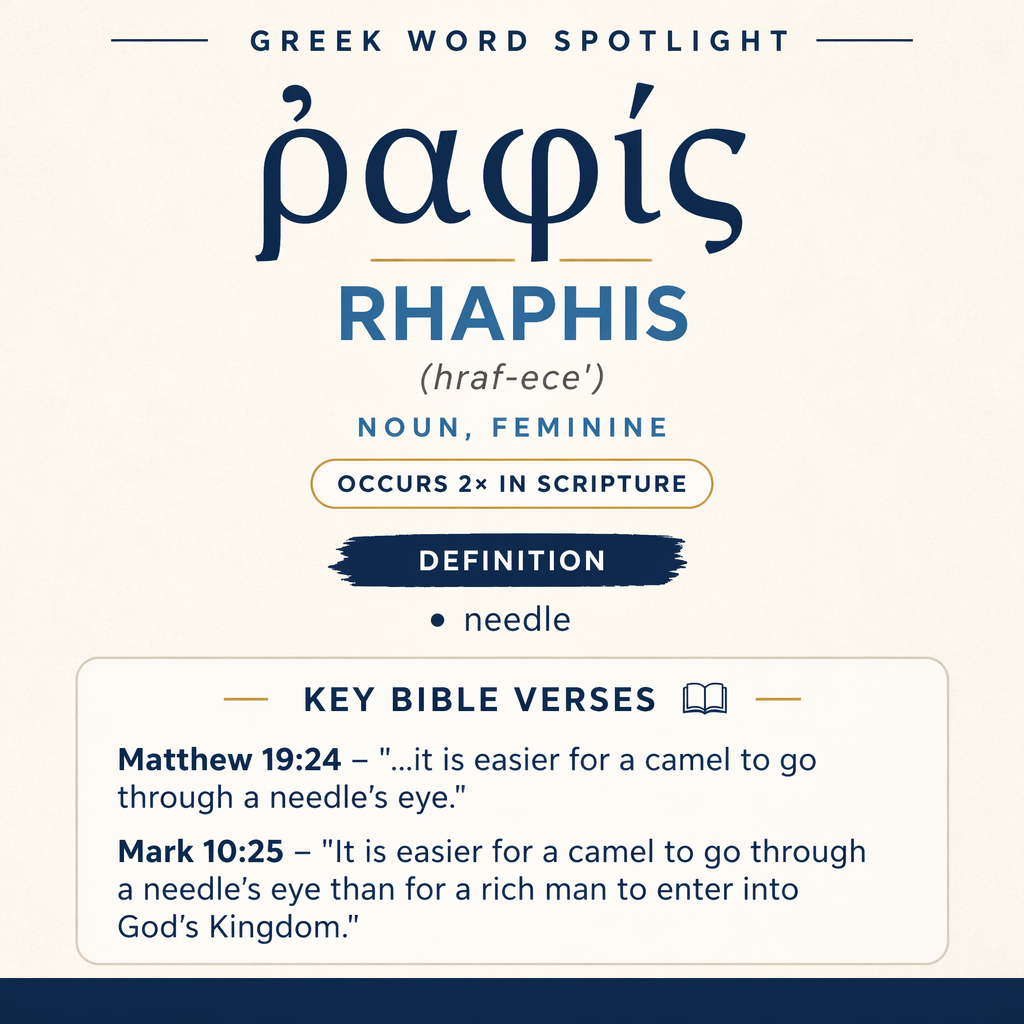
ῥαφίς (Rhaphis) means “needle” and appears twice in Scripture, in Matthew 19:24 and Mark 10:25.
Gospel Illustration
In both verses, it appears in the phrase “needle’s eye” within a comparison involving a camel and a rich man entering God’s Kingdom.
Learn More →ῥαφίς refers to a “needle” and appears in two Gospel sayings that compare entry into God’s Kingdom with an intentionally impossible-sounding action. In both places, the word anchors a vivid picture of extreme restriction: a “needle’s eye.”
Occurrences
“Again I tell you, it is easier for a camel to go through a needle’s eye, than for a rich man to enter into God’s Kingdom.” (Matthew 19:24)
Here ῥαφίς occurs inside the fixed image “a needle’s eye,” where the needle is treated as a real, familiar object with a tiny opening. The comparison is shaped by two movements: “to go through” on the one hand, and “to enter into God’s Kingdom” on the other. By invoking a needle, the saying selects an object whose “eye” is associated with a narrow passage, and the needle’s eye becomes the measure of what “easier” looks like in the comparison. The phrase does not merely add color; it supplies the concrete standard by which the statement’s force is felt. A camel is placed against the needle’s eye as an outsized body set against an extremely small opening, making “easier” function rhetorically as an intensifier: the first scenario is presented as the less difficult one. In the logic of the sentence, the needle’s eye is the extreme limit of “through,” and thus it sharpens the point about the “rich man” and “God’s Kingdom” by contrast, placing the kingdom-entry clause in the category of what is being pressed beyond ordinary human expectation.
“It is easier for a camel to go through a needle’s eye than for a rich man to enter into God’s Kingdom.” (Mark 10:25)
This occurrence presents the same core image with a slightly different framing: instead of “Again I tell you,” the saying is stated directly as a general truth. ῥαφίς again appears as the object that defines the constriction implied by “a needle’s eye,” and the sentence again balances two infinitive-like actions: “to go through” and “to enter.” The needle, by virtue of its “eye,” brings the listener’s attention to a point-sized opening that must be negotiated, and the phrase “go through” invites mental visualization of an attempt to pass from one side to the other. The needle’s eye functions as a physical bottleneck, and the comparison uses that bottleneck to frame the second clause (“for a rich man to enter into God’s Kingdom”) as the more difficult side of the comparison. Because the needle is a mundane object, the picture does not depend on specialized knowledge: the ordinary scale of a needle’s eye is enough to establish the sense of impossibility that drives the proverb-like statement.

Sense and Usage
Across these two sayings, ῥαφίς is not used in isolation but in a possessive construction, “a needle’s eye.” The “needle” is therefore present in the scene primarily as the owner of an “eye,” that is, as the object whose defining feature in this context is an opening so small that it becomes a standard image for extreme narrowness. The definition “needle” is enacted concretely: the word points to an everyday tool whose size and function make its eye an apt reference-point for restriction. The sayings rely on what a needle is like in normal experience—small, precise, and associated with a tiny aperture—without requiring additional explanation within the text. In other words, ῥαφίς contributes not by elaborating what a needle does, but by supplying a scaled-down frame of reference against which the rest of the comparison can be measured.
The immediate collocation “needle’s eye” also shows how the term is used to create a spatial metaphor. Both verses hinge on verbs of motion and entry: “to go through” and “to enter into.” A needle’s eye is naturally conceptualized as a passageway, but a passageway of vanishingly small proportions; the phrase compresses space to a minimum. Because the first clause imagines something enormous attempting to pass through something minute (“a camel” through “a needle’s eye”), the needle becomes the instrument by which the saying calibrates “easier.” The hearer is led to assess the second clause (“for a rich man to enter into God’s Kingdom”) not by argument, but by the felt force of the image. Thus, within these occurrences, the semantic contribution of ῥαφίς is bound up with scale: it calls up a small object whose eye serves as an emblem of the narrowest conceivable opening.
These texts also show that ῥαφίς can carry its weight even when the narrative provides no surrounding description of the object itself. The term is able to do this precisely because it is placed in a highly picturable phrase. The needle is not introduced as a new topic; it is employed as a shared point of reference. In both Matthew 19:24 and Mark 10:25, the focus of the statement is the relative difficulty of “enter[ing] into God’s Kingdom” for “a rich man,” yet the needle is the chosen vehicle for expressing that difficulty. The word therefore participates in a rhetorical strategy: it takes something small and familiar and places it beside something large (“camel”) to intensify the contrast and to frame kingdom-entry as surpassing ordinary human expectation.
Imagery
In these two sayings, ῥαφίς evokes a tightly focused visual field: the tiny “eye” of a needle, imagined as an opening to be passed through. That image is then set against a camel, producing a stark disproportion that makes the comparison memorable. The needle’s eye becomes a kind of boundary-marker in the imagination—an extreme point of narrowness—so that the statement about entering God’s Kingdom is heard against the background of an action that strains the limits of what “through” can mean.
Sources: Lexical data from Strong’s Exhaustive Concordance and the Translators Brief Lexicon of Extended Strongs for Greek (STEPBible, CC BY). Occurrence data from the Translators Amalgamated Greek New Testament (STEPBible, CC BY). Scripture quotations from the World English Bible (public domain).