Exploring the Meaning of Rheo in Greek
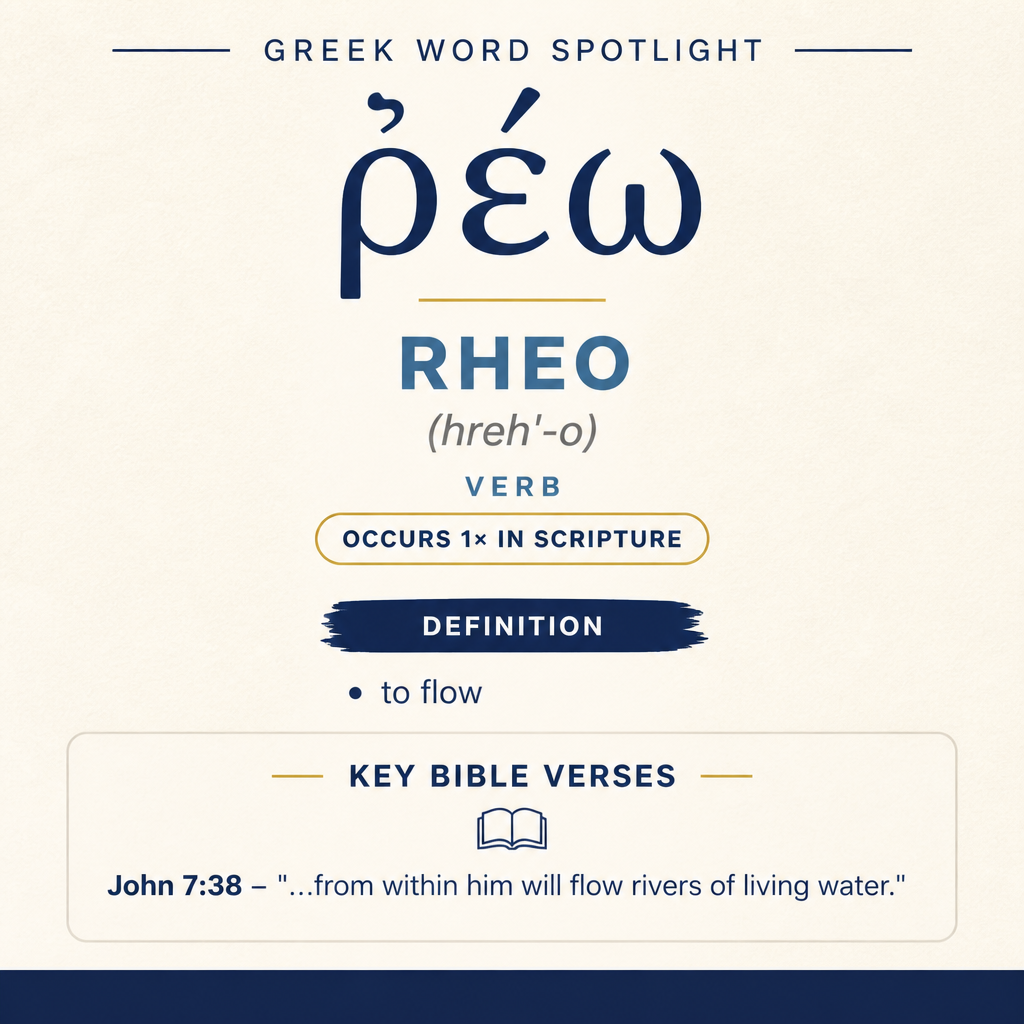
ῥέω means “to flow” and appears once in Scripture, in John 7:38.
Scripture Occurrence
This verb occurs 1 time in Scripture. Its single occurrence is in John 7:38.
Learn More →Context in John
In John 7:38, it describes “rivers of living water” flowing from within the believer.
Learn More →ῥέω expresses the action of flowing, and it appears in Jesus’ saying about “rivers of living water” issuing from within the believer. In its lone New Testament attestation, it carries vivid movement imagery that turns an inner reality into an outward, ongoing outpouring.
Occurrences
“He who believes in me, as the Scripture has said, from within him will flow rivers of living water.” (John 7:38)
In this sentence, ῥέω supplies the key dynamic verb that makes the picture work: the “rivers of living water” are not merely present, offered, or promised in the abstract; they are pictured as actually moving. The direction is explicit—“from within him”—so the verb frames an origin point inside the believer and an outward movement from that interior source. The plural “rivers” intensifies the image, and ῥέω is the verbal hinge that turns that plurality into something active rather than static. The statement also connects the act of believing (“He who believes in me”) with the consequence that “will flow”; ῥέω therefore marks the result as something that proceeds from faith in Jesus and is expressed as continual motion rather than a one-time event.

The wording “will flow” places the action in the future relative to the moment of speaking, projecting a coming outflow that will be characteristic of “he who believes.” The imagery is not of a single trickle but of “rivers,” and ῥέω holds together the sense of sustained movement implied by river language: rivers are defined by ongoing flow, not by being stored or contained. By choosing a verb of flowing, the saying frames “living water” in terms of a visible, tangible process—water that moves—so the focus falls on the active issuing of what is “living,” rather than on the container or the channel. The phrase “as the Scripture has said” sets the claim within the authority of Scripture, and the verb ῥέω stands at the center of what Scripture is taken to support: the expected pattern is an interior source producing an outward flow.

Sense and Usage
The basic sense “to flow” naturally evokes the movement of liquid, and in John 7:38 it is applied to “rivers of living water.” The noun phrase already supplies the liquid picture; ῥέω does the work of portraying that picture as an action. Because the subject of the flowing is “rivers of living water,” the verb is not describing a person’s movement but the movement of something pictured as water. This allows the saying to speak about an inner spiritual reality in the language of physical motion: what is within becomes something that streams outward. The result is an image of outflow that is both sourced (“from within him”) and abundant (“rivers”).
In this usage, the verb also shapes how the reader hears the relation between “within” and “flow.” “Within” could suggest hiddenness or containment, but ῥέω insists on emergence: whatever is within does not remain sealed up. The prepositional phrase fixes the origin point, and the verb portrays the transition from internal to external. The image is therefore not simply that the believer has access to water or possesses water, but that water moves outward from the believer as from a spring-fed river system. Even without adding details beyond the sentence, the verb of flowing implies a directional, continuous action rather than a single momentary transfer.
The immediate phrasing also lets ῥέω carry an implication of vitality through its object, “living water.” The verb itself means “to flow,” but when paired with “living water,” it portrays water as active and life-like—water that does what water in motion does. In everyday experience, water that flows is fresh and in motion, and the saying harnesses that ordinary perception to make “living water” feel experiential rather than merely conceptual. The verb thus strengthens the metaphor by insisting on motion: “living” is heard not only as a quality but as something expressed in what the water does—flowing as rivers.
Grammatically, the form “will flow” presents the action as certain and consequential, linked to the condition “He who believes in me.” The clause structure (“He who believes … will flow …”) makes the flowing the marked outcome of believing. That outcome is not described with a verb of speaking, thinking, or possessing, but with a verb of physical movement. The choice of ῥέω therefore frames the promise as something that proceeds from the believer in a way that can be imagined: an ongoing outflow from an inner source, pictured as multiple rivers.
Imagery
John 7:38 uses ῥέω to turn “living water” into a scene of interior-to-exterior movement: “from within him will flow rivers of living water.” The verb invites the reader to picture a human life as the place from which a river system emerges—water not pooled and guarded, but streaming outward in abundance. By anchoring the promise in the action of flowing, the saying presents the believer not as the endpoint of “living water” but as the point from which it goes forth.
Sources: Lexical data from Strong’s Exhaustive Concordance and the Translators Brief Lexicon of Extended Strongs for Greek (STEPBible, CC BY). Occurrence data from the Translators Amalgamated Greek New Testament (STEPBible, CC BY). Scripture quotations from the World English Bible (public domain).