Exploring the Meaning of Puroo in Greek
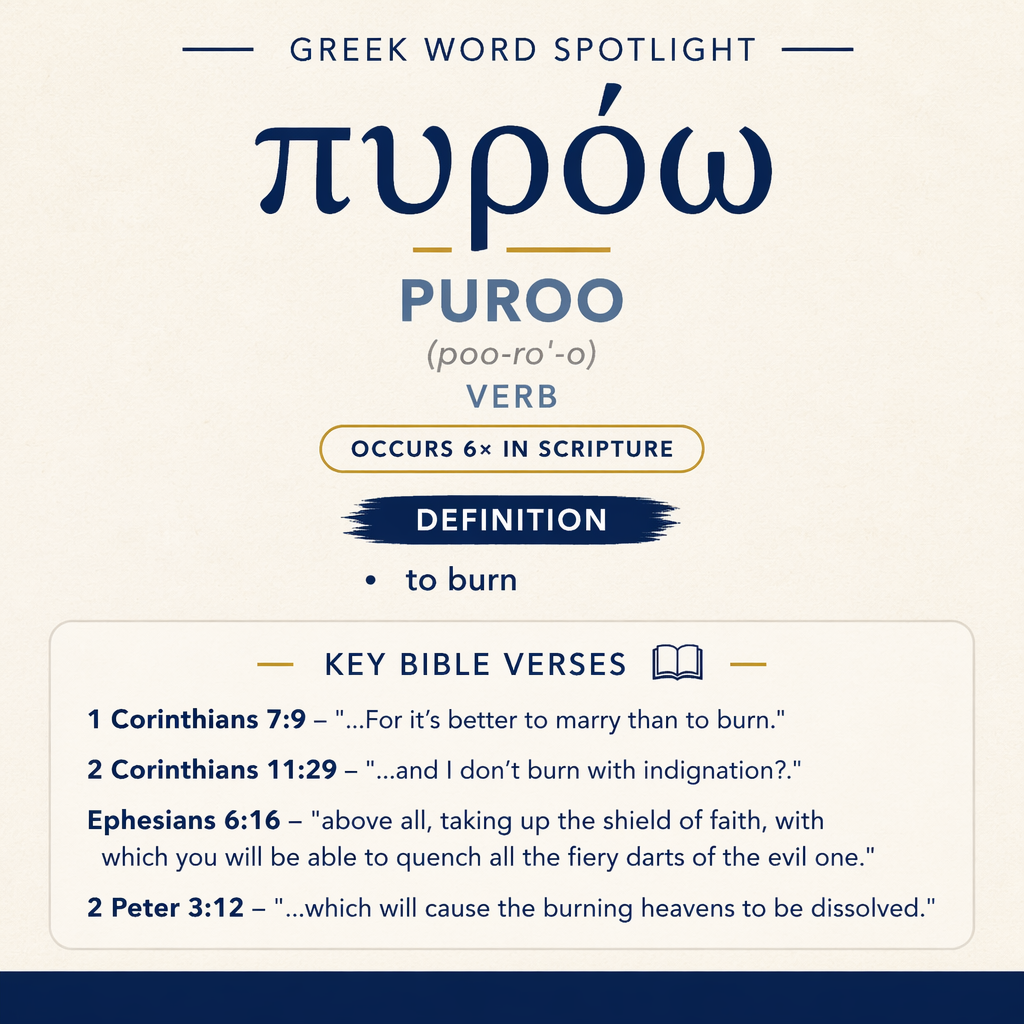
πυρόω means “to burn” and occurs 6 times in Scripture, including 1 Corinthians 7:9, Ephesians 6:16, and Revelation 3:18.
Core Meaning
πυρόω is defined as “to burn.” It is used both literally and figuratively in the listed passages.
Learn More →Range of Use
In 1 Corinthians 7:9 it appears in “better to marry than to burn,” and in 2 Corinthians 11:29 it expresses burning indignation. In Ephesians 6:16 it relates to “fiery darts.”
Learn More →Fire & Refining
In 2 Peter 3:12 it describes burning associated with the heavens being dissolved. In Revelation 1:15 and 3:18 it appears with refining imagery like a furnace and gold refined by fire.
Learn More →πυρόω expresses the idea of burning across a small cluster of New Testament contexts that range from personal desire and inner emotion to weapons imagery, cosmic dissolution, and the refining of metals. In the passages where it appears, the verb’s burning imagery is applied both literally (fire, furnace, melting) and figuratively (intense inward experience).
Occurrences
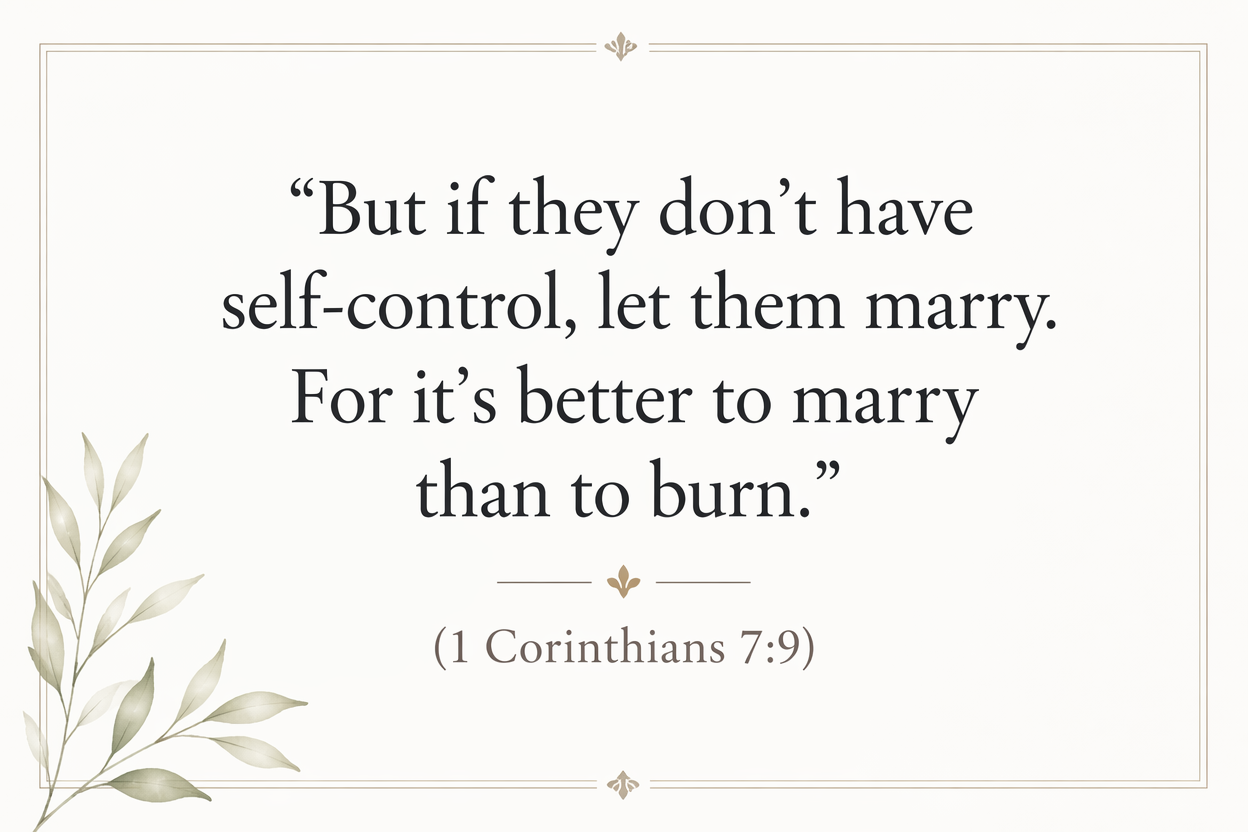
“But if they don’t have self-control, let them marry. For it’s better to marry than to burn.” (1 Corinthians 7:9)
Here πυρόω frames a practical comparison: marriage is set over against “burn[ing]” in a context explicitly keyed to “self-control.” The burning is presented as an undesirable state for those who “don’t have self-control,” and the verse uses it as the reason (“For…”) behind the counsel to marry. The verb’s force is not merely that something is warm or slightly heated; it functions as a strong image for a consuming inner condition that stands in tension with restraint.
“Who is weak, and I am not weak? Who is caused to stumble, and I don’t burn with indignation?” (2 Corinthians 11:29)
In this rhetorical pair of questions, πυρόω is tied to “indignation,” describing an internal reaction that flares up in response to another person being “caused to stumble.” The wording links the burning to relational and moral concern: weakness elicits shared weakness, and someone else’s stumbling provokes burning indignation. The verb thus carries the intensity of a fire-image into the realm of emotion, depicting indignation as something that can ignite and burn within a person.
“above all, taking up the shield of faith, with which you will be able to quench all the fiery darts of the evil one.” (Ephesians 6:16)
In this martial scene, πυρόω appears in the description “fiery darts.” The burning element belongs to the darts themselves, marking them as weapons characterized by fire. The action of the shield is to “quench” them, so the verse sets burning against extinguishing. πυρόω therefore contributes vividness and danger to the threat: these are not neutral projectiles but fire-bearing ones, opposed by a defensive measure that puts fire out.
“looking for and earnestly desiring the coming of the day of God, which will cause the burning heavens to be dissolved, and the elements will melt with fervent heat?” (2 Peter 3:12)
Here πυρόω is drawn into an end-time picture of large-scale dissolution: “the burning heavens” are said to be “dissolved,” and “the elements will melt with fervent heat.” The verb helps portray a world in which burning is not localized to a hearth or a battlefield but extends to the “heavens” themselves, associated with melting and dissolving. The scene uses the language of heat and burning to describe a comprehensive unmaking of the present order, with πυρόω supporting the portrayal of intensity that results in collapse and liquefaction.
“His feet were like burnished brass, as if it had been refined in a furnace. His voice was like the voice of many waters.” (Revelation 1:15)
Although the focus is “His feet,” πυρόω’s burning imagery is carried through the refining comparison: “as if it had been refined in a furnace.” The furnace image implies the sort of burning environment in which metal is processed, and the result is “burnished brass” with a distinctive appearance. πυρόω thus supports a visual quality—metal that looks as though it has undergone furnace exposure—and contributes to the passage’s overall sensory density (sight in the feet’s appearance and sound in the voice “like… many waters”).
“I counsel you to buy from me gold refined by fire, that you may become rich; and white garments, that you may clothe yourself, and that the shame of your nakedness may not be revealed; and eye salve to anoint your eyes, that you may see.” (Revelation 3:18)
In this counsel, πυρόω stands behind the phrase “refined by fire,” attached to “gold.” The burning element (“fire”) is the means by which the gold is described as refined, and the refined gold is presented as something to acquire: “buy from me gold refined by fire.” The verse then extends the counsel to “white garments” and “eye salve,” but the fire-refined gold sets the tone: πυρόω here undergirds an image of value and purification through an encounter with burning, with the result framed as enrichment (“that you may become rich”).

Sense and Usage
Across these six passages, πυρόω consistently contributes the conceptual and sensory world of burning, but it does so in more than one register. In 1 Corinthians 7:9 and 2 Corinthians 11:29, burning is interiorized: the verb depicts an inward condition or reaction that can be experienced personally—either an unrestrained drive contrasted with “self-control,” or indignation that ignites when someone is “caused to stumble.” In both cases, burning functions as a metaphor of intensity, communicating something that presses on a person from within, as fire presses outward from fuel.
In Ephesians 6:16, the burning is weaponized and external: the “fiery darts” carry fire toward their target, and the key counteraction is to “quench” them. πυρόω thus heightens the peril of the attack and clarifies why quenching is the appropriate response. The fire-image also makes the conflict concrete; it is not only impact that is feared, but burning damage that must be extinguished.
In 2 Peter 3:12, burning expands to a cosmic scale. The language is not limited to a thing burning while remaining intact; it is burning that leads into dissolution and melting: “the burning heavens” are “dissolved,” and “the elements will melt with fervent heat.” πυρόω here supports a portrayal of burning as transformative in the strongest sense—heat so intense that structures come apart.
In Revelation 1:15 and 3:18, πυρόω is aligned with the process and result of refining. A “furnace” and “fire” frame an image in which burning is the environment through which metal is brought to a particular state. In Revelation 1:15, the result is described visually—feet like “burnished brass,” with the comparison “as if it had been refined in a furnace.” In Revelation 3:18, the result is framed in terms of value and acquisition—“gold refined by fire” offered as something to buy. In both scenes, burning is not merely destructive; it is associated with producing a certain quality in metal.
Read together, these uses show πυρόω as a flexible fire-verb that can depict inward intensity, hostile threat, world-altering heat, and the furnace-setting in which metal is refined. The common thread is the force of burning as an active condition—something that consumes, heats, threatens, dissolves, or processes—rather than a static description.
Imagery
The passages cluster around three vivid images: a person burning within (desire in 1 Corinthians; indignation in 2 Corinthians), fire in conflict (“fiery darts” that must be “quench[ed]” in Ephesians), and fire as an agent of change (heavens dissolving and elements melting in 2 Peter; metal refined in a furnace and “refined by fire” in Revelation). Each scene uses burning to make intensity visible—whether the intensity belongs to the heart, the battlefield, the cosmos, or the forge—and πυρόω is the verbal hinge that carries that heat into the reader’s imagination.
Sources: Lexical data from Strong’s Exhaustive Concordance and the Translators Brief Lexicon of Extended Strongs for Greek (STEPBible, CC BY). Occurrence data from the Translators Amalgamated Greek New Testament (STEPBible, CC BY). Scripture quotations from the World English Bible (public domain).