Exploring the Meaning of Pur in Greek
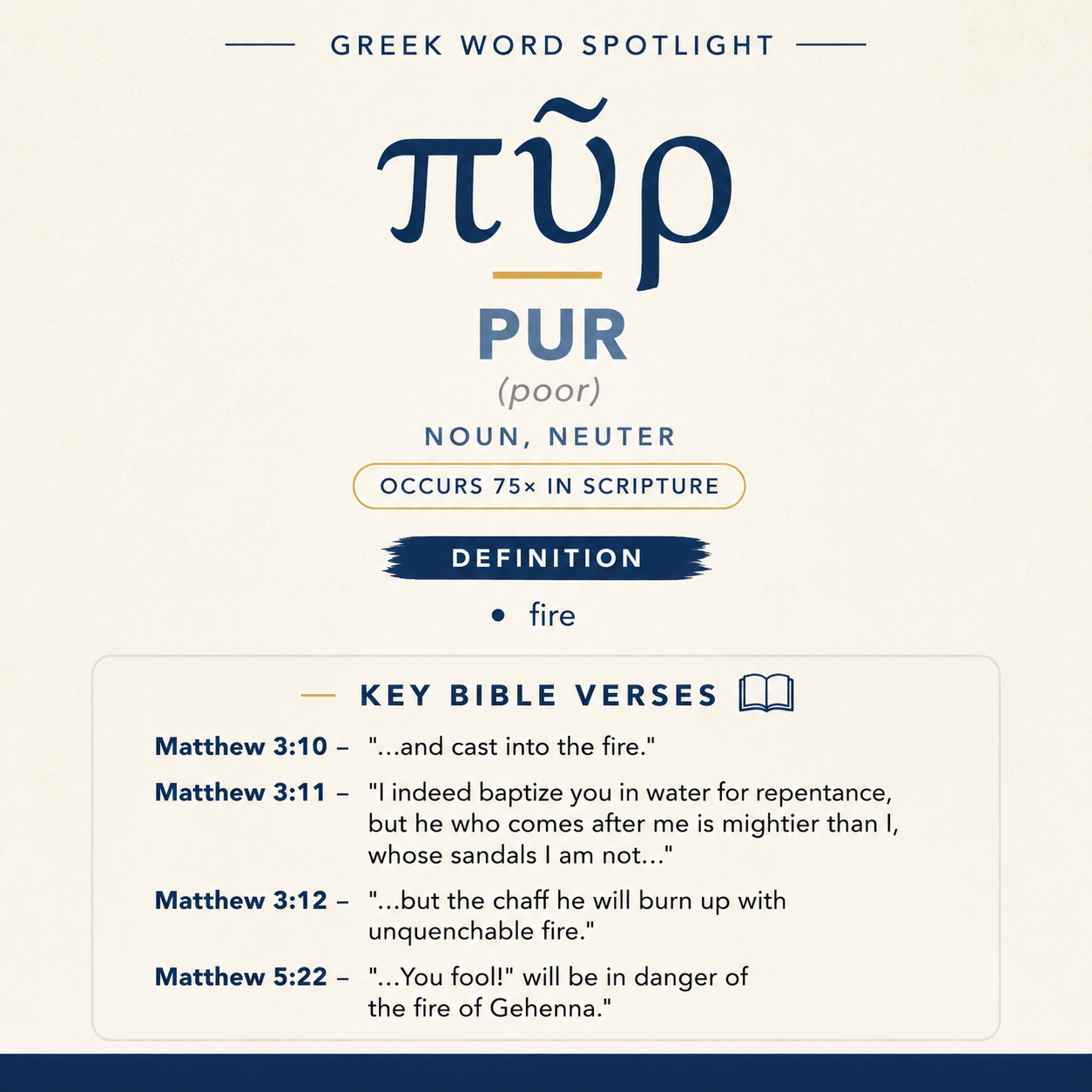
πῦρ means “fire” in Greek and appears 75 times in Scripture, including Matthew 3:10–12; 5:22; 7:19; 13:40, 42, 50.
Scripture Occurrences
It occurs 75 times in Scripture. It appears in Matthew 3:10–12; 5:22; 7:19; 13:40, 42, 50.
Learn More →Matthew Contexts
In Matthew, πῦρ appears in sayings about trees thrown into fire and weeds burned with fire. It is also used in phrases like “furnace of fire” (Matthew 13:42, 50).
Learn More →πῦρ means “fire.” In these passages it appears in sayings and scenes where fire functions as a concrete danger, a means of burning what is worthless, and an image bound up with judgment and exclusion.
Occurrences
“Even now the ax lies at the root of the trees. Therefore every tree that doesn’t produce good fruit is cut down, and cast into the fire.” (Matthew 3:10)
Here πῦρ is the end-point of a fruitless tree: after cutting, it is “cast into the fire.” The image treats fire as a decisive disposal and destruction of what fails the stated standard (“good fruit”), tightening the urgency of the warning (“Even now”).
I indeed baptize you in water for repentance, but he who comes after me is mightier than I, whose sandals I am not worthy to carry. He will baptize you in the Holy Spirit. (Matthew 3:11)
In this line the focus is on baptism “in water” and “in the Holy Spirit.” The surrounding sayings about burning and winnowing frame the speaker’s contrast between his own action and the mightier one’s action, keeping “fire” imagery nearby as part of the larger proclamation even when the sentence itself centers on water and Spirit.
“His winnowing fork is in his hand, and he will thoroughly cleanse his threshing floor. He will gather his wheat into the barn, but the chaff he will burn up with unquenchable fire.” (Matthew 3:12)
πῦρ stands in a harvest scene: wheat is gathered and stored, while chaff is burned. Calling the fire “unquenchable” intensifies the picture of a burning that cannot be put out or halted. Fire here marks the fate of what is separated out as refuse when the floor is “thoroughly” cleansed.
“But I tell you that everyone who is angry with his brother without a cause will be in danger of the judgment. Whoever says to his brother, ‘Raca!’ will be in danger of the council. Whoever says, ‘You fool!’ will be in danger of the fire of Gehenna.” (Matthew 5:22)
πῦρ is linked with escalating accountability for anger and contemptuous speech. The phrase “the fire of Gehenna” sets fire within a judicial framework (“in danger of the judgment… the council”), presenting it as a peril tied to moral and relational rupture, not merely to physical accident.
“Every tree that doesn’t grow good fruit is cut down, and thrown into the fire.” (Matthew 7:19)
The tree-and-fruit warning returns with the same concrete outcome: the unproductive tree is “thrown into the fire.” Fire again functions as the terminal consequence attached to the evaluation of fruit, giving the teaching a vivid, irreversible conclusion.
“As therefore the darnel weeds are gathered up and burned with fire; so will it be at the end of this age.” (Matthew 13:40)
πῦρ appears in an agricultural analogy: weeds are collected and “burned with fire.” The comparison points beyond the field—“so will it be at the end of this age”—so fire becomes the image that carries the force of the analogy from ordinary farming practice to an eschatological outcome.
“and will cast them into the furnace of fire. There will be the weeping and the gnashing of teeth.” (Matthew 13:42)
Fire is now intensified as “the furnace of fire,” not an open flame but a contained, consuming setting. The accompanying description—“weeping and the gnashing of teeth”—ties the furnace image to anguish, making πῦρ part of a scene of severe distress and finality.
“and will cast them into the furnace of fire. There will be the weeping and the gnashing of teeth.” (Matthew 13:50)
The same furnace language recurs, reinforcing the stability of the picture: being “cast… into the furnace of fire” expresses removal and confinement, while the repeated “weeping and the gnashing of teeth” keeps the emotional tone paired with the fire imagery.
“Lord, have mercy on my son, for he is epileptic, and suffers grievously; for he often falls into the fire, and often into the water.” (Matthew 17:15)
Here πῦρ is straightforwardly literal: a dangerous element into which the boy “often falls.” Fire is paired with water as twin threats, highlighting the severity of the suffering (“suffers grievously”) and the urgency of the plea for mercy.
“If your hand or your foot causes you to stumble, cut it off, and cast it from you. It is better for you to enter into life maimed or crippled, rather than having two hands or two feet to be cast into the eternal fire.” (Matthew 18:8)
πῦρ appears as “the eternal fire,” set in a stark comparison: drastic self-amputation is portrayed as preferable to being “cast into” that fire. Fire here functions as the negative alternative to “enter[ing] into life,” and the adjective “eternal” heightens the gravity of what is at stake.
“If your eye causes you to stumble, pluck it out, and cast it from you. It is better for you to enter into life with one eye, rather than having two eyes to be cast into the Gehenna of fire.” (Matthew 18:9)
Fire is again linked with Gehenna, now as “the Gehenna of fire.” As in the previous saying, the verb “cast” expresses being thrown into that fate, while the “better… rather than” structure makes fire the dreadful counterpoint to life. The repeated body-part imagery (hand/foot/eye) places πῦρ within warnings about what causes one to “stumble.”
“Then he will say also to those on the left hand, ‘Depart from me, you cursed, into the eternal fire which is prepared for the devil and his angels;” (Matthew 25:41)
πῦρ is “the eternal fire” into which the addressed are commanded to depart. The scene is judicial and relational: “Depart from me” combines separation from the speaker with entry into the fire. The clause “prepared for the devil and his angels” assigns the fire a defined destination within the sentence’s logic, sharpening the severity of the pronouncement upon “you cursed.”
Sense and Usage
Across these sayings, πῦρ retains its basic sense as fire while shifting between literal danger and figurative judgment imagery. In Matthew 17:15, fire is a physical hazard alongside water, emphasizing immediate peril and bodily harm. In the agricultural and arboreal images (Matthew 3:10; 3:12; 7:19; 13:40), fire is the outcome for what is cut down, separated out, or deemed worthless—trees without good fruit, chaff, and weeds. In these scenes, burning functions as the decisive disposal that follows sorting: an ax at the root, a winnowing fork in hand, gathering and cleansing, and then burning.
In the moral and eschatological warnings (Matthew 5:22; 18:8–9; 25:41), fire is named with qualifying phrases that deepen its role in the discourse: “the fire of Gehenna,” “the Gehenna of fire,” and “the eternal fire.” These expressions place fire within a framework of judgment (“in danger”), exclusion (“Depart from me”), and irreversible consequence (“to be cast into”). The repeated verbs—“cast,” “thrown,” “burn,” “burn up”—keep the imagery active and forceful: fire is not static scenery but a destination and an action done to what is removed.
The juxtaposition of fire with life is especially pronounced in Matthew 18:8–9, where entering “into life” is contrasted with being “cast into” fire. Likewise, Matthew 3:12’s barn versus unquenchable fire sets storage and preservation against burning. In these contexts, πῦρ gathers emotional weight from the surrounding language—unquenchable, furnace, eternal, Gehenna—without changing what it is: fire, presented as the agent and place of a severe end.
Imagery
The passages repeatedly portray fire as the final destination for what is rejected: fruitless trees, chaff, weeds, and persons cast out in judgment. Whether the scene is a threshing floor, a field at harvest, or a courtroom-like warning about anger and speech, πῦρ gives the teaching a concrete, sensory endpoint—burning—that communicates the seriousness of the separation being described.
Sources: Lexical data from Strong’s Exhaustive Concordance and the Translators Brief Lexicon of Extended Strongs for Greek (STEPBible, CC BY). Occurrence data from the Translators Amalgamated Greek New Testament (STEPBible, CC BY). Scripture quotations from the World English Bible (public domain).