Exploring the Meaning of Pulon in Greek
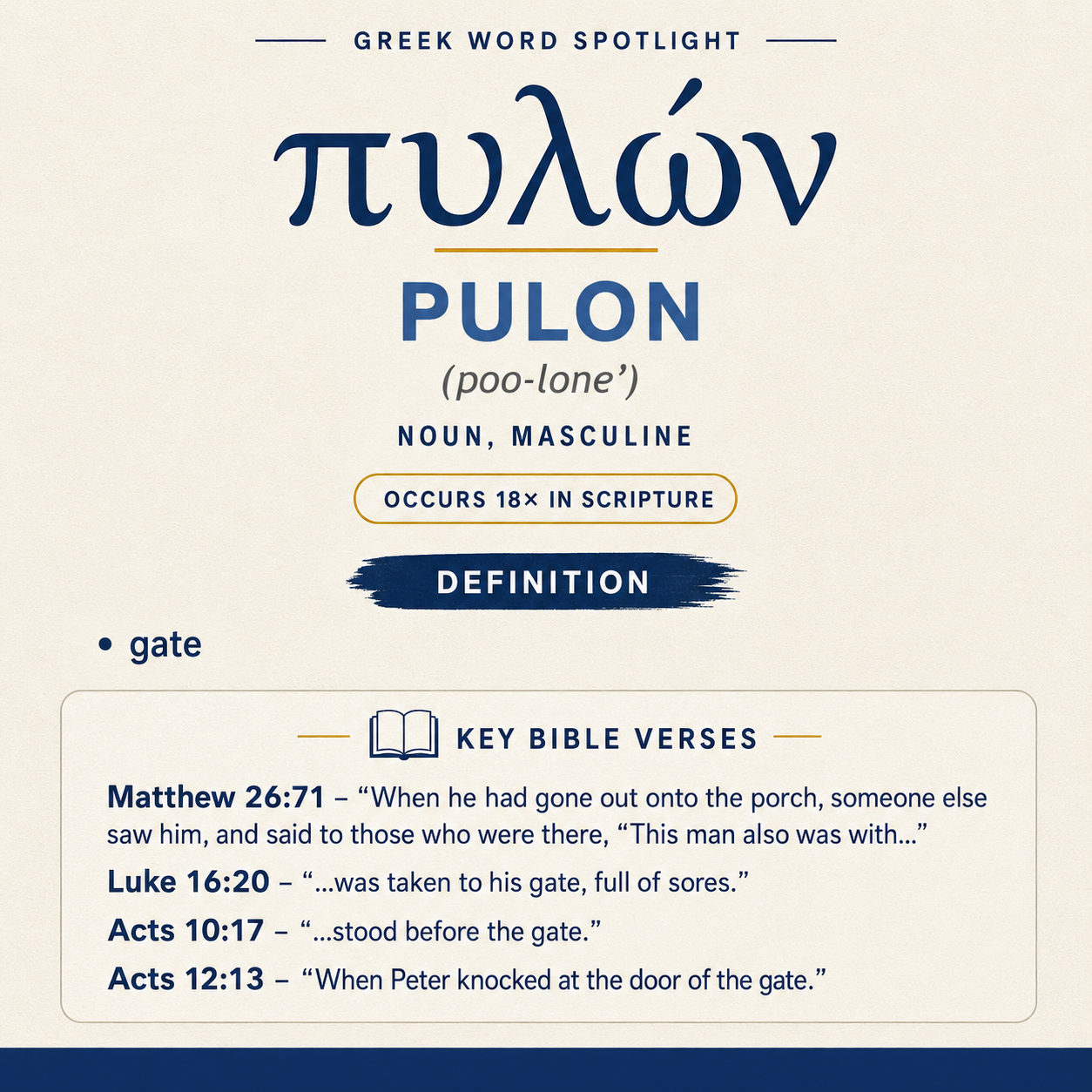
πυλών means “gate” and occurs 18 times in Scripture, including Matthew 26:71, Luke 16:20, Acts 12:13–14, and Revelation 21:12–13.
Core Meaning
πυλών is defined as “gate.” It refers to a gate or gates in the cited passages.
Learn More →Narrative Scenes
It appears in scenes like Lazarus being laid at a gate (Luke 16:20) and Peter at the gate with Rhoda answering (Acts 12:13–14).
Learn More →City & Vision
It is used for city gates (Acts 14:13) and for the twelve gates of the New Jerusalem (Revelation 21:12–13).
Learn More →πυλών refers to a gate, the controlled point of entry and exit that marks a boundary between outside and inside. In the passages where it appears, it frames scenes of movement, access, waiting, and the visibility of who stands at the threshold.
Occurrences
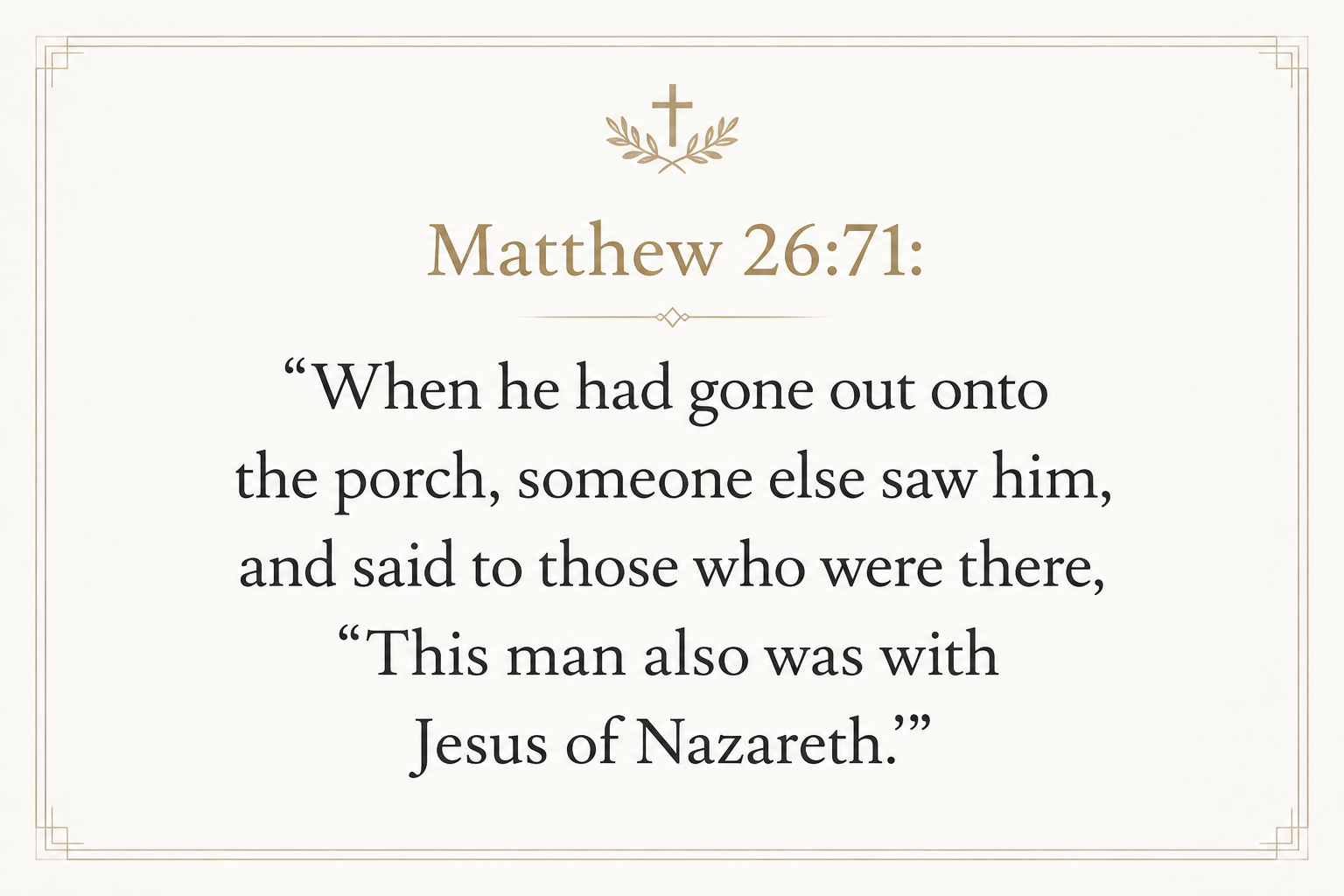
Matthew 26:71: “When he had gone out onto the porch, someone else saw him, and said to those who were there, “This man also was with Jesus of Nazareth.””
Here πυλών anchors the setting at a building’s boundary space: the porch is where one has gone “out,” yet remains close enough to be seen and addressed by others who are “there.” The gate-area functions as a public-facing threshold where identity can be observed and contested in the hearing of bystanders.
Luke 16:20: “A certain beggar, named Lazarus, was taken to his gate, full of sores,”
In this scene the gate is the fixed location where Lazarus is placed. The wording highlights how the gate is not merely architectural; it is a social and spatial dividing line where need is displayed. Lazarus is positioned at the boundary of another person’s property and protection, close enough to be noticed, yet still outside.
Acts 10:17: “Now while Peter was very perplexed in himself what the vision which he had seen might mean, behold, the men who were sent by Cornelius, having made inquiry for Simon’s house, stood before the gate,”
πυλών marks the men’s arrival point after “having made inquiry for Simon’s house.” They do not enter immediately; they “stood before the gate,” at the place where access must be granted. The gate here is the practical boundary that turns a search into a request for entry.
Acts 12:13: “When Peter knocked at the door of the gate, a servant girl named Rhoda came to answer.”
The phrase “the door of the gate” presents πυλών as a substantial entryway with a door that can be knocked upon and answered from within. The gate is the interface between Peter outside and the household inside; it is the point where recognition and response begin.
Acts 12:14: “When she recognized Peter’s voice, she didn’t open the gate for joy, but ran in, and reported that Peter was standing in front of the gate.”
Gate imagery sharpens the tension: recognition happens through the gate (“Peter’s voice”), yet entry is delayed (“she didn’t open the gate”). Twice the wording keeps Peter located “in front of the gate,” emphasizing the gate’s function as a barrier that can remain closed even when the person outside is known.
Acts 14:13: “The priest of Jupiter, whose temple was in front of their city, brought oxen and garlands to the gates, and would have made a sacrifice along with the multitudes.”
Here πυλών is plural and civic: “the gates” belong to “their city.” The action converges at the city’s entry point, with the priest bringing sacrificial animals and festal garlands there. The gates serve as a public gathering place where religious action is staged “along with the multitudes,” visible at the city’s boundary.
Revelation 21:12: “having a great and high wall; having twelve gates, and at the gates twelve angels; and names written on them, which are the names of the twelve tribes of the children of Israel.”
πυλών participates in a highly structured city description: a “great and high wall” paired with “twelve gates.” The gates are not unattended; “at the gates” stand “twelve angels,” and the gates bear “names written on them.” The gate becomes an ordered, guarded, and identified point of entry, integrated into the city’s design and meaning.
Revelation 21:13: “On the east were three gates; and on the north three gates; and on the south three gates; and on the west three gates;”
This verse distributes the gates by compass direction. πυλών here conveys access from every side—east, north, south, and west—while retaining symmetry (“three gates” each). The gate is part of the city’s orientation to the world around it.
Revelation 21:15: “He who spoke with me had for a measure a golden reed to measure the city, its gates, and its walls.”
Gates are included among the measured features of the city, alongside “the city” itself and “its walls.” πυλών is treated as a definable, countable, and dimensioned element—an essential component of the city’s form, not an incidental opening.
Revelation 21:21: “The twelve gates were twelve pearls. Each one of the gates was made of one pearl. The street of the city was pure gold, like transparent glass.”
Here πυλών is highlighted for its material splendor: each gate is “made of one pearl.” The emphasis falls on the singularity of each gate (“each one”) and the coherence between the gates and the city’s overall magnificence (“pure gold, like transparent glass”). The gate is a place of entry, yet also a visible feature proclaiming the city’s character.
Revelation 21:25: “Its gates will in no way be shut by day (for there will be no night there),”
πυλών is described in terms of its openness: the gates “will in no way be shut by day.” The explanatory parenthesis links this continual openness to the city’s environment (“for there will be no night there”). Gates normally regulate closure and security; here the gate’s defining action is the absence of shutting during the day in a place without night.
Revelation 22:14: “Blessed are those who do his commandments, that they may have the right to the tree of life, and may enter in by the gates into the city.”
In this line πυλών is explicitly the route of entry: to “enter in” is to do so “by the gates into the city.” The gate is the authorized channel through which entrance is described, tied to the language of “right” and the destination “into the city.”

Sense and Usage
Across these passages, πυλών consistently functions as the architectural threshold that makes inside and outside meaningful categories. In narrative settings (Matthew and Acts), it is the practical place where people are seen, where requests are made, and where entry is either granted or withheld. In Matthew 26:71 the gate-area is a zone of exposure, where someone can be “seen” and publicly identified. In Acts 10:17 the men “stood before the gate” after locating the house, showing the gate as the point where a search culminates in a moment of waiting. Acts 12:13–14 intensifies this: a “door of the gate” can be knocked upon, answered, recognized by voice, and still remain closed, so that the gate becomes the narrative hinge between presence and access.
In Luke 16:20 the gate is not a place of passing through but a fixed boundary where a person is placed. Lazarus being “taken to his gate” presents the gate as the edge of another’s space, a location where proximity to plenty does not equal participation in it. The gate thus bears social weight: it is where exclusion can be quietly maintained while remaining within sight.
Acts 14:13 shows πυλών at the level of a city rather than a house. “The gates” are where the public can gather and where communal action can be performed. The gate, therefore, can be both a control point and a meeting place—an edge that also becomes a stage, especially when “the multitudes” assemble there.
In Revelation 21–22 the gate is expanded into a defining feature of the city itself. The repeated focus on number (“twelve gates”), placement (three on each side), supervision (“at the gates twelve angels”), and physical description (measured, made of pearl, not shut by day) portrays gates as more than openings; they are elements that express order, identity, and accessibility. Revelation 22:14 gives the most direct functional statement: entry “into the city” is described as entry “by the gates,” making the gate the specified means of access within the vision’s portrayal.
Imagery
The imagery associated with πυλών in these texts is the moment of standing at a boundary: a porch where one is observed (Matthew 26:71), a gate where someone is laid in need (Luke 16:20), a threshold where visitors wait (Acts 10:17), and a closed entry that delays a welcomed person outside (Acts 12:14). In Revelation, the same boundary becomes luminous and ordered—numbered, guarded, and never shut by day—so that the gate carries the weight of both separation and entry, marking the city as a place with defined access and enduring openness.
Sources: Lexical data from Strong’s Exhaustive Concordance and the Translators Brief Lexicon of Extended Strongs for Greek (STEPBible, CC BY). Occurrence data from the Translators Amalgamated Greek New Testament (STEPBible, CC BY). Scripture quotations from the World English Bible (public domain).