
Exploring the Meaning of Ptoma in Greek
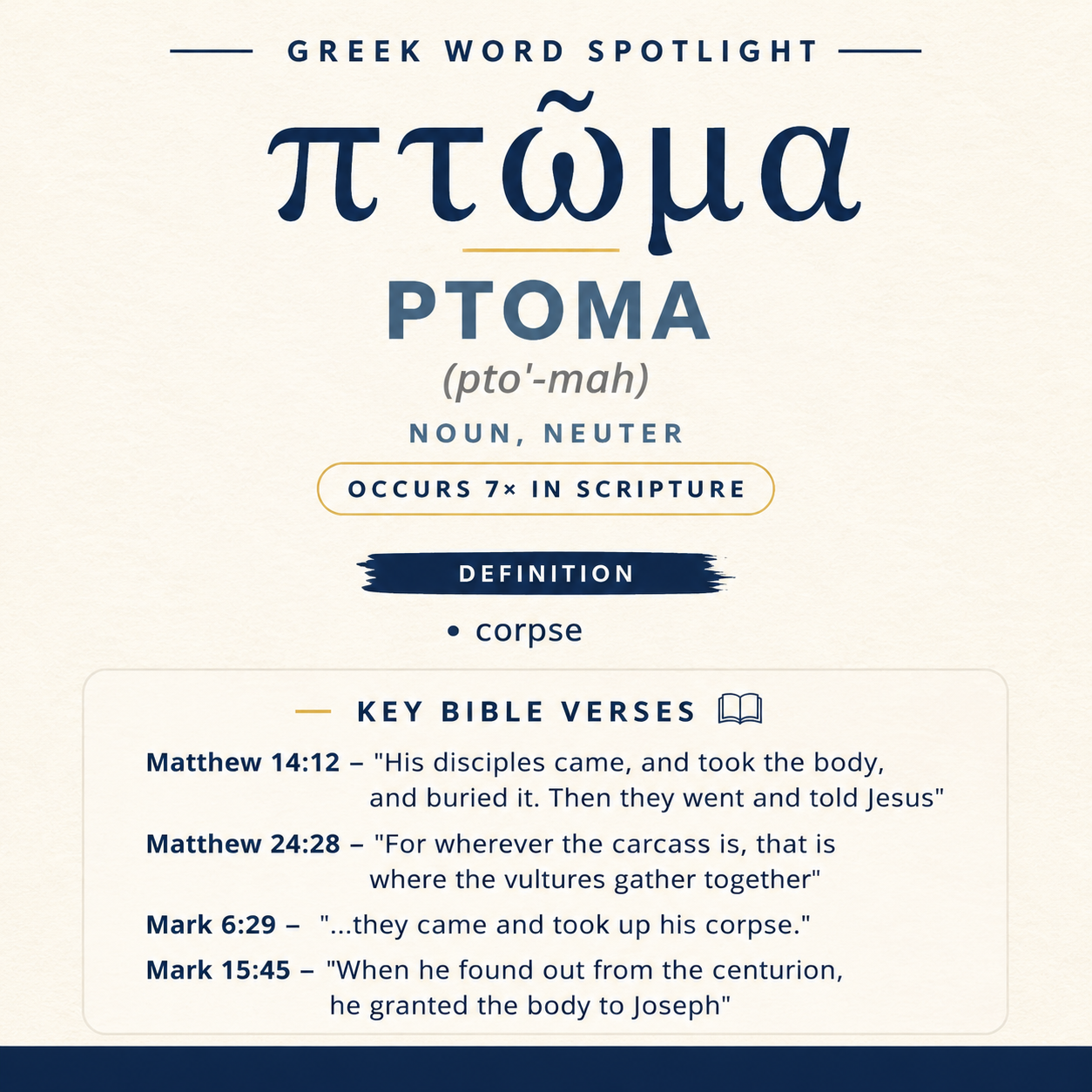
πτῶμα means “corpse” and appears in Matthew, Mark, and Revelation (7 total occurrences).
Core Meaning
πτῶμα is defined as “corpse.” In the Gospels it is rendered “body,” “corpse,” or “carcass.”
Learn More →Gospel Usage
Matthew 14:12 and Mark 6:29 describe disciples taking and burying a body. Mark 15:45 records the body being granted to Joseph after confirmation.
Learn More →Revelation Scenes
Revelation 11:8–9 speaks of “dead bodies” lying in the street of a great city. Peoples and nations look at them for three and a half days.
Learn More →πτῶμα refers to a “corpse,” the physical remains of a dead person, and it appears in narrative scenes of burial as well as in vivid public imagery of death. Across its contexts, it directs attention to what is handled, granted, displayed, or left exposed after life has ended.
Occurrences
Matthew 14:12: “His disciples came, and took the body, and buried it. Then they went and told Jesus.”
Here πτῶμα designates what the disciples can “t[ake]” and “bur[y].” The word anchors the action in the concrete task of dealing with the dead: retrieval, burial, and the closure those actions provide before the living “went and told Jesus.” The narrative weight falls on the transition from death to burial—πτῶμα is the object that must be cared for, not debated.
Matthew 24:28: “For wherever the carcass is, that is where the vultures gather together.”
In this proverb-like statement, πτῶμα is the fixed point in the scene: a corpse’s presence draws scavengers. The word supplies the stark physicality that makes the saying work—death has a visibility and consequence that can be observed “wherever” it occurs. πτῶμα is not described as buried or protected here; it is the exposed remains that become the center of gathering.
Mark 6:29: “When his disciples heard this, they came and took up his corpse, and laid it in a tomb.”
πτῶμα again stands at the center of the disciples’ response, but this time the burial action is detailed as “took up” and “laid it in a tomb.” The word marks the deceased as someone still receiving care and placement. The movement from hearing the report to handling the corpse makes the scene tactile and immediate: what they “heard” leads to what they must now carry and lay down.
Mark 15:45: “When he found out from the centurion, he granted the body to Joseph.”
In this setting, πτῶμα is something that must be “granted” by authority. The word contributes a legal or administrative dimension to the corpse: it is not only a reality to be buried but also an object over which permission is exercised. The verse emphasizes verification (“found out from the centurion”) and then transfer (“granted … to Joseph”), and πτῶμα names what is transferred.
Revelation 11:8: “Their dead bodies will be in the street of the great city, which spiritually is called Sodom and Egypt, where also their Lord was crucified.”
Here πτῶμα is plural and public: “Their dead bodies” lie “in the street.” The word gives the prophecy its shocking physical image—corpses left not in a tomb but in open civic space. The location is amplified by description of “the great city,” and the scene’s force depends on the indignity of bodies remaining where people pass by.
Revelation 11:9: “From among the peoples, tribes, languages, and nations, people will look at their dead bodies for three and a half days, and will not allow their dead bodies to be laid in a tomb.”
This occurrence extends the prior image by adding time (“three and a half days”), spectatorship (“people will look”), and deliberate prevention of burial (“will not allow … to be laid in a tomb”). πτῶμα functions as the focal object of international attention and hostility. The repetition within the verse (“their dead bodies … their dead bodies”) underscores the ongoing exposure: the corpses remain visible and unburied by intention, not by accident.

Sense and Usage
πτῶμα names the corpse as a physical remainder that can be moved, placed, and exposed. In the narrative accounts, the word is tied to acts of care and control: disciples “took” the corpse and “buried it” (Matthew 14:12), “took up” the corpse and “laid it in a tomb” (Mark 6:29), and an official “granted the body” to another party (Mark 15:45). These settings present the corpse as something that must be dealt with—handled respectfully, transferred lawfully, and placed appropriately. The corpse is not an abstraction; it is the concrete object around which the living must act.
At the same time, πτῶμα can serve as a blunt marker of death’s visibility in the world. In Matthew 24:28, the corpse is the sign that draws the vultures; the word’s force lies in the inevitability of what follows when a corpse is present and unprotected. Revelation intensifies this public dimension: corpses are left “in the street” (Revelation 11:8), watched for days, and specifically kept from burial (Revelation 11:9). There πτῶμα becomes an image of humiliation and exposure, because the normal movement seen in the Gospel scenes—taking up and laying in a tomb—is interrupted and forbidden.
Across these passages, the word’s contribution is consistently concrete: a corpse is something seen (“people will look”), something gathered around (“vultures gather together”), something granted (“he granted the body”), and something laid away—or refused that laying away (“will not allow … to be laid in a tomb”). The repeated contrast between burial and exposure helps define how πτῶμα functions: either as the object of burial practice or as the object left out in the open, producing a spectacle and attracting attention.
Imagery
The scenes cluster around what happens to a corpse after death: it may be taken and buried, transferred under authority, or left where it should not be—open to animals, open to view, and withheld from the shelter of a tomb. In these passages πτῶμα therefore carries a persistent visual element: the body is present in space, and the surrounding actions (burial, granting, gathering, looking, refusing burial) are organized around that presence.
Sources: Lexical data from Strong’s Exhaustive Concordance and the Translators Brief Lexicon of Extended Strongs for Greek (STEPBible, CC BY). Occurrence data from the Translators Amalgamated Greek New Testament (STEPBible, CC BY). Scripture quotations from the World English Bible (public domain).





