Exploring the Meaning of Proschusis in Greek
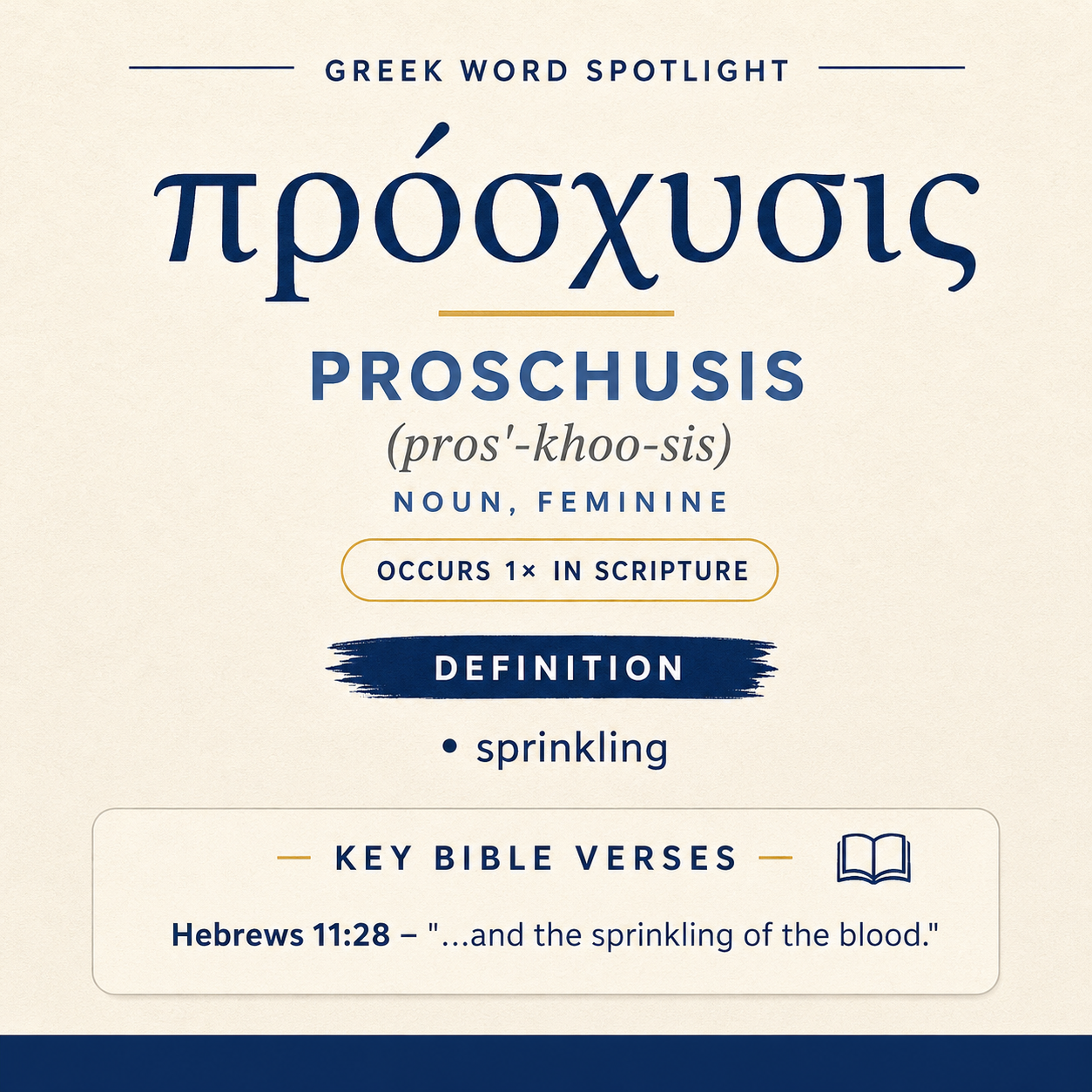
πρόσχυσις means “sprinkling” and appears once in Scripture in Hebrews 11:28.
Context in Hebrews
Hebrews 11:28 mentions “the sprinkling of the blood” in connection with keeping the Passover.
Learn More →πρόσχυσις means “sprinkling” and appears once in the New Testament, in Hebrews 11:28. In that context it is bound to the Passover and explicitly described as “the sprinkling of the blood.”
Root and Related Words
πρόσχυσις (Proschusis) is related to pros (πρός), meaning “to/with” (Strong’s G4314).

Occurrences
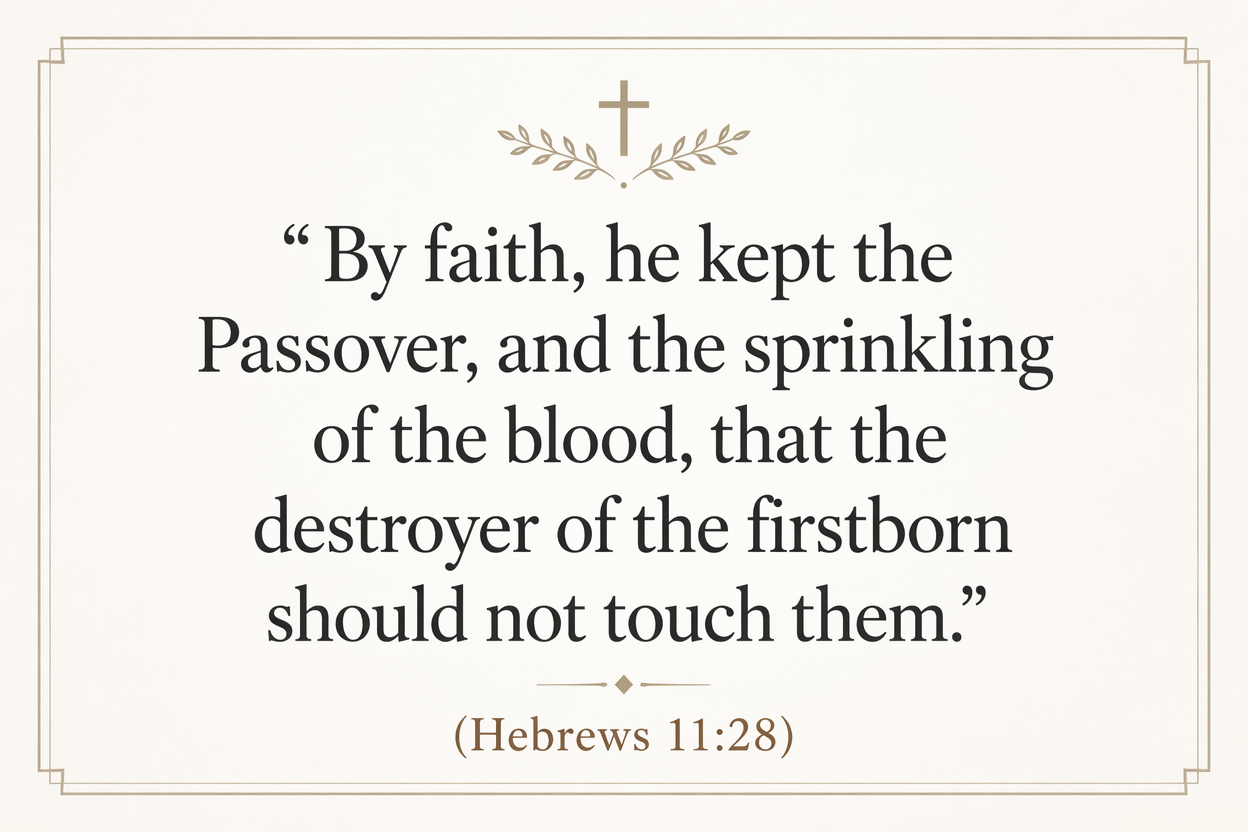
“By faith, he kept the Passover, and the sprinkling of the blood, that the destroyer of the firstborn should not touch them.” (Hebrews 11:28)
Here πρόσχυσις names a definite act: “the sprinkling of the blood.” The wording places this sprinkling alongside “he kept the Passover” as a concrete element of what was done “by faith.” It is not presented as an idea or a general practice, but as a specific sprinkling connected to a specific substance (“the blood”), with a stated outcome: “that the destroyer of the firstborn should not touch them.” Within the sentence, the sprinkling functions as a means closely tied to protection—something performed in such a way that it relates directly to whether “the destroyer of the firstborn” may “touch” the people in view.
The verse also frames πρόσχυσις within a tightly linked set of actions and results. The coordination “he kept the Passover, and the sprinkling of the blood” treats both items as recognizable components of one faithful response. The clause that follows (“that the destroyer of the firstborn should not touch them”) makes the sprinkling part of a chain that runs from faith, to obedient action, to deliverance from harm. The word therefore carries a practical, almost procedural force in the verse: it is something done with blood, and its significance is explained in terms of what it prevents.
Even in this brief mention, πρόσχυσις contributes vivid physical imagery. Sprinkling implies distribution rather than pooling: blood is not merely present, but applied in a scattered or dispersed way. The verse does not describe the method in detail, but its phrasing is enough to show that what mattered was not only having blood, but the act of sprinkling it. The stress falls on the action as a decisive moment within the Passover observance—an act connected to the boundary between being “touched” and not being “touched” by the destroyer.
Sense and Usage
As used in Hebrews 11:28, “sprinkling” is a ritual action named succinctly, without elaboration, yet given immediate explanatory weight by the purpose clause that follows it. The verse itself supplies the key features that shape how the sense is heard: (1) it is a sprinkling “of the blood,” so the action is defined by its material; (2) it stands alongside keeping the Passover, so it belongs to a recognized pattern of observance; and (3) it is presented as effectual with respect to danger, “that the destroyer of the firstborn should not touch them.”
Because πρόσχυσις appears here with the definite article (“the sprinkling”), it is presented as a particular sprinkling understood within the narrative world of the passage. The verse does not treat sprinkling as a merely illustrative metaphor; rather, it is one of the concrete acts faith expresses. In this single use, the word’s sense is therefore not abstracted away from action: it denotes an event that can be performed, can be associated with an object (“the blood”), and can be linked to a stated consequence (“should not touch them”).
The collocation “the sprinkling of the blood” also places emphasis on application. Blood is mentioned not simply as an offering or a concept, but as something that is handled in a distinct manner—sprinkled. That nuance matters to the verse’s logic: the protective outcome is attached to the sprinkling itself, not merely to the existence of blood in general. In this way, πρόσχυσις carries a sense of deliberate enactment, an appointed step within a larger act of obedience described as faith-filled.
The related preposition pros (πρός), “to/with,” helps account for how the noun can naturally suggest movement or directionality within the action: sprinkling involves placing or bringing the sprinkled material toward some target or in connection “with” something. Hebrews 11:28 does not specify the target in so many words, but it clearly places the sprinkling into a relational framework: it is done in such a way that it bears on whether the destroyer “should not touch them.” The act therefore stands at the intersection of ritual performance and tangible safeguarding, conveying that what is sprinkled is not random but connected to an intended protective effect.
Imagery
In Hebrews 11:28, πρόσχυσις evokes the sight of blood applied by sprinkling as part of Passover-keeping. The verse’s imagery is stark and concrete: blood, a destroyer who might “touch,” and an act whose stated purpose is to prevent that contact. The word thus carries the picture of a decisive application—sprinkling as a boundary-marking act that corresponds to preservation from harm.
Sources: Lexical data from Strong’s Exhaustive Concordance and the Translators Brief Lexicon of Extended Strongs for Greek (STEPBible, CC BY). Occurrence data from the Translators Amalgamated Greek New Testament (STEPBible, CC BY). Scripture quotations from the World English Bible (public domain).