Exploring the Meaning of Praxis in Greek
πρᾶξις means “action” and occurs 6 times in Scripture: Matthew 16:27; Luke 23:51; Acts 19:18; Romans 8:13; Romans 12:4; Colossians 3:9.
Core Meaning
πρᾶξις is defined as “action.” In the listed verses it is rendered with terms like “deed(s)” and “doings.”
Learn More →Scripture Occurrences
This word appears 6 times in Scripture. The references are Matthew 16:27; Luke 23:51; Acts 19:18; Romans 8:13; Romans 12:4; Colossians 3:9.
Learn More →Textual Contexts
The occurrences include contexts of rendering to everyone according to actions (Matthew 16:27) and confessing deeds (Acts 19:18). It also appears with “deeds of the body” (Romans 8:13) and “old man” doings (Colossians 3:9).
Learn More →πρᾶξις (Praxis) means “action.” It appears in scenes of judgment, moral accountability, public confession, and the practical outworking of life in relation to the body and its ways.
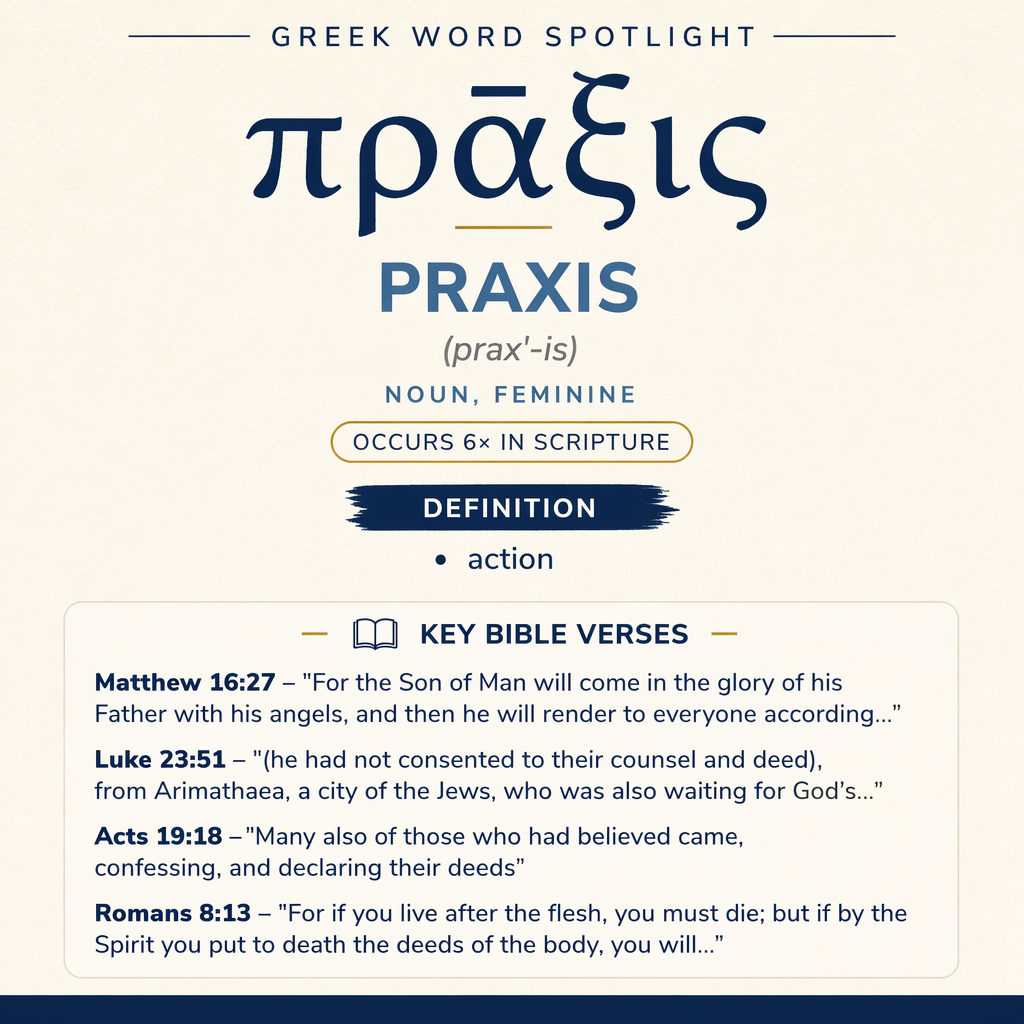
Occurrences
“For the Son of Man will come in the glory of his Father with his angels, and then he will render to everyone according to his deeds.” (Matthew 16:27)
Here πρᾶξις is set within a courtroom-like horizon: the Son of Man comes “with his angels,” and recompense is measured “according to” what each person has done. The term functions as the concrete standard by which “everyone” is evaluated. The focus is not on intentions or claims in isolation, but on actions that can be rendered back in proportion—deeds that stand as assessable realities at the moment of reckoning.

“(he had not consented to their counsel and deed), from Arimathaea, a city of the Jews, who was also waiting for God’s Kingdom:” (Luke 23:51)
In this parenthetical description, πρᾶξις is paired with “counsel” and singled out as something Joseph did not approve. The word marks the step from deliberation (“counsel”) into enacted behavior (“deed”). The scene defines Joseph by separation: he is characterized not merely by an inward disagreement but by non-participation—his will is not aligned with the action taken. The line also situates his moral stance within his wider posture as one “waiting for God’s Kingdom,” so the “deed” in view serves as a moral boundary that distinguishes him from “their” collective course.
“Many also of those who had believed came, confessing, and declaring their deeds.” (Acts 19:18)
πρᾶξις here belongs to a public reckoning among “those who had believed.” The verbs frame the actions as disclosed: they “came,” “confessing,” and “declaring” what they had done. The word therefore contributes the content of confession—not general guilt but specific actions that can be named. In the flow of the sentence, deeds are treated as communicable and describable realities; the community response is not abstract assent but exposure of actions to the light through spoken acknowledgment.
“For if you live after the flesh, you must die; but if by the Spirit you put to death the deeds of the body, you will live.” (Romans 8:13)
This occurrence places πρᾶξις in a stark life-and-death contrast. “Live after the flesh” leads to death; “by the Spirit” a person “put[s] to death the deeds of the body” and so lives. The term is cast as something that can be targeted and mortified: actions are not merely observed but actively opposed. The phrase “deeds of the body” anchors action in embodied patterns—what the body does—while the means of opposition (“by the Spirit”) frames the change as empowered rather than merely self-driven. The word thus serves as the practical arena where the conflict between “flesh” and “Spirit” becomes visible.
“For even as we have many members in one body, and all the members don’t have the same function,” (Romans 12:4)
Although the sentence as quoted is about “members” and “function,” πρᾶξις in this setting contributes the idea of action expressed through differentiated roles. The body metaphor assumes activity: members exist not as ornaments but as agents of distinct work. Within such a framework, action is distributed—many parts, not one uniform operation. The verse sets a conceptual grid where deeds are understood as the varied outputs that belong to particular members, making room for diversity in how action is carried out within a single, unified body.
“Don’t lie to one another, seeing that you have put off the old man with his doings,” (Colossians 3:9)
Here πρᾶξις appears in the language of clothing and identity: the community is told not to lie because they have “put off the old man with his doings.” The word helps specify what belongs to the “old man”—not only an inner disposition but the actions that characterize that former mode of life. “Doings” are portrayed as attached to an identity that can be removed; the moral exhortation (“Don’t lie”) is grounded in the claim that a decisive change has already been made. In this verse, action is inseparable from the self it expresses: the old self comes with its practices, and removing the self entails removing its actions.

Sense and Usage
Across these passages, πρᾶξις consistently operates as action considered in its outward, accountable form—what can be rendered, consented to or refused, confessed, put to death, assigned as a function, or stripped off as part of an old identity. In Matthew 16:27, actions serve as the measure in a universal reckoning: they are the yardstick for what is rendered “to everyone.” This situates action as something with lasting weight, not ephemeral motion, and it anchors responsibility in the tangible record of what a person has done.
Luke 23:51 shows action as the practical endpoint of collective decision-making. “Counsel” can remain internal to a group’s deliberation, but “deed” marks the realization of that counsel in the world. In that line, the moral significance of action is sharpened by contrast: to “not consent” to a deed is to stand apart from the group’s enacted choice. πρᾶξις therefore can function as a boundary-marker, separating participants from non-participants not in theory but in practice.
Acts 19:18 highlights another dimension: actions as confessional content. Deeds are treated as describable and speakable; they can be “declared.” The word’s force here lies in its specificity—confession is not left in vague terms but is tied to what was actually done. In a community context, πρᾶξις becomes the point where belief is accompanied by transparent accounting of one’s actions, suggesting that action is the concrete domain in which repentance and honesty take shape.
Romans 8:13 makes action the battleground of moral transformation. The “deeds of the body” are not presented as neutral; they are something to be “put to death.” In this way πρᾶξις is neither a mere description of behavior nor simply the product of nature; it is a set of actions that can be confronted and extinguished. The verse also places action within an agency structure: mortifying deeds is done “by the Spirit,” connecting the change in action to a new empowering influence. The contrast shows that life is not framed only by what one is but by what one does—and by what one stops doing.
Romans 12:4 situates action within coordinated diversity. The body image assumes many distinct operations: “all the members don’t have the same function.” In such a context, action is not evaluated only morally (as in Matthew, Luke, Romans 8, and Colossians) but also structurally: different members contribute different kinds of active service. πρᾶξις thus can be heard against the backdrop of organized activity—actions that belong properly to particular parts within a unified whole.
Colossians 3:9 brings action into the sphere of identity and ethical consistency. “Put off the old man with his doings” portrays actions as characteristic outputs of a former self. The prohibition of lying is grounded in that change: if the old self with its deeds has been removed, certain actions no longer fit. Here πρᾶξις carries a habitual nuance within the verse’s imagery: “doings” are the practices that accompany a way of life, and changing the person entails changing what is practiced.
Taken together, these uses portray action as (1) accountable before ultimate judgment, (2) distinguishable from counsel and therefore morally clarifying, (3) confessable and nameable within a believing community, (4) subject to decisive opposition in the pursuit of life, (5) diversified according to function within one body, and (6) bound up with the old self in a way that makes ethical exhortation coherent. The passages do not treat action as a detachable accessory; rather, actions are the visible interface between inward allegiance (“waiting for God’s Kingdom”), communal life (“don’t lie to one another”), and ultimate outcome (“you must die… you will live”).
Imagery
The imagery attached to πρᾶξις in these verses is concrete and varied: a reckoning where deeds are rendered back (Matthew 16:27), a council whose decisions harden into a deed (Luke 23:51), a gathering where believers openly declare what they have done (Acts 19:18), a struggle in which deeds are put to death (Romans 8:13), a body whose members each have distinct function (Romans 12:4), and clothing language where the old self is taken off together with its doings (Colossians 3:9). In each case, action is pictured as something that can be weighed, owned, resisted, coordinated, and removed—an observable reality that connects character to outcome.
Sources: Lexical data from Strong’s Exhaustive Concordance and the Translators Brief Lexicon of Extended Strongs for Greek (STEPBible, CC BY). Occurrence data from the Translators Amalgamated Greek New Testament (STEPBible, CC BY). Scripture quotations from the World English Bible (public domain).