
Exploring the Meaning of Pragmateia in Greek
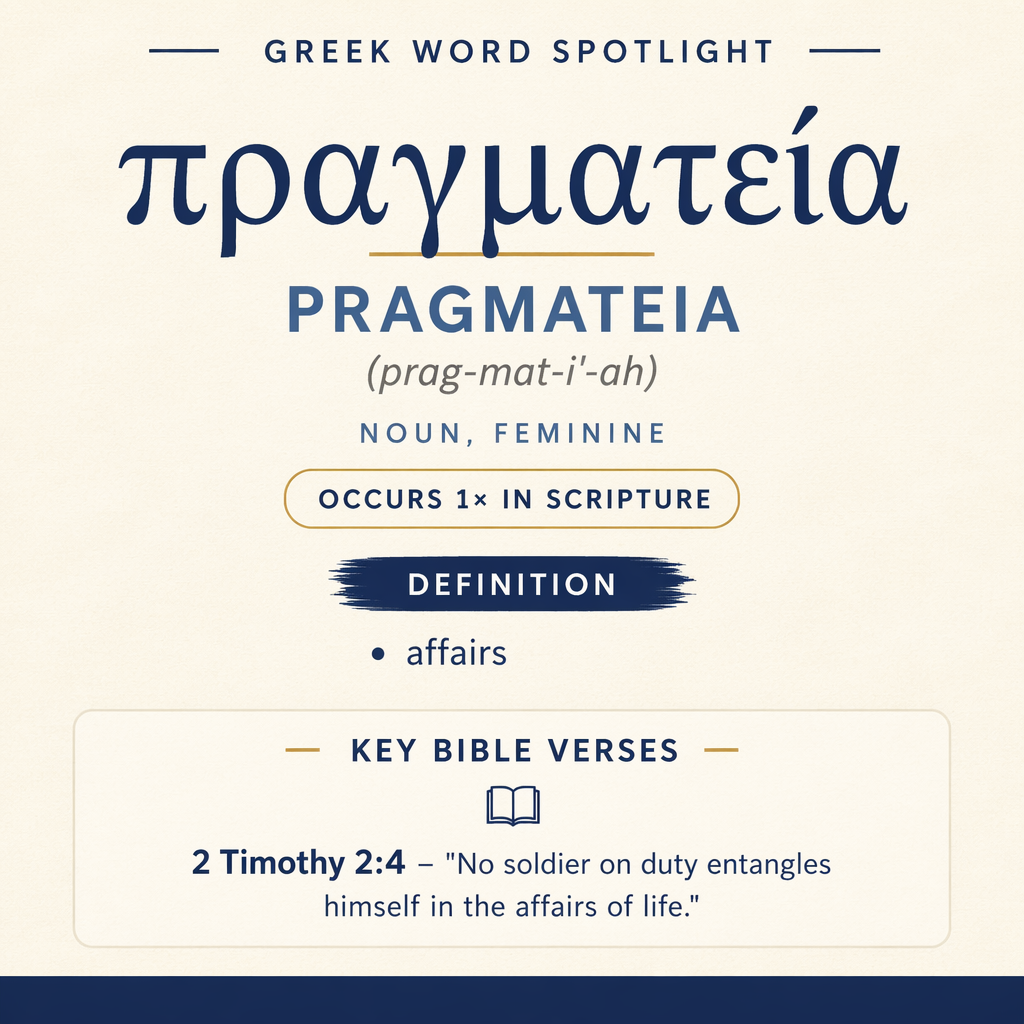
πραγματεία means “affairs” and appears once in Scripture, in 2 Timothy 2:4.
Context in Verse
In 2 Timothy 2:4, a soldier is warned not to entangle himself in the affairs of life.
Learn More →πραγματεία refers to “affairs” and appears once in the New Testament, in Paul’s exhortation to Timothy about single-minded service. In its lone setting it names the everyday concerns that can hinder a soldier’s focus and purpose.
Root and Related Words
πραγματεία is connected with the verb pragmateuomai (πραγματεύομαι), “to trade.”

Occurrences
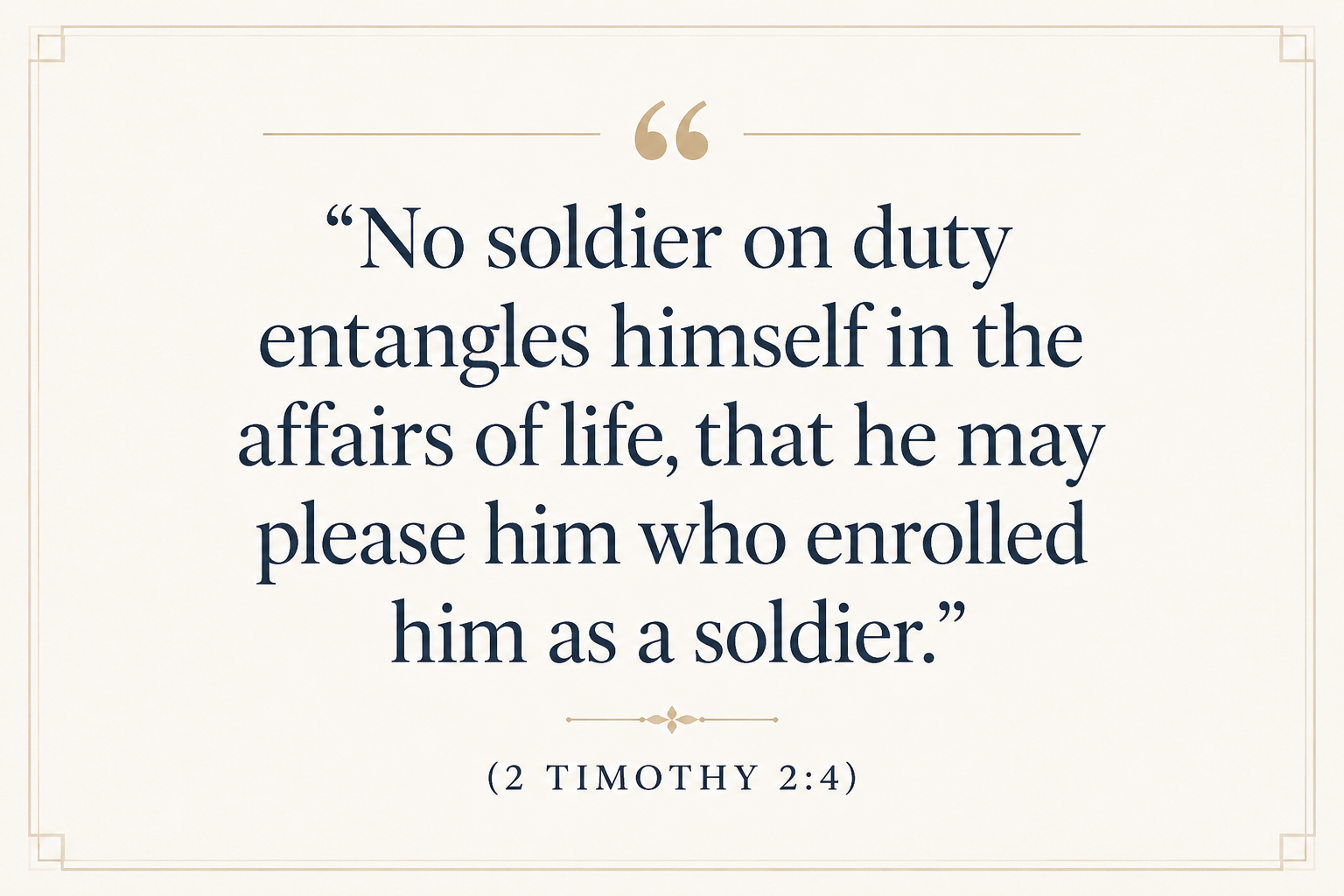
“No soldier on duty entangles himself in the affairs of life, that he may please him who enrolled him as a soldier.” (2 Timothy 2:4)
Here πραγματεία stands within a compact military picture: a “soldier on duty” has a clear aim—“that he may please him who enrolled him as a soldier.” The noun identifies what threatens that aim: “the affairs of life,” described as something that can entangle. The sentence is structured as a contrast between two kinds of involvement. On one side is the soldier’s proper involvement: being “on duty,” oriented toward the will of the one who enrolled him. On the other side is an improper involvement: becoming wrapped up in “the affairs of life.” The choice of verb (“entangles”) portrays these affairs as capable of binding a person’s movements and attention, like something that catches and holds fast. In this line, the word marks ordinary, day-to-day involvements as a potential competing sphere of concern—real enough to draw a person in, yet inappropriate for someone whose identity in the illustration is defined by commission and obligation.
The phrase “affairs of life” also places the noun within a broader frame of “life,” giving it an everyday setting rather than a specialized or technical one. The point is not that such affairs exist only outside the soldier’s world; rather, they are presented as a class of concerns that can intrude upon duty and divide loyalties. The logic of the verse depends on this: pleasing the enroller requires freedom from entanglement, and freedom from entanglement requires a refusal to be wrapped up in these affairs. Thus πραγμάτεια in this scene functions as the name for a set of involvements that, if allowed to dominate, can impede the soldier’s primary objective.
Sense and Usage
In 2 Timothy 2:4, “affairs” is not treated as a neutral list of tasks but as a web of involvements that can claim a person and restrict action. The word fits the verse’s moral geometry: duty has a single direction (“please him who enrolled him”), whereas the “affairs of life” have a pulling, tangling effect. The focus is practical: the issue is what someone becomes “entangled” in, and the consequence is whether that person can fully carry out the role implied by being “on duty.”
Because the illustration turns on the contrast between being enlisted and being entangled, the “affairs” named by πραγματεία are best understood within this verse as competing claims on attention, time, and commitment—concerns that may be legitimate in ordinary life, yet become obstructive when they dominate a person whose calling in the analogy is defined by service. The verse does not itemize what these affairs are; instead, it characterizes them by their effect. They are “of life,” belonging to the ordinary sphere in which people manage responsibilities and concerns, but they are also something a soldier must not allow to wrap around him. The force of the term in context is therefore shaped less by catalog and more by outcome: affairs are what can distract from pleasing the superior who has enlisted the soldier.
The presence of the military metaphor also sharpens the sense of the word. A soldier “on duty” implies a defined mission and a chain of command. Within that structure, “affairs” represent the kind of involvement that blurs priorities and compromises readiness. The word serves Paul’s argument by giving a concrete label to that blur: the everyday claims that can occupy someone so thoroughly that the central aim—pleasing the one who enrolled him—no longer governs decisions. The verse assumes that effective service requires a certain unencumbered state, and that entanglement in these affairs is the opposite of that state.
Imagery
The imagery attached to πραγματεία in 2 Timothy 2:4 is tactile and constricting: “entangles” suggests strands or nets that catch and hold. Against this stands the image of a soldier whose life is organized by enlistment and the desire to please the enroller. Within that contrast, “affairs” are pictured not as mere background noise but as something that can wrap around duty and hinder forward movement, making the soldier less free to act with the single aim the verse highlights.
Sources: Lexical data from Strong’s Exhaustive Concordance and the Translators Brief Lexicon of Extended Strongs for Greek (STEPBible, CC BY). Occurrence data from the Translators Amalgamated Greek New Testament (STEPBible, CC BY). Scripture quotations from the World English Bible (public domain).





