Exploring the Meaning of Polutimos in Greek
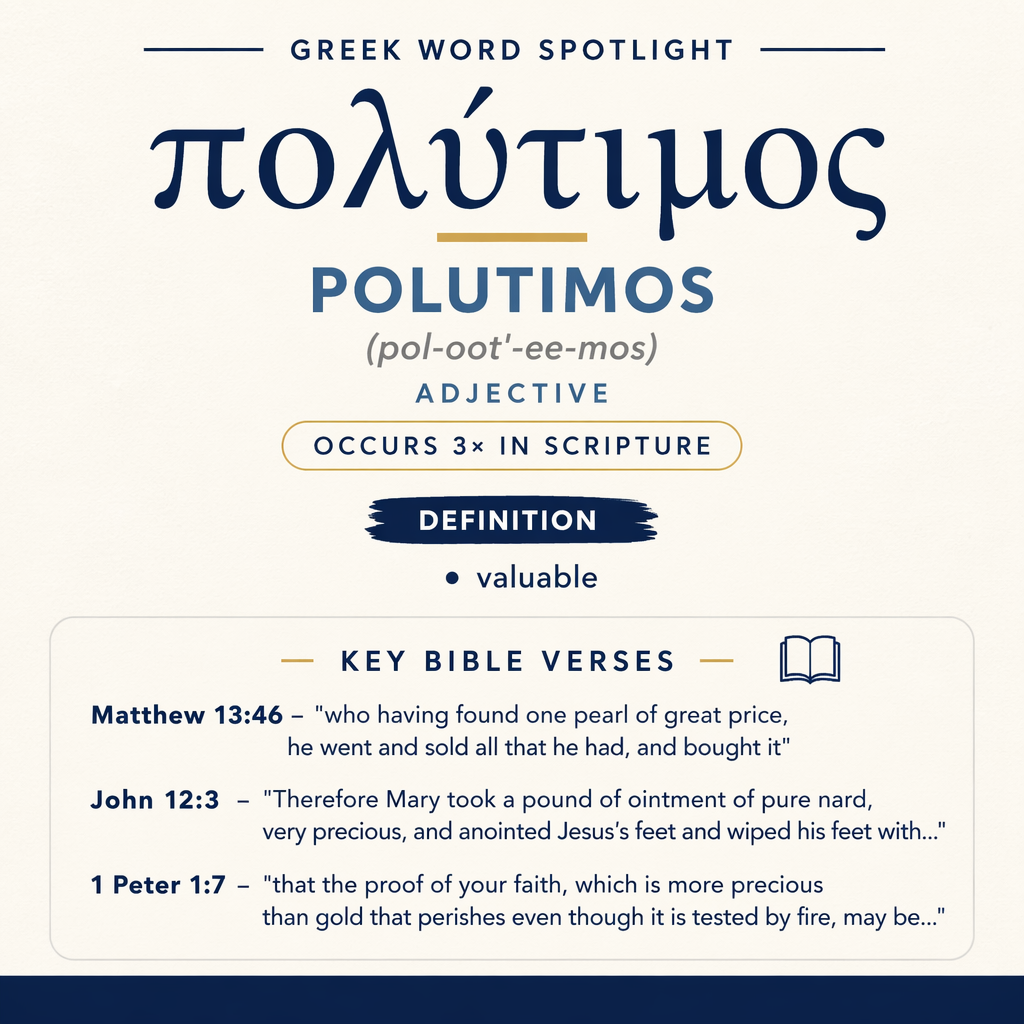
πολύτιμος means “valuable” and appears three times in Scripture: Matthew 13:46, John 12:3, and 1 Peter 1:7.
Gospel Examples
In Matthew 13:46 it describes a pearl of great price, and in John 12:3 it describes very precious pure nard ointment.
Learn More →Faith Compared
In 1 Peter 1:7 it describes faith as more precious than gold that perishes though tested by fire.
Learn More →πολύτιμος means “valuable.” It appears in the language of commercial worth (a pearl), in the description of an aromatic ointment poured out in devotion, and in a comparison that sets faith’s proven quality above perishable gold.
Root and Related Words
πολύτιμος is connected with πολύς (polys), “much” (Strong’s G4183), and τιμή (timē), “honor” (Strong’s G5092). Together these related terms frame πολύτιμος as a word used where value is not small or incidental, but weighty enough to govern choices and comparisons.

Occurrences
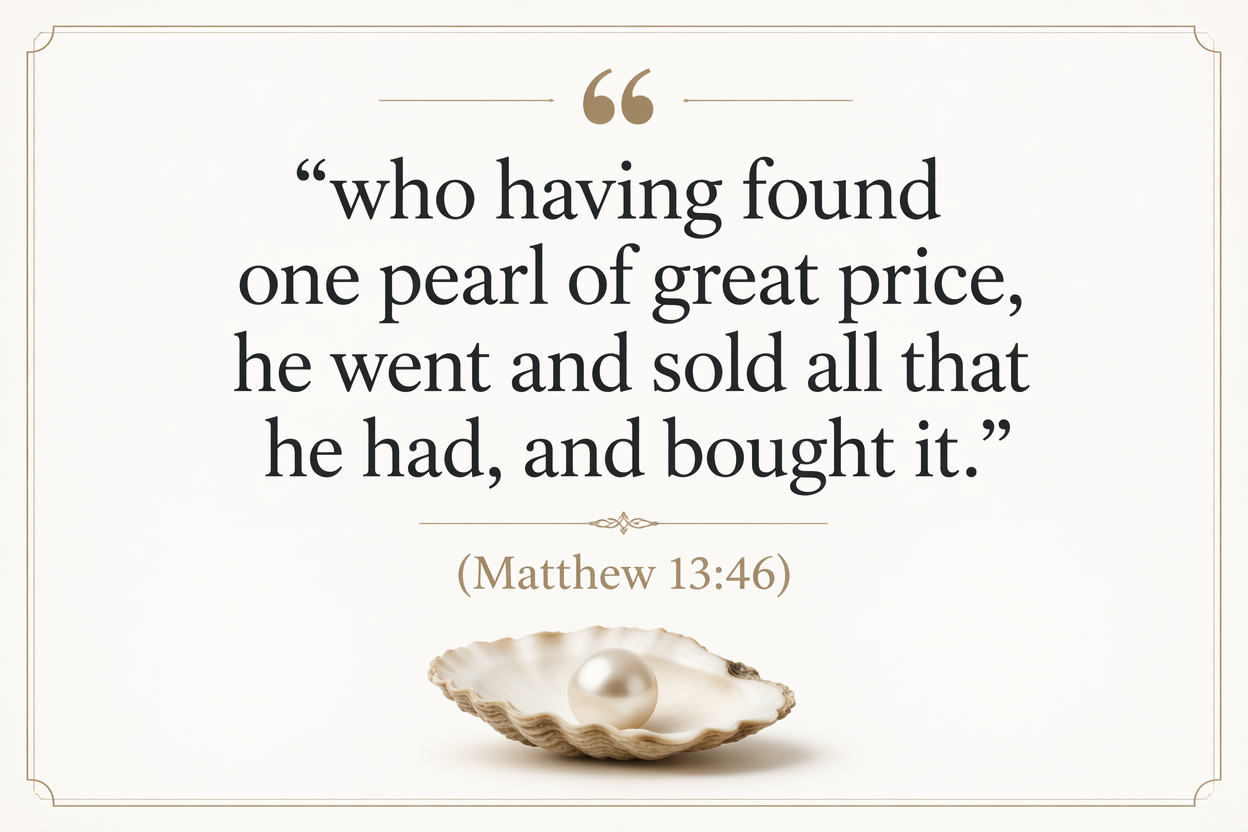
“who having found one pearl of great price, he went and sold all that he had, and bought it.” (Matthew 13:46)
Here πολύτιμος qualifies a single “pearl” as “of great price,” pressing the reader to feel its worth in concrete economic terms. The man’s actions interpret the adjective: he “sold all that he had” and then “bought it.” The word therefore functions within a marketplace logic—value is shown by what a person is willing to exchange for it. The pearl is not merely attractive or uncommon; it is portrayed as valuable enough to re-order a person’s entire portfolio of possessions. In the compact wording of the verse, πολύτιμος sits at the hinge between discovery (“having found”) and total liquidation (“sold all”), describing the kind of worth that makes such a decision coherent rather than reckless.
“Therefore Mary took a pound of ointment of pure nard, very precious, and anointed Jesus’s feet and wiped his feet with her hair. The house was filled with the fragrance of the ointment.” (John 12:3)
In John’s scene, πολύτιμος describes “a pound of ointment of pure nard” as “very precious,” shifting the idea of value from coin and purchase to a costly substance poured out in a personal act. The adjective heightens the sense of what is being expended: this is not ordinary ointment but a valuable one, and it is used lavishly—Mary “took a pound” and anointed Jesus’s feet. The action is tactile and intimate (“wiped his feet with her hair”), and the effect is public in the simplest way: “The house was filled with the fragrance.” πολύτιμος thus helps the narrative communicate that what fills the space is not only scent but the aroma of something valuable, offered without reserve. The word anchors the scene’s sensory detail to an assessment of worth, so that the reader understands the magnitude of the act through the magnitude of the gift.
“that the proof of your faith, which is more precious than gold that perishes even though it is tested by fire, may be found to result in praise, glory, and honor at the revelation of Jesus Christ—” (1 Peter 1:7)
In 1 Peter, πολύτιμος is set in a comparative frame: “more precious than gold.” The verse stays within the realm of value language, but its focus is evaluative rather than commercial. “Gold” is treated as a standard of worth, yet it is described as something that “perishes,” even with the refining imagery of being “tested by fire.” Against that backdrop, “the proof of your faith” is labeled with a greater preciousness, and the expected outcome is not profit but recognition: “praise, glory, and honor.” The adjective therefore contributes to an argument about what deserves the highest valuation. It allows the writer to speak about faith’s tested reality as something to be appraised like a treasure—yet in a way that culminates in eschatological acknowledgment (“at the revelation of Jesus Christ”).
Sense and Usage
Across these three passages, “valuable” is never an abstract label floating above the text; it is always attached to something that can be assessed by cost, by expenditure, or by comparison. In Matthew 13:46, value is demonstrated through transaction: selling “all that he had” is the narrative proof that the pearl’s worth is extraordinary. The adjective serves the story by making the man’s behavior intelligible; the selling is not a strange exaggeration but the fitting response to what he has “found.”
In John 12:3, the same sense of value is expressed through the irretrievable use of a prized material. The ointment is called “very precious” precisely where the narrative emphasizes how completely it is poured out and how widely its effects spread (“The house was filled”). In this context, πολύτιμος accentuates the costliness of the act without requiring the reader to compute a price. The worth of the ointment is felt by the scale of the anointing and by the atmosphere it creates; value becomes something that can be smelled in the room because something valuable has been released.
In 1 Peter 1:7, πολύτιμος functions as a measuring term in moral and spiritual evaluation. The writer chooses “gold” as the comparative baseline, treating it as a widely recognized marker of what counts as valuable. Yet gold is described in a way that relativizes its status: it “perishes,” even when subjected to a process meant to prove or purify it (“tested by fire”). The “proof of your faith” is then positioned as surpassing that standard. The adjective thus carries the same idea of value but applies it to what endures through testing and what is worthy of “praise, glory, and honor.”
Taken together, these uses show that πολύτιμος can speak to value recognized in different arenas: commercial exchange (a purchase made at the cost of everything else), sacrificial offering (a precious substance poured out), and comparative appraisal (faith’s proven quality weighed against gold). In each case, the adjective does more than mark something as valuable; it shapes the reader’s sense of what rational action looks like in response to value—selling, anointing, or persevering so that proof may be found to result in honor.
Imagery
The imagery of πολύτιμος in these passages moves from the hand to the house to the furnace. A single pearl prompts a decisive sale and purchase (Matthew 13:46). A “very precious” ointment is poured out so fully that its fragrance fills an entire space (John 12:3). And the comparison to gold “tested by fire” places value in the context of proving and endurance, with the prospect of “praise, glory, and honor” (1 Peter 1:7). In all three, value is not hidden; it is displayed—by what is surrendered, by what is poured out, and by what remains under testing.
Sources: Lexical data from Strong’s Exhaustive Concordance and the Translators Brief Lexicon of Extended Strongs for Greek (STEPBible, CC BY). Occurrence data from the Translators Amalgamated Greek New Testament (STEPBible, CC BY). Scripture quotations from the World English Bible (public domain).