Exploring the Meaning of Ptoesis in Greek
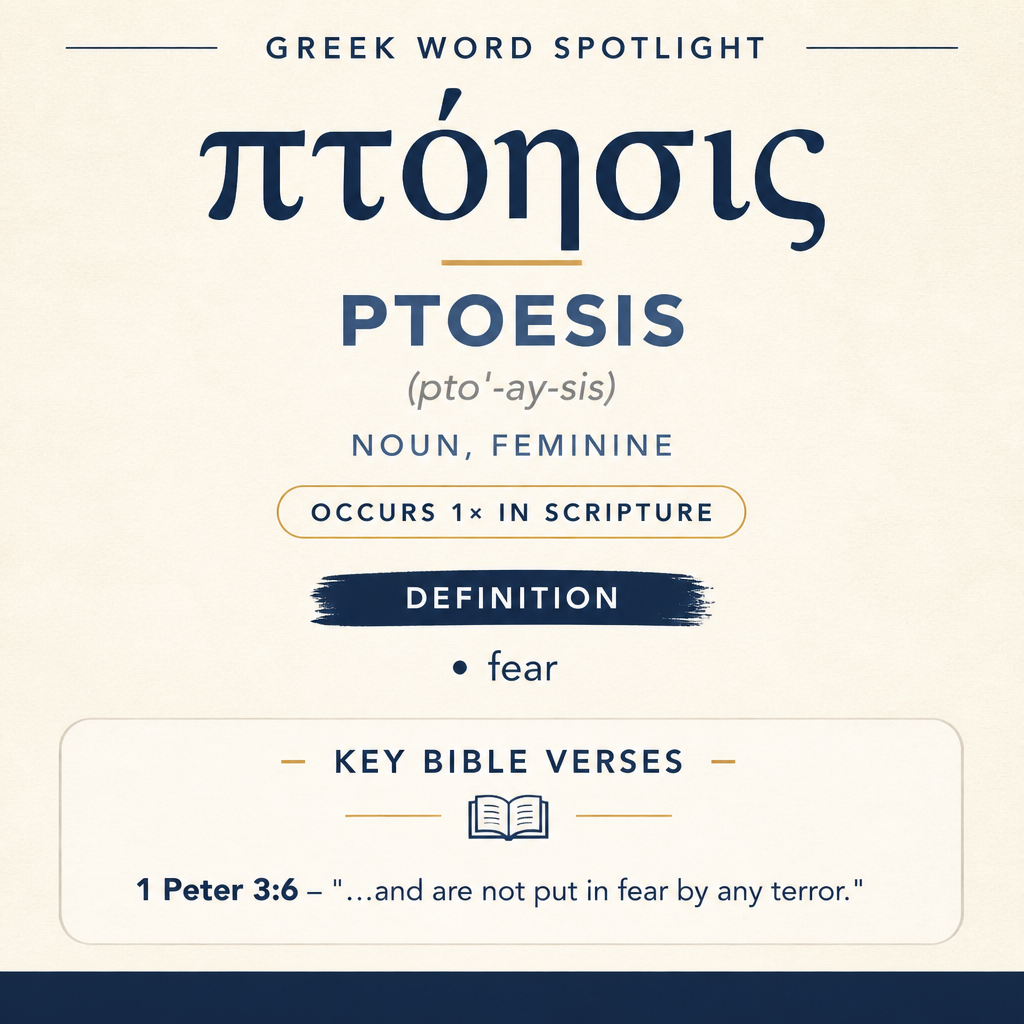
πτόησις means “fear” and appears once in Scripture, in 1 Peter 3:6.
Scripture Occurrence
πτόησις occurs 1 time in Scripture. Its single occurrence is in 1 Peter 3:6.
Learn More →Verse Context
In 1 Peter 3:6, the verse speaks of not being “put in fear.” πτόησις names that fear.
Learn More →πτόησις means “fear” and appears in the exhortation of 1 Peter 3:6, where it is paired with “terror” and set against the call to “do well.” The word is used to describe what Christian conduct is not to be driven by.
Root and Related Words
πτόησις is related to the verb ptoeō (πτοέω), “to frighten” (Strong’s G4422).

Occurrences
“So Sarah obeyed Abraham, calling him lord, whose children you now are, if you do well, and are not put in fear by any terror.” (1 Peter 3:6)
In this sentence, πτόησις names the emotional state that the readers are to resist: being “put in fear.” The construction links the word to an outside pressure—fear is not presented as self-chosen but as something that can be inflicted (“put in fear”) in connection with “terror.” Within the flow of the verse, fear is framed as a possible response to threatening circumstances, but it is not treated as the governing motive for the behavior described (“if you do well”). The line thus sets courage—continuing to “do well”—over against the destabilizing effect that terror can exert when it tries to produce fear.
The verse also places πτόησις in a family-identity context: “whose children you now are.” That identity is expressed with an “if” clause: “if you do well, and are not put in fear by any terror.” Fear is therefore not merely an internal feeling but a condition that, if yielded to, would stand in tension with the steadiness implied by doing good. In the immediate wording, πτόησις functions as the threatened outcome of “terror,” the attempted psychological result of intimidation.
Sense and Usage
The single New Testament use of πτόησις presents fear as an imposed reaction, a state that “terror” tries to produce. The pairing of terms (“fear” and “terror”) intensifies the picture: terror is not an abstract idea but a force that aims to unsettle, and fear is the inner disturbance that follows. In this usage, fear is treated as something that can interrupt or compromise the resolve to “do well.”
The verse’s grammar is also instructive for how πτόησις works in context. The readers are addressed with a conditional description: they are Sarah’s “children … if you do well, and are not put in fear by any terror.” The second clause does not add a new kind of action alongside “do well,” but identifies a posture that protects the first. The sense is that persistent good conduct is maintained when terror fails to produce fear. πτόησις, then, stands for the psychological leverage that threatening circumstances attempt to gain.
Because πτόησις is expressed through the passive idea of being acted upon (“put in fear”), it emphasizes vulnerability to intimidation, not merely the presence of an emotion. The word sits at the point where external threat meets internal response. The exhortation does not deny that terror exists; it denies terror the right to dictate the inner state called “fear.” In that way, πτόησις marks the target of coercion: if terror can cause fear, it can shape behavior; if fear is refused, “doing well” remains intact.
Finally, πτόησις in 1 Peter 3:6 is inseparable from the moral frame of the verse. Fear is not discussed as a clinical condition or as a general human experience, but as something that competes with the call to act rightly. The text places fear in the realm of moral pressure—what might tempt someone away from good by making terror feel decisive. πτόησις names that pressured state and identifies it as something to be resisted.
Imagery
The verse supplies a simple but sharp image: “terror” attempting to produce “fear,” like an external weight pressing inward. πτόησις is the inward effect that intimidation seeks, and the exhortation pictures steadfastness as continuing to “do well” without letting that pressure become fear.
Sources: Lexical data from Strong’s Exhaustive Concordance and the Translators Brief Lexicon of Extended Strongs for Greek (STEPBible, CC BY). Occurrence data from the Translators Amalgamated Greek New Testament (STEPBible, CC BY). Scripture quotations from the World English Bible (public domain).