Exploring the Meaning of Prosphiles in Greek
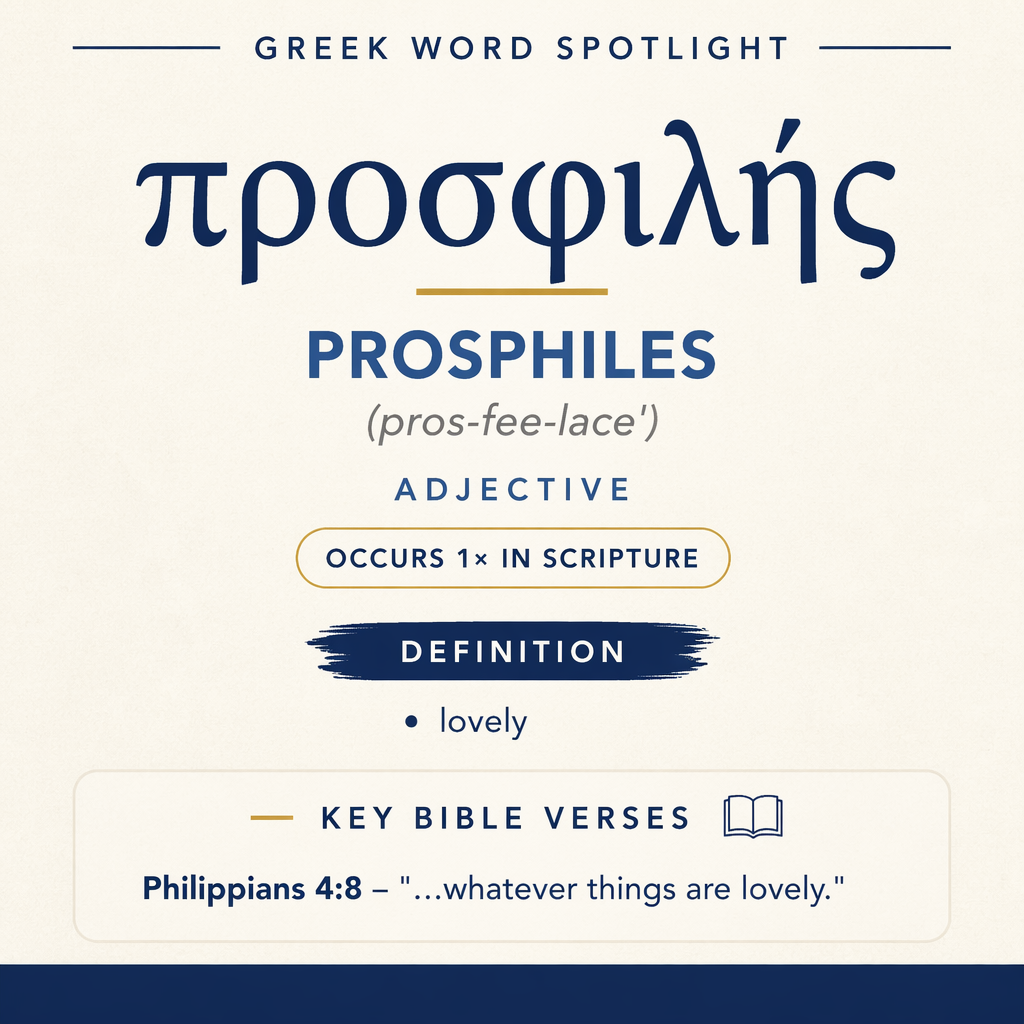
προσφιλής means “lovely” and appears once in Scripture, in Philippians 4:8.
Scripture Occurrence
This word occurs 1 time in Scripture. It is found in Philippians 4:8.
Learn More →Verse Context
In Philippians 4:8, it appears in a list of qualities believers are to focus on. The verse begins, “Finally, brothers, whatever things are true...”
Learn More →προσφιλής means “lovely” and is used once in the New Testament, in Paul’s closing exhortation to the Philippian church about the kinds of things that should occupy Christian thought.
Root and Related Words
προσφιλής (Prosphiles) is formed from πρός (pros), “to/with” (Strong’s G4314), and φιλέω (phileō), “to love” (Strong’s G5368). The combination places the idea of love in a relational direction—toward or with—so that what is described has a quality that draws affectionate regard.

Occurrences
“Finally, brothers, whatever things are true, whatever things are honorable, whatever things are just, whatever things are pure, whatever things are lovely, whatever things are of good report: if there is any virtue and if there is any praise, think about these things.” (Philippians 4:8)
In Philippians 4:8, προσφιλής appears as one item in a carefully arranged list of qualities. The verse is not describing a single object but setting out categories—“whatever things are…”—that together define a pattern for discernment. Within that pattern, “lovely” functions as a criterion for what is fit to be held in the mind: “think about these things.” The placement between “pure” and “of good report” shows that the term operates alongside moral and reputational considerations. It is not offered as a private preference detached from character; rather, it joins a set of evaluative filters that are meant to govern the believer’s inner life.
The structure of the sentence gives προσφιλής a broad reach. Because the word is attached to “whatever things,” it can apply to actions, attitudes, speech, relationships, and choices—anything that can be assessed as belonging to this class. In the same breath, Paul adds two further tests: “if there is any virtue and if there is any praise.” That framing pushes the reader to treat “lovely” as a public-minded excellence, something capable of being commended, not merely enjoyed. The final imperative, “think about these things,” makes the word more than descriptive; it becomes directive. The “lovely” is presented as mental material that shapes the community’s outlook and conduct, especially as the letter nears its conclusion (“Finally, brothers”).
Sense and Usage
“Lovely” in this passage belongs to the domain of moral attention: it names a quality that makes something suitable to be welcomed into one’s contemplation. Paul does not leave the term floating on its own, because he surrounds it with overlapping virtues—“true… honorable… just… pure… of good report”—and then anchors the whole list in what can be recognized as “virtue” and “praise.” Within this network, προσφιλής marks what is fitting to love or to hold with affection in the life of the mind. The word therefore helps bridge the personal and the communal: it speaks to what a believer finds worthy of affection while remaining accountable to standards that others can also recognize and commend.
The verse’s repeated “whatever things are…” also implies that “lovely” is not restricted to one narrow sphere (such as aesthetics alone) but is a quality that may be found wherever truth, honor, justice, and purity are found. Paul’s method is not to give a checklist of specific activities, but to teach a way of evaluating. προσφιλής contributes by identifying a dimension of goodness that attracts rather than repels, that invites rather than coerces. In the logic of the sentence, this attractiveness is not superficial; it is placed in company with “just” and “pure,” so that the “lovely” is a feature of what is ethically sound and spiritually wholesome. The mind is instructed to dwell on such things, suggesting that the “lovely” has staying power—it is not a passing curiosity but something one can return to, ponder, and allow to shape one’s inner orientation.
Because the word occurs in a list that ends with a command, its sense is practical. The “lovely” is not merely observed; it is selected. Paul’s exhortation assumes competing mental inputs, and he directs the community toward a disciplined focus. προσφιλής thus functions as a guardrail for thought: it helps define the kind of content that should be welcomed and the kind that should be displaced by better objects of reflection. The result is a portrait of Christian mental life in which affection and evaluation work together—what is “lovely” is not set against truth or justice, but is part of the same constellation of worthy things.
Imagery
Even in an abstract list, προσφιλής carries a gentle image: the mind turning toward what is attractive in character and reputation. Philippians 4:8 pictures thought as something that can be directed—gathered up from many possible “things” and set deliberately upon what is commendable. In that scene, “lovely” names a quality that draws the gaze and steadies it, encouraging a settled attention to what is worthy of affection.
Sources: Lexical data from Strong’s Exhaustive Concordance and the Translators Brief Lexicon of Extended Strongs for Greek (STEPBible, CC BY). Occurrence data from the Translators Amalgamated Greek New Testament (STEPBible, CC BY). Scripture quotations from the World English Bible (public domain).