
Exploring the Meaning of Prosphagion in Greek
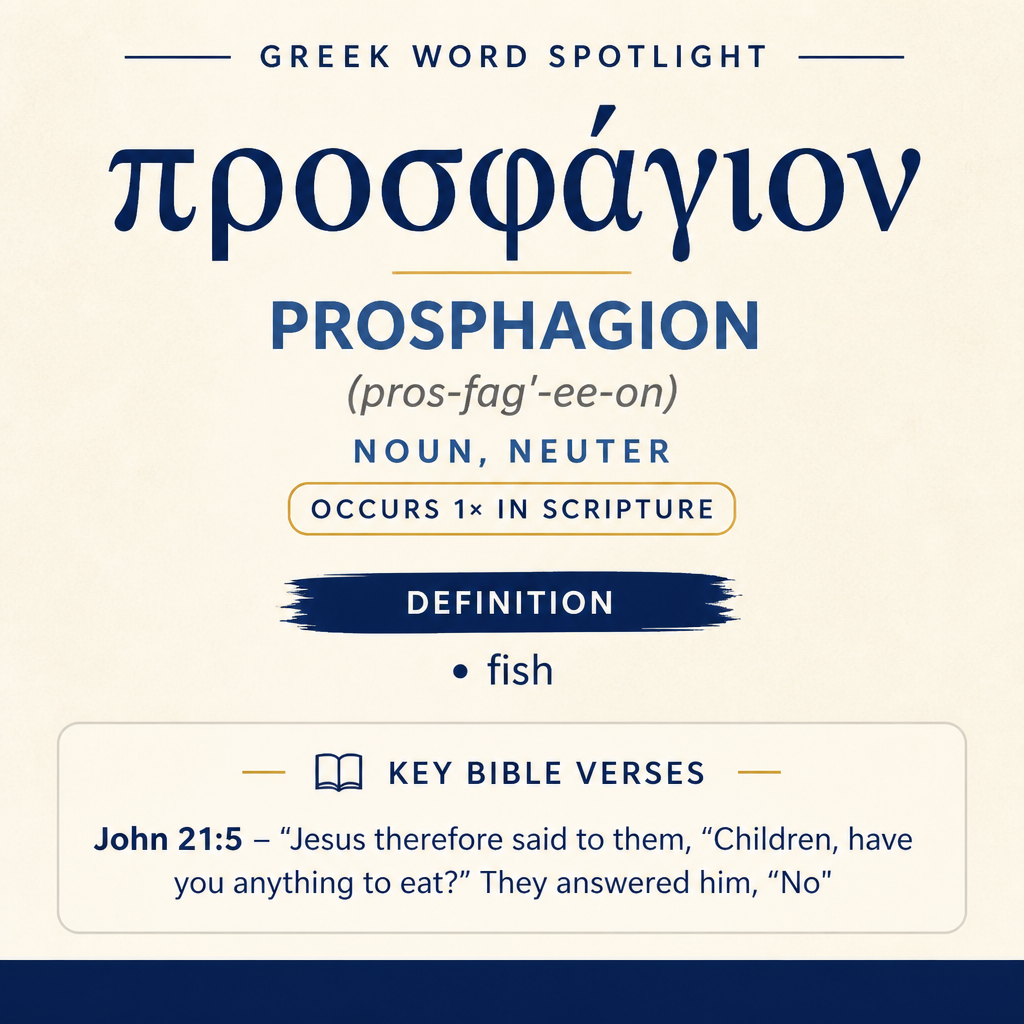
προσφάγιον means “fish” and appears once in Scripture in John 21:5.
Verse Context
In John 21:5, Jesus asks, “Children, have you anything to eat?” They answer, “No.”
Learn More →προσφάγιον refers to fish, and it appears once in the New Testament, in John 21:5. In that scene it belongs to the concrete question of whether there is anything on hand to eat.
Root and Related Words
προσφάγιον is connected with the preposition πρός (pros), “to/with” (Strong’s G4314), and with φαγεῖν (phagein), “to eat” (Strong’s G5315). These related elements place the word naturally within the setting of food in relation to eating—something supplied “with” or “for” eating in ordinary speech.

Occurrences
Jesus therefore said to them, “Children, have you anything to eat?” They answered him, “No.” (John 21:5)
In John 21:5 the word is framed by an everyday exchange: Jesus addresses the group as “Children” and asks directly whether they have anything available for eating. The reply, “No,” makes the lack explicit and immediate. Within the verse’s short dialogue, προσφάγιον functions as the specific kind of food that would answer the question; it brings the scene down to the practical matter of a meal rather than a general discussion of hunger. The narrative force comes from the abrupt contrast between the expectation implied by “have you anything to eat?” and the emptiness of “No.”
The wording also situates the question in a communal context: the food in view is not private but shared—something “they” would have for the group. The term therefore helps portray the moment as one of provision or the need for provision, in which a simple inventory (“anything to eat?”) reveals deficiency and sets up what the scene requires next: food that is presently missing.
Sense and Usage
As used in John 21:5, προσφάγιον carries the plain, tangible sense of fish as food—an item that can be had or not had. The question assumes that such food might reasonably be available, but the answer denies it. Because the verse is built around a request for information and a negative response, the word’s contribution is to make the lack measurable and concrete: the problem is not an abstract shortage but the absence of something edible that would meet immediate need.
The surrounding phrasing (“have you anything to eat?”) keeps the term within the sphere of ordinary bodily life: eating, sharing, and sustaining a group. It also sharpens the emotional tone without overt description. A reader does not need an explanation of what the lack entails; the word itself evokes a simple meal that would normally quiet hunger. In this way προσφάγιον serves the narrative economy of the line: a single everyday noun anchors the scene in physical reality and makes the “No” more pointed.
Imagery
John 21:5 evokes the image of a meal that could have been present but is not. By naming fish as the thing sought for eating, the verse paints a moment of emptiness—hands without food, a question hanging in the air, and a straightforward admission of need.
Sources: Lexical data from Strong’s Exhaustive Concordance and the Translators Brief Lexicon of Extended Strongs for Greek (STEPBible, CC BY). Occurrence data from the Translators Amalgamated Greek New Testament (STEPBible, CC BY). Scripture quotations from the World English Bible (public domain).





