Exploring the Meaning of Prostithemi in Greek
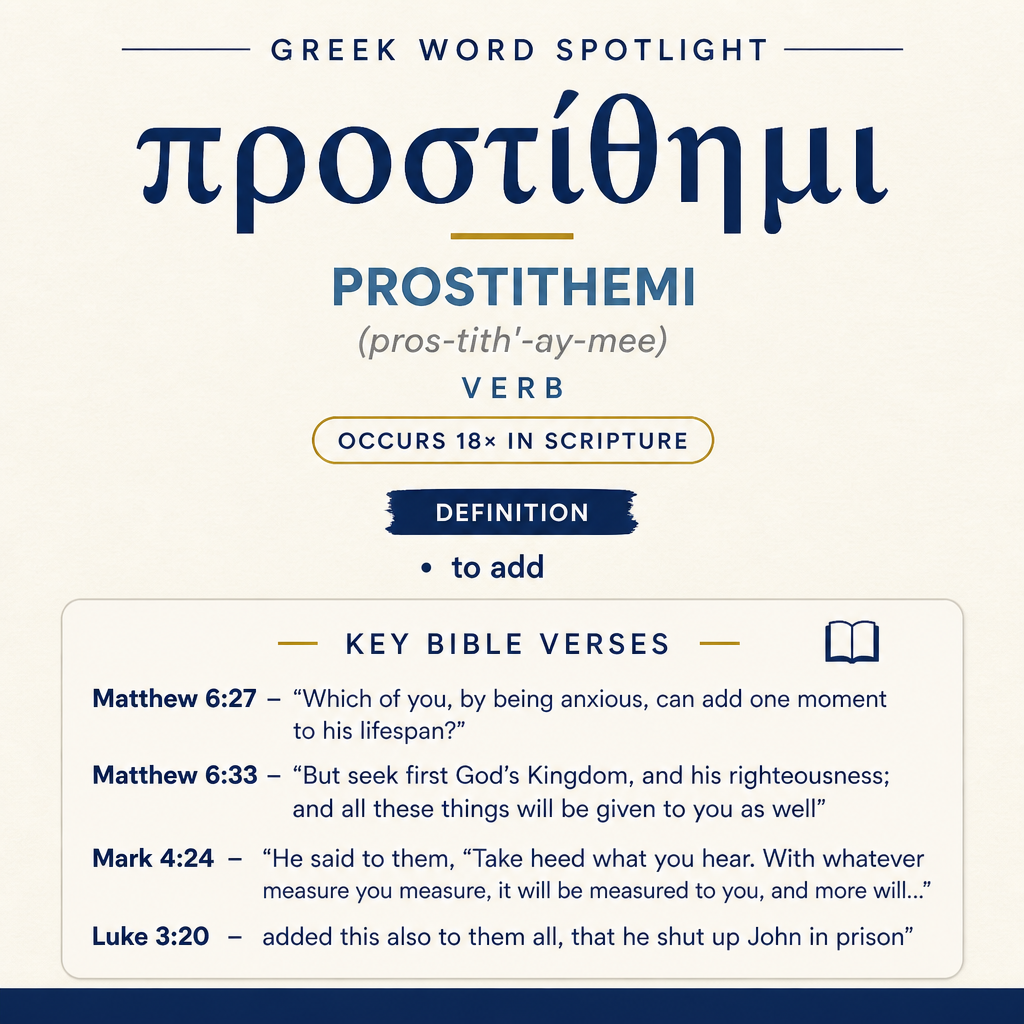
προστίθημι means “to add” and occurs 18 times in Scripture, including Matthew 6:27, Matthew 6:33, Mark 4:24, and Luke 3:20.
Core Meaning
προστίθημι means “to add.” In Luke 17:5 it appears in the request, “Increase our faith.”
Learn More →Teaching Contexts
Jesus uses it about what anxiety cannot do: it cannot add to one’s lifespan (Matthew 6:27) or height (Luke 12:25).
Learn More →Added Provision
It is used with seeking God’s Kingdom: “all these things will be added to you” (Luke 12:31), paralleling Matthew 6:33.
Learn More →προστίθημι expresses the act of adding, whether to a person’s life, to a set of provisions, to a request, to a sequence of actions, or to a growing community. In the passages where it appears, the verb regularly highlights what gets appended—an increment, an additional item, an extra deed, or further persons being joined.
Occurrences
“Which of you, by being anxious, can add one moment to his lifespan?” (Matthew 6:27)
Here προστίθημι names the specific outcome anxiety cannot accomplish: it cannot bring an addition, even a small one (“one moment”), to the quantity of a person’s lifespan. The verb frames lifespan as something that might be extended by an increment, and then denies that such an addition lies within anxious striving.
But seek first God’s Kingdom, and his righteousness; and all these things will be given to you as well. (Matthew 6:33)
In this setting the idea is of further provisions coming alongside a prior priority (“seek first”). προστίθημι marks the result as something appended in response to that priority: “all these things” come as an added benefit, not as the primary aim. The verb thus conveys an ordered sequence—first the Kingdom and righteousness, then additional things.
He said to them, “Take heed what you hear. With whatever measure you measure, it will be measured to you, and more will be given to you who hear. (Mark 4:24)
The saying uses the language of measurement and return. Within that framework, προστίθημι contributes the sense of an extra amount beyond what is already measured out: “and more will be given to you who hear.” The verb fits the logic of addition to a baseline—an increase that follows the measure and corresponds to the hearer’s reception.
added this also to them all, that he shut up John in prison. (Luke 3:20)
προστίθημι describes how one act is piled onto others: “this also” is added “to them all.” The added element is then specified—“that he shut up John in prison.” The verb gives the narrative a cumulative feel, presenting imprisonment as an additional deed appended to a preceding set.
Which of you by being anxious can add a cubit to his height? (Luke 12:25)
As in Matthew 6:27, the verb is used in a rhetorical question about the limits of anxiety. The proposed addition is physical and measurable (“a cubit” to “his height”), and προστίθημι highlights the impossibility of producing such an increment by worry. The focus remains on adding as a concrete increase.
But seek God’s Kingdom, and all these things will be added to you. (Luke 12:31)
Here the promise is stated directly in terms of addition: “all these things will be added to you.” προστίθημι portrays the “things” as something appended to the seeker, implying they come as an accrual beyond the primary pursuit (“seek God’s Kingdom”). The verb keeps the emphasis on receiving extras rather than treating them as the pursuit itself.
The apostles said to the Lord, “Increase our faith.” (Luke 17:5)
The request is voiced as a desire for addition: faith is treated as something that can have more added to it. προστίθημι therefore functions in a petitionary setting, where what is sought is not a different object but an augmented measure of what is already present (“our faith”).
As they heard these things, he went on and told a parable, because he was near Jerusalem, and they supposed that God’s Kingdom would be revealed immediately. (Luke 19:11)
In this narrative transition, προστίθημι expresses continuation: he “went on and told a parable.” The verb marks the parable as an added act of speaking appended to what had already been said (“as they heard these things”). It signals sequence—additional teaching delivered in response to their expectation about the Kingdom.
He sent yet another servant, and they also beat him, and treated him shamefully, and sent him away empty. (Luke 20:11)
Within the parable’s series of sendings, προστίθημι drives the repetition forward: another servant is added to the sequence of messengers. The verb contributes a sense of escalation by accumulation—one more emissary dispatched—while the quoted line reports how that additional servant is handled.
He sent yet a third, and they also wounded him, and threw him out. (Luke 20:12)
Again, the verb sustains the unfolding series: a “third” is added after prior servants. προστίθημι helps depict persistence through repeated additions to the attempt—another sending, another opportunity—while the response remains violent. The emphasis is not on a change of action but on the addition of yet one more servant into the pattern.
Then those who gladly received his word were baptized. There were added that day about three thousand souls. (Acts 2:41)
προστίθημι here names a communal growth: people are added in a countable way (“about three thousand souls”). The verb frames these baptized hearers as an attachment to an existing body, increasing its number. The addition is time-marked (“that day”), giving a snapshot of a large accrual in a single moment.
praising God, and having favor with all the people. The Lord added to the assembly day by day those who were being saved. (Acts 2:47)
This verse portrays addition as ongoing and attributed to the Lord: “The Lord added to the assembly day by day.” προστίθημι communicates steady accumulation over time, with the objects of addition specified as “those who were being saved.” The verb thus supports a picture of continuing growth in which new people are regularly appended to the existing assembly.

Sense and Usage
Across these passages, προστίθημι consistently retains the notion of adding, but it does so in several concrete settings. In Matthew 6:27 and Luke 12:25, adding is posed as a measurable increase—time (“one moment”) or stature (“a cubit”)—and the rhetorical force depends on the clarity of the increment. The verb makes the imagined change precise: not a vague improvement, but an actual addition to a quantifiable measure.
In Matthew 6:33 and Luke 12:31, the verb expresses added provisions in relation to a primary pursuit. The ordering is central: the Kingdom is sought, and “all these things” come as an addition. προστίθημι helps distinguish what is primary from what is appended, so that the “things” are portrayed as an accrual alongside the seeker rather than the object of first desire.
Mark 4:24 uses the logic of measurement and return, where “more” is an addition beyond what is already measured. The verb fits naturally with the imagery of quantities: an initial measure sets a baseline, and additional measure is appended. Luke 17:5 shifts the same adding idea into a request, treating faith as capable of receiving an added measure—an increase conceived as more being put onto what already exists.
Luke’s narrative and parabolic uses highlight addition as continuation or repetition. In Luke 19:11, the verb marks an added speech-act: after previous words, another element (a parable) is appended as the next step. In Luke 3:20, it characterizes a further deed added onto a collection of actions, with “this also” underscoring the cumulative pile-up. In Luke 20:11–12, the sending of “yet another” and “yet a third” portrays a sequence built by successive additions—each new servant is one more attempt added to the previous ones, and the growing list intensifies the sense of repeated action.
Acts 2:41 and 2:47 apply προστίθημι to people being added to a community. The verb comfortably carries counting language (“about three thousand souls”) and temporal rhythms (“day by day”), showing addition as both a sudden large increase and a regular ongoing pattern. In these scenes, adding is not merely attaching an abstract item; it is the incorporation of persons into an “assembly,” producing a visible growth in number and presence.
Imagery
The passages together give προστίθημι a tangible feel: moments, cubits, measured portions, an appended deed, an added parable, extra servants in a line, and people joined to an assembly. Whether the addition is impossible for anxiety, promised as an appended provision, requested as increased faith, or narrated as an expanding community, the verb consistently paints reality as something that can receive increments—items placed alongside what is already there.
Sources: Lexical data from Strong’s Exhaustive Concordance and the Translators Brief Lexicon of Extended Strongs for Greek (STEPBible, CC BY). Occurrence data from the Translators Amalgamated Greek New Testament (STEPBible, CC BY). Scripture quotations from the World English Bible (public domain).