
Exploring the Meaning of Prostasso in Greek
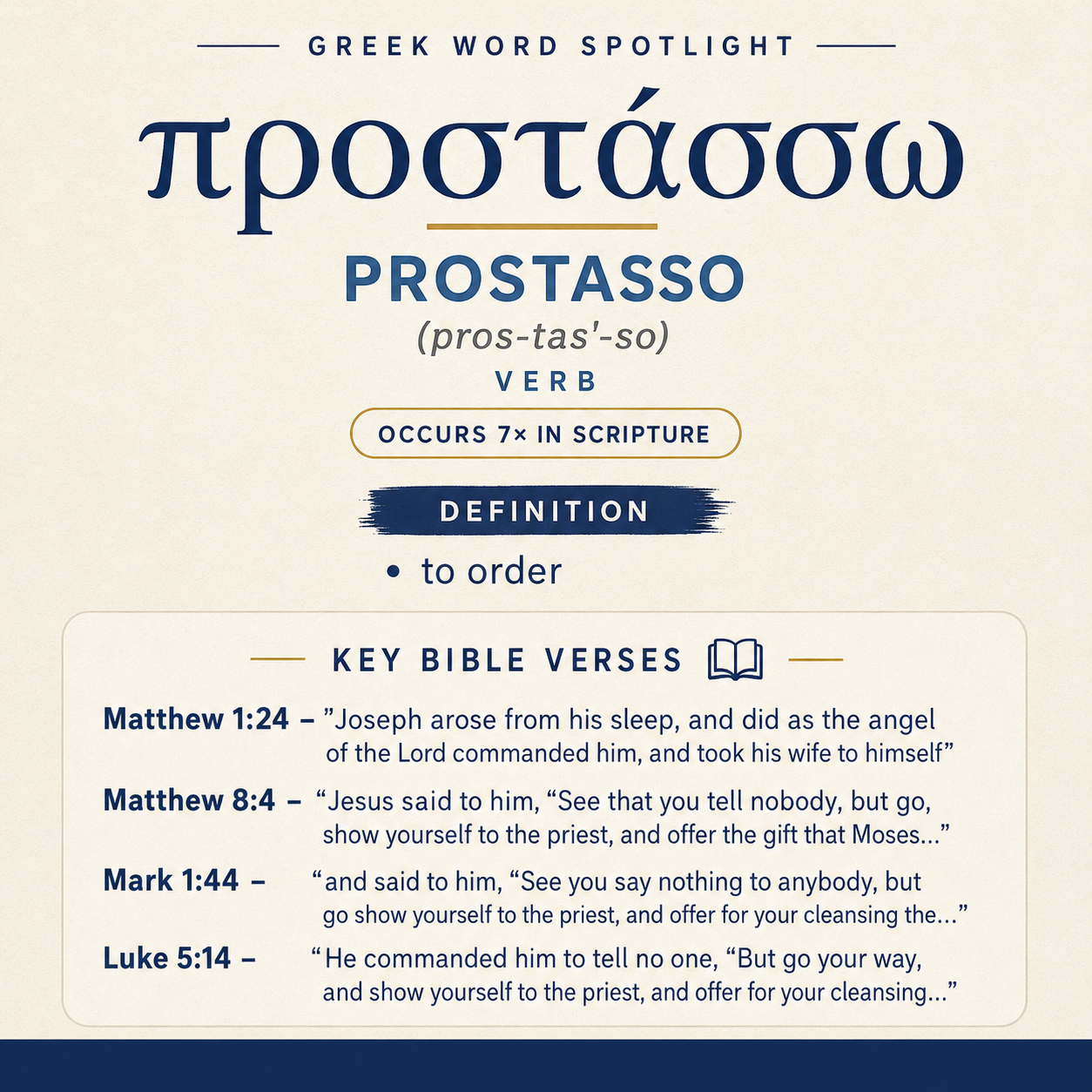
προστάσσω means “to order” and occurs 7 times in Scripture (Matthew 1:24; 8:4; Mark 1:44; Luke 5:14; Acts 10:33; 10:48; 17:26).
Core Meaning
προστάσσω is defined as “to order.” In its listed passages, it is used for giving a command.
Learn More →Gospel Commands
In Matthew 1:24, Joseph does what the angel of the Lord commanded. In Matthew 8:4, Mark 1:44, and Luke 5:14, Jesus commands a man to tell no one and to show himself to the priest.
Learn More →Acts Occurrences
Acts 10:33 records gathering in God’s sight after a message was sent. Acts 10:48 records a command to be baptized in the name of Jesus Christ, and Acts 17:26 speaks of determined appointed seasons.
Learn More →προστάσσω expresses the act of ordering—speech that carries binding force and expects compliance. In the passages where it appears, the verb frames directives given by heavenly messengers, by Jesus, by God, and by apostolic authority, and it also underlies reference to what Moses commanded.
Occurrences
Matthew 1:24 — “Joseph arose from his sleep, and did as the angel of the Lord commanded him, and took his wife to himself;”
Here προστάσσω marks a directive delivered by “the angel of the Lord,” and the verse immediately narrates the commanded action being carried out: Joseph “did as” he was commanded. The ordering is not left as a mere report of instruction; it functions as the hinge between revelation and obedience, showing that the command concretely shapes Joseph’s next steps (“arose… and took his wife”).

Matthew 8:4 — “Jesus said to him, “See that you tell nobody, but go, show yourself to the priest, and offer the gift that Moses commanded, as a testimony to them.””
Although the verse begins with Jesus’ own imperatives (“tell nobody… go… show yourself… offer”), προστάσσω appears in the clause that appeals to Mosaic command: “the gift that Moses commanded.” The ordering here functions as an authoritative precedent that governs what the healed man is to present. The command is attached to a specific, recognizable act (“offer the gift”), and it is oriented toward public verification (“as a testimony to them”).
Mark 1:44 — “and said to him, “See you say nothing to anybody, but go show yourself to the priest, and offer for your cleansing the things which Moses commanded, for a testimony to them.””
Mark’s wording similarly anchors the instructed offering in what “Moses commanded,” but in this scene the command serves to define the proper response “for your cleansing.” προστάσσω thus supports a chain of directed actions: silence toward others, appearance before the priest, and an offering that corresponds to what has already been commanded. The verb carries the weight of established authority that guides the man’s course and supplies a “testimony.”
Luke 5:14 — “He commanded him to tell no one, “But go your way, and show yourself to the priest, and offer for your cleansing according to what Moses commanded, for a testimony to them.””
Luke includes an explicit “He commanded him to tell no one,” and then links the man’s further steps to the Mosaic command—“according to what Moses commanded.” προστάσσω therefore operates on two levels in this verse: a direct command governing speech (“tell no one”) and a referenced command governing ritual response (“offer… according to what Moses commanded”). In the scene, ordering is presented as both immediate (spoken by Jesus) and mediated through prior authoritative instruction.
Acts 10:33 — “Therefore I sent to you at once, and it was good of you to come. Now therefore we are all here present in the sight of God to hear all things that have been commanded you by God.””
In Cornelius’s words, προστάσσω frames the meeting as an event convened under divine ordering: those assembled are “present in the sight of God” to hear what “have been commanded you by God.” The command here is not a single item spelled out in the verse; its force lies in establishing God as the one who orders what is to be spoken and heard. The verb gives the gathering a posture of accountability—what will be heard is characterized as commanded, not optional counsel.
Acts 10:48 — “He commanded them to be baptized in the name of Jesus Christ. Then they asked him to stay some days.”
Here προστάσσω appears as a decisive directive within the community’s response: “He commanded them to be baptized in the name of Jesus Christ.” The ordering is concrete and immediate, calling for an action that publicly marks allegiance “in the name of Jesus Christ.” The narrative then turns to hospitality (“they asked him to stay”), which highlights by contrast that baptism is presented as commanded, while the request to remain is a request rather than an order.
Acts 17:26 — “He made from one blood every nation of men to dwell on all the surface of the earth, having determined appointed seasons, and the boundaries of their dwellings,”
In Paul’s speech, the thought of ordering is carried by God’s decisive determination: human habitation across the earth unfolds under “appointed seasons” and “boundaries” that have been set. Even within a verse that emphasizes creation and providential arrangement, προστάσσω contributes the sense that history and geography are not left to human initiative alone; they stand within a framework of divinely ordered limits and times.

Sense and Usage
Across these passages, προστάσσω consistently signals an order that claims rightful authority and expects response. The word is used in settings where compliance is either narrated (Joseph “did as” commanded) or assumed as the proper posture (“to hear all things that have been commanded you by God”). The commands themselves range from personal and situational (directions about speech and movement) to practices anchored in established instruction (“offer… what Moses commanded”) and to acts that define communal identity (“be baptized in the name of Jesus Christ”).
A notable feature is how often the verb links an authority figure to a concrete action. In the healing accounts, the ordering is not abstract; it is embedded in specific steps: do not publicize, go to the priest, offer what is commanded, and let the result serve “as a testimony.” In Acts 10, the command frames both the content of proclamation (what God has commanded Peter) and the community’s response (baptism commanded). In Acts 17, the verb’s force fits a broader claim: the ordering that governs human life includes not only instructions delivered in speech but also the determined structure of times and boundaries.
The passages also show that προστάσσω can point to different sources of commanding authority. An angel commands Joseph; Moses is referenced as having commanded gifts or offerings; God is named as the one commanding what Peter is to communicate; and a leading figure in the narrative commands baptism. These uses do not compete so much as they locate command within recognized channels—heavenly messenger, foundational law, divine direction, and apostolic directive—each presented as capable of binding instruction within its scene.
Imagery and Texture
The verb often carries the imagery of ordered life: a sleeping man rising to act (Matthew 1:24), a healed person moving from private encounter to public verification “to the priest” with an offering “for a testimony” (Matthew 8:4; Mark 1:44; Luke 5:14), a roomful of hearers gathered “in the sight of God” (Acts 10:33), and a community directed into baptism (Acts 10:48). Even in the cosmic scope of Acts 17:26, the picture remains concrete: peoples dwelling over the earth within “appointed seasons” and “boundaries.” In these scenes, προστάσσω gives narrative moments a particular texture—events unfold not merely because someone suggests a course, but because an order is issued that shapes what happens next.
Sources: Lexical data from Strong’s Exhaustive Concordance and the Translators Brief Lexicon of Extended Strongs for Greek (STEPBible, CC BY). Occurrence data from the Translators Amalgamated Greek New Testament (STEPBible, CC BY). Scripture quotations from the World English Bible (public domain).





