Exploring the Meaning of Pro in Greek
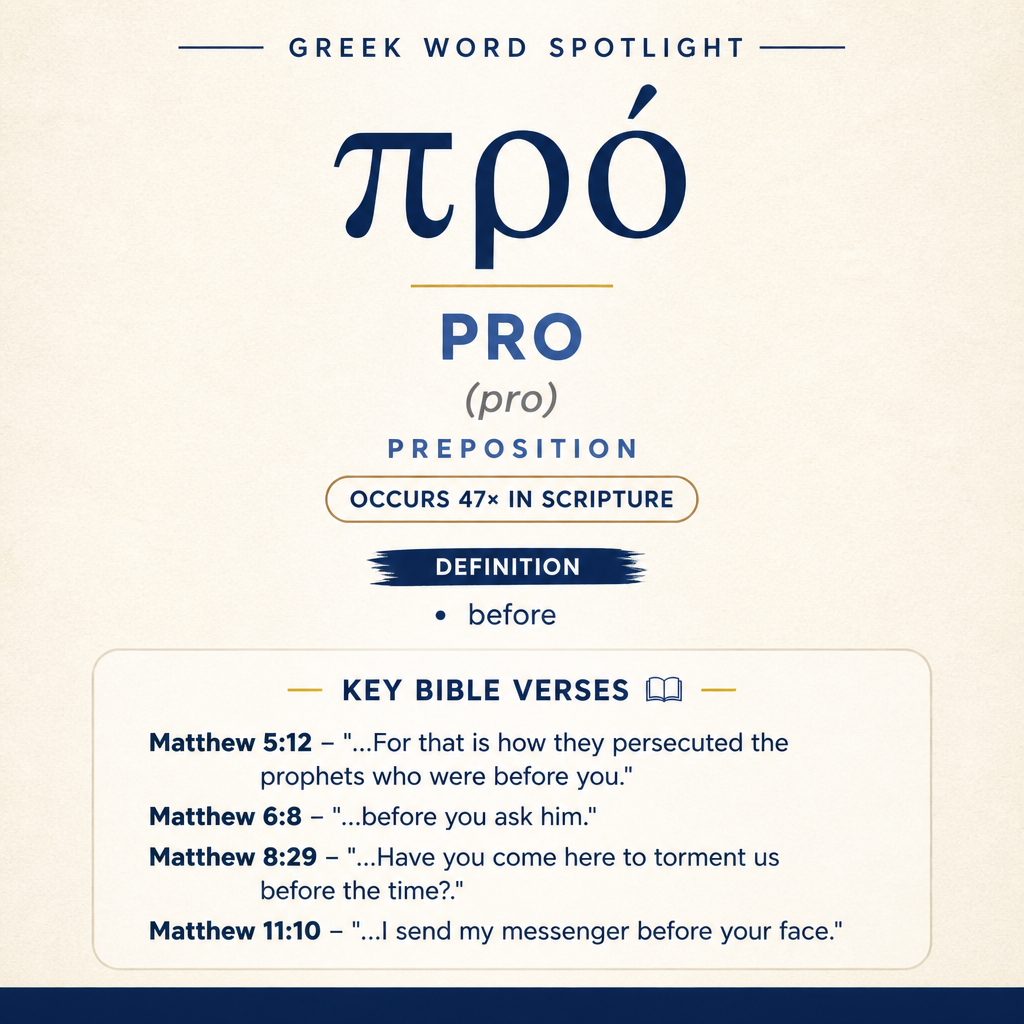
πρό means “before” and occurs 47 times in Scripture, including Matthew, Mark, and Luke.
Core Meaning
πρό is defined as “before.” It expresses priority in time or position, as shown in “before you ask him” (Matthew 6:8).
Learn More →Gospel Examples
In Matthew 11:10 and Mark 1:2, πρό appears in the quotation, “I send my messenger before your face.” Luke 7:27 repeats the same wording.
Learn More →Before Key Events
πρό is used for time before major moments, such as “before the flood” (Matthew 24:38). It also appears in Matthew 8:29 in the phrase “before the time.”
Learn More →πρό expresses the idea of being “before” someone or something, whether in time, in sequence, or in front of a person’s presence. In the passages cited here, it marks what comes earlier (events, preparations, naming) and what stands in front (messengers sent ahead, defendants brought into a ruler’s presence).
Occurrences
“Rejoice, and be exceedingly glad, for great is your reward in heaven. For that is how they persecuted the prophets who were before you.” (Matthew 5:12)
Here πρό places “the prophets” earlier than the present audience in a line of suffering: persecution is framed as something that happened to those who came before. The word links present experience to an earlier pattern without shifting the focus away from the audience’s current “reward in heaven.”

“Therefore don’t be like them, for your Father knows what things you need, before you ask him.” (Matthew 6:8)
πρό marks a time relation between divine knowledge and human asking. The sequence matters: the Father’s knowing is set prior to the request itself, so prayer is not presented as informing God but as occurring after his prior awareness.
“Behold, they cried out, saying, “What do we have to do with you, Jesus, Son of God? Have you come here to torment us before the time?”” (Matthew 8:29)
πρό sets “the time” as a boundary that has not yet arrived; the question assumes a proper time for torment and fears an action occurring earlier than that. The preposition sharpens the protest by making timing the central issue, not the identity of Jesus (which they acknowledge).
“For this is he, of whom it is written, ‘Behold, I send my messenger before your face, who will prepare your way before you.’” (Matthew 11:10)
πρό appears twice to depict both position and sequence. “Before your face” places the messenger out in front of the one addressed, and “prepare your way before you” presents preparation as something done in advance of the coming journey. The repeated “before” ties the messenger’s role to going ahead so that what follows can proceed on a prepared path.
“For as in those days which were before the flood they were eating and drinking, marrying and giving in marriage, until the day that Noah entered into the ship,” (Matthew 24:38)
πρό locates a whole period of ordinary life in relation to the flood: it was “before” it. The preposition helps set a contrast between routine activities and the approaching event, and it brackets that earlier time as continuing “until the day that Noah entered into the ship.”
“As it is written in the prophets, “Behold, I send my messenger before your face, who will prepare your way before you:” (Mark 1:2)
As in Matthew 11:10, πρό gives the messenger’s defining orientation—out in front, preceding the one whose arrival is anticipated. The word supplies the spatial immediacy (“before your face”) and the temporal advantage of preparation (“before you”), depicting advance work done ahead of the main figure’s coming.
“When eight days were fulfilled for the circumcision of the child, his name was called Jesus, which was given by the angel before he was conceived in the womb.” (Luke 2:21)
πρό marks a clear “before” in time: the name “Jesus” was given earlier than the conception. The verse anchors the child’s naming in a prior act (“given by the angel”), with πρό specifying that this determination preceded the child’s existence in the womb.
“This is he of whom it is written, ‘Behold, I send my messenger before your face, who will prepare your way before you.’” (Luke 7:27)
Again πρό characterizes the messenger’s function as going ahead. The doubled use reinforces that the messenger stands in front of the addressed person and that his work consists of advance preparation; “before” is the key relational idea binding messenger, face-to-face presence, and prepared way.
“and sent messengers before his face. They went and entered into a village of the Samaritans, so as to prepare for him.” (Luke 9:52)
πρό situates the “messengers” in front of Jesus, preceding his arrival. The narrative outcome (“entered into a village… so as to prepare for him”) shows what this “before” accomplishes: their position ahead of him enables preparation in the place he has not yet reached.
“Now after these things, the Lord also appointed seventy others, and sent them two by two ahead of him into every city and place where he was about to come.” (Luke 10:1)
Though phrased “ahead of him,” the scene embodies the same “before” relationship: those sent go in advance of the Lord into locations he “was about to come” to. The temporal sequence (messengers first, the Lord after) creates a deliberate ordering of mission and arrival.
“When the Pharisee saw it, he marveled that he had not first washed himself before dinner.” (Luke 11:38)
πρό marks the expected ordering of actions in a meal setting. Washing is conceived as something that should happen earlier than dinner; the Pharisee’s amazement hinges on that customary sequence being reversed or omitted.
“But before all these things, they will lay their hands on you and will persecute you, delivering you up to synagogues and prisons, bringing you before kings and governors for my name’s sake.” (Luke 21:12)
πρό works on two fronts in this verse. First, “before all these things” places persecution earlier than other unnamed events, prioritizing it in the timeline. Second, “bringing you before kings and governors” depicts being led into the presence of authorities—“before” them—so that suffering includes both the earlier onset of persecution and the concrete experience of appearing in front of rulers.

Sense and Usage
Across these passages πρό consistently draws a line of priority: something is positioned or scheduled earlier than something else, or placed in front of someone’s presence. In several texts the “before” is explicitly temporal. Matthew 6:8 aligns the Father’s knowledge earlier than prayer; Matthew 8:29 debates whether torment is occurring earlier than its proper time; Luke 2:21 anchors the naming of Jesus earlier than his conception; Luke 11:38 makes washing an action expected earlier than eating. Matthew 24:38 stretches temporal “before” across an entire season of life—“those days which were before the flood”—so that ordinary behavior is located on the earlier side of a decisive event.
Other occurrences connect “before” with forward placement that enables preparation. The repeated formula “before your face” and “before you” (Matthew 11:10; Mark 1:2; Luke 7:27) portrays an agent who goes in front and makes ready what lies ahead. Luke 9:52 narrates that relationship in action: messengers are sent “before his face” and their advance arrival in a Samaritan village is for the purpose of preparation. Luke 10:1 likewise has the Lord sending others “ahead of him” into places “where he was about to come,” emphasizing ordered movement: advance workers first, the coming figure afterward.
Luke 21:12 shows that πρό can connect temporal ordering and physical presence in a single breath. Persecution occurs “before all these things,” and the persecuted are brought “before kings and governors.” In that setting, “before” is both a matter of when suffering begins and where it takes place—publicly, in the presence of powerful officials. Matthew 5:12 uses “before you” differently again: it situates earlier people (“the prophets”) in relation to the audience, so that “before” marks prior generations and establishes a sequence of experience through time.
Imagery
The word’s imagery in these verses is often vivid because “before” naturally creates a scene of movement and placement: a messenger out in front of someone’s face, workers entering a village ahead of an arriving Lord, defendants standing in front of kings and governors. Even when it is purely temporal—before asking, before the time, before the flood—the preposition frames life as ordered around thresholds and arrivals, with earlier moments casting their shadow forward into what comes next.
Sources: Lexical data from Strong’s Exhaustive Concordance and the Translators Brief Lexicon of Extended Strongs for Greek (STEPBible, CC BY). Occurrence data from the Translators Amalgamated Greek New Testament (STEPBible, CC BY). Scripture quotations from the World English Bible (public domain).