
Exploring the Meaning of Poudes in Greek
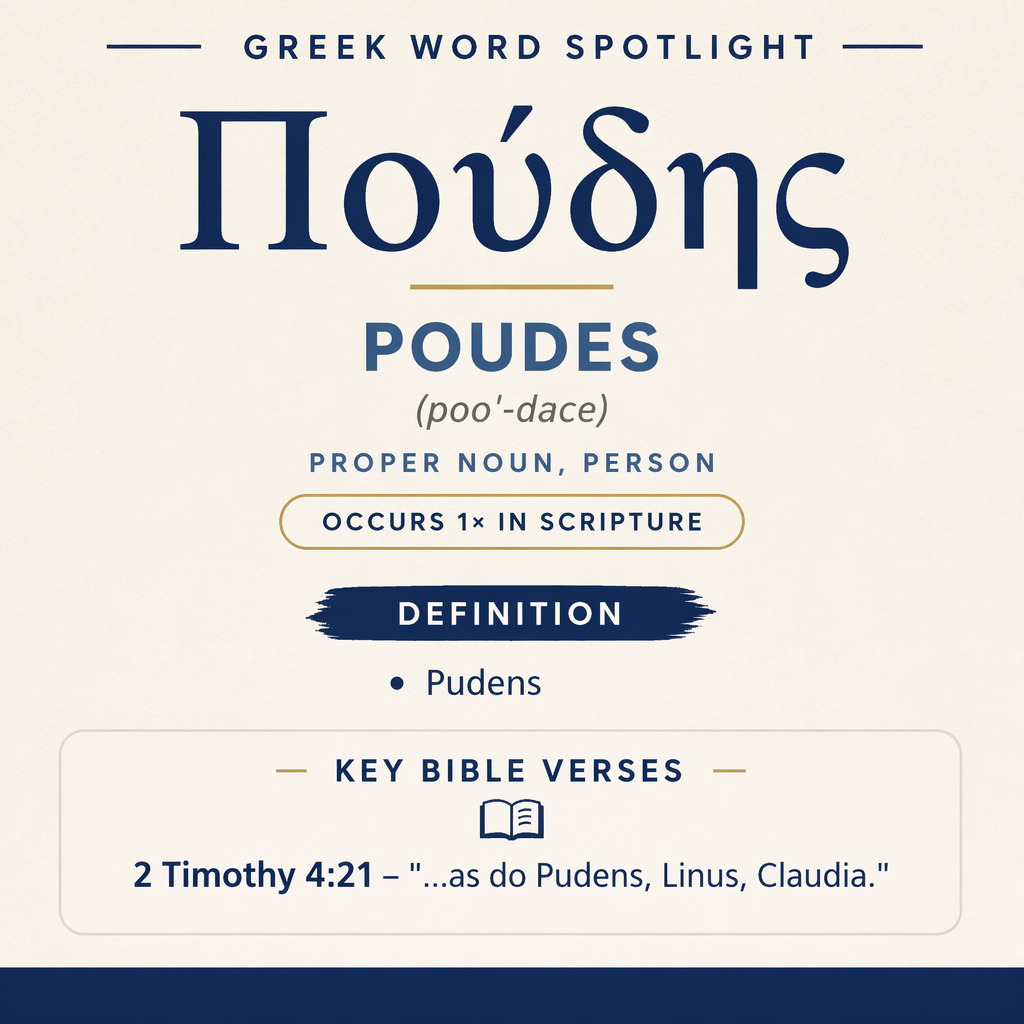
Πούδης (Poudes) means Pudens and appears once in Scripture, in 2 Timothy 4:21.
Verse Context
In 2 Timothy 4:21, Pudens is among those who send greetings, alongside Eubulus, Linus, Claudia, and all the brothers.
Learn More →Πούδης refers to Pudens and appears in a single New Testament occurrence, within a closing greeting list. In that setting, the name functions as part of a small network of individuals sending salutations in a letter’s final lines.
Occurrences
“Be diligent to come before winter. Eubulus salutes you, as do Pudens, Linus, Claudia, and all the brothers.” (2 Timothy 4:21)
Here Πούδης (Pudens) is presented as one of several named greeters. The verse has two movements: an urgent travel request (“Be diligent to come before winter”) followed by a cluster of salutations (“Eubulus salutes you, as do Pudens, Linus, Claudia, and all the brothers”). In this second movement, Pudens is coordinated with other individuals by the phrasing “as do,” which places him alongside Eubulus, Linus, and Claudia as a distinct personal voice within the larger group called “all the brothers.” The name therefore contributes specificity within a communal closing: the greeting is not only from a collective body but also from identifiable members of that body.

The positioning of Pudens in the list also matters for how the verse reads. Eubulus is singled out first with the direct verb “salutes,” and then the others are added in a coordinated series (“as do Pudens, Linus, Claudia”), before the line widens again to include “all the brothers.” Within this structure, Pudens belongs to the intermediate layer: neither the initial singled-out greeter nor the anonymous collective, but one of the explicitly named persons who stand between those two poles. The effect is to make the closing greetings feel concrete and relational, as a real set of people attached to the sender(s) and concerned for the recipient.

Sense and Usage
As a personal name, Πούδης designates an individual rather than describing an action or quality. In 2 Timothy 4:21, the name functions in the ordinary way proper nouns function in letters: it identifies who is participating in a social act—in this case, sending greetings. The sense “Pudens” is realized not by any descriptive content about the person, but by the role the person is shown to play in the immediate discourse. The verse supplies a simple but clear depiction: Pudens is someone whose greeting can be conveyed to the recipient alongside greetings from others.
The fact that Pudens is listed with other named individuals shapes the usage. A single proper name can sometimes serve as a focal point in a narrative, but here it operates as one element in a string of names. That list-setting suggests a shared location or shared association among the greeters, because they speak with one voice in the act of saluting. The list also implies that the recipient is expected to recognize, or at least receive meaningfully, a greeting from Pudens specifically. Even without further description, the inclusion of the name implies that the greeting from this individual matters enough to be transmitted with the letter and preserved in its closing.
Within the verse’s social dynamics, Pudens contributes to the letter’s sense of community and immediacy. The travel request “come before winter” creates urgency, and the subsequent greetings anchor that urgency in relationships: the recipient is not being urged in isolation but is being addressed within a circle of people who are aware of, and involved in, the correspondence. Pudens’ name thus functions as a marker of participation in that circle. The greeting list is not merely formal; it reads as a personal roll call of those who are present with the sender(s) and who extend regard to the recipient.
In addition, Pudens appears among both men and women as indicated by the mixed set of names (“Pudens, Linus, Claudia”), and then alongside “all the brothers,” a broader term for the believing community. The verse’s language creates a layered social picture: individuals with personal names and a wider group identity. Pudens’ name belongs to the individualized layer—an instance of personal identity within a collective greeting. This is a common and natural use of a proper noun in epistolary discourse: it is not an abstract label but a concrete identification that makes the closing of the letter feel populated by real persons.
Closing Imagery
The imagery tied to Πούδης in this passage is the imagery of a winter-timed farewell and a spoken greeting carried across distance. “Come before winter” evokes a narrowing window of time, and the linked salutations portray a gathered group voicing goodwill toward someone absent. Pudens’ name sits within that scene as one of the distinct voices included in the farewell: a specific person within a roomful of “brothers,” sending a greeting that the letter itself delivers.
Sources: Lexical data from Strong’s Exhaustive Concordance and the Translators Brief Lexicon of Extended Strongs for Greek (STEPBible, CC BY). Occurrence data from the Translators Amalgamated Greek New Testament (STEPBible, CC BY). Scripture quotations from the World English Bible (public domain).




