
Exploring the Meaning of Piprasko in Greek
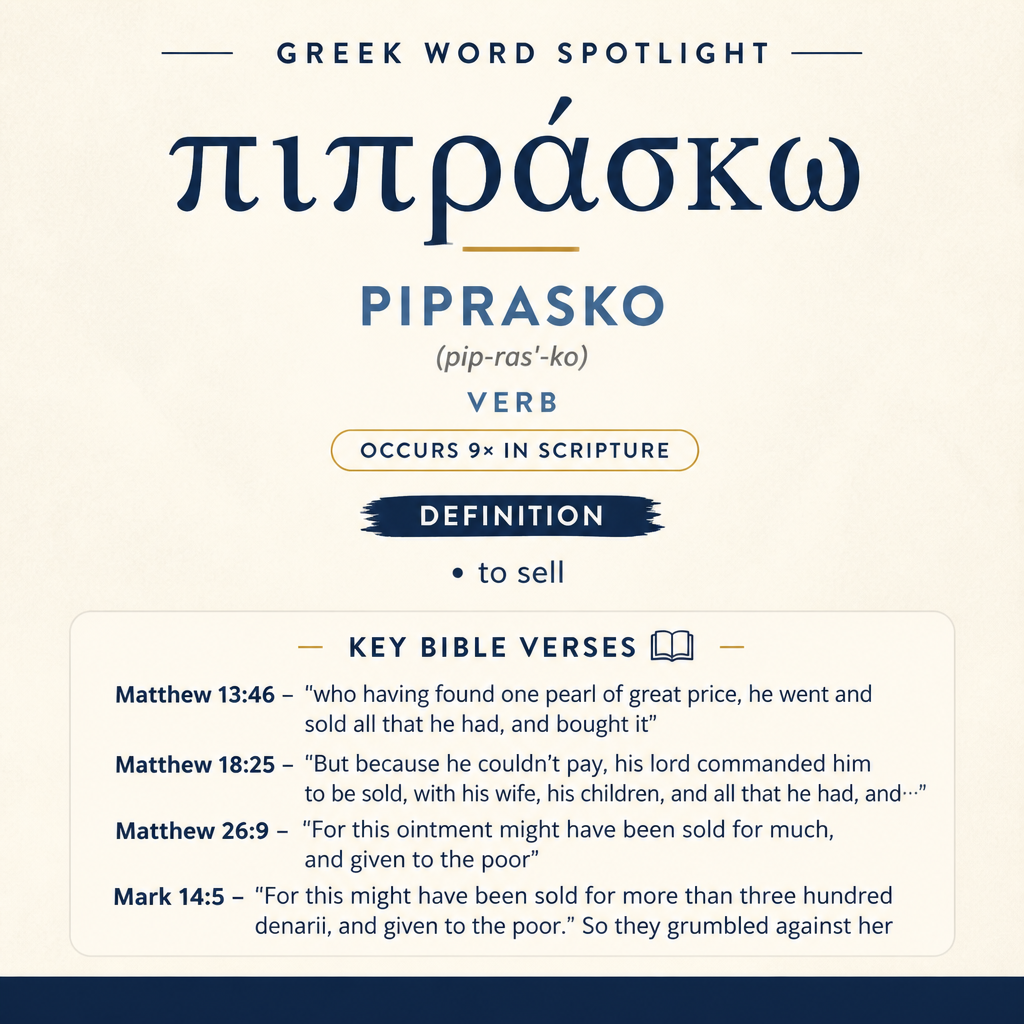
πιπράσκω means “to sell” and occurs 9 times in Scripture, including Matthew 13:46, Matthew 18:25, Matthew 26:9, Mark 14:5, John 12:5, and Acts 2:45.
Core Meaning
πιπράσκω means “to sell.” It is used for selling possessions, goods, and items of value.
Learn More →Gospel Contexts
In Matthew 13:46 it describes selling all one has to buy a pearl. In Matthew 26:9, Mark 14:5, and John 12:5 it refers to ointment that could have been sold.
Learn More →Acts Contexts
In Acts 2:45 and Acts 4:34 it describes believers selling possessions and goods to meet needs. In Acts 5:4 it refers to property “after it was sold.”
Learn More →πιπράσκω means “to sell,” appearing in sayings of Jesus, Gospel narratives about costly ointment, the early church’s communal generosity, a confrontation about a property transaction, and Paul’s description of being “sold under sin.” Across these settings, the verb consistently marks a transfer framed in terms of price, ownership, and the consequences of what is exchanged.
Occurrences
Matthew 13:46 — “who having found one pearl of great price, he went and sold all that he had, and bought it.”
Here πιπράσκω names the decisive act that liquidates “all that he had” in order to fund a purchase. The verb stands at the hinge between valuing (“one pearl of great price”) and acquiring (“bought it”): selling is the surrender of prior holdings so that a new, surpassing possession can be obtained. The wording highlights totality (“all that he had”) rather than the mechanics of the transaction, stressing the scope of what is sold.
Matthew 18:25 — “But because he couldn’t pay, his lord commanded him to be sold, with his wife, his children, and all that he had, and payment to be made.”
In this parable setting, the verb shifts from voluntary choice to coercive remedy: “his lord commanded him to be sold.” Selling functions as an enforced means of “payment to be made” when a debt “couldn’t” be paid otherwise. The reach of the sale expands beyond the debtor to “his wife, his children, and all that he had,” placing πιπράσκω in a scene where persons and household goods are treated as assets for settling accounts.
Matthew 26:9 — “For this ointment might have been sold for much, and given to the poor.”
In the complaint about the ointment, πιπράσκω is used hypothetically (“might have been sold”), pairing the act of selling with an explicit valuation (“for much”) and a proposed redirection of proceeds (“given to the poor”). The verb contributes the idea of converting a valuable object into resources. The criticism assumes that selling is the appropriate path for turning an item’s worth into charitable giving.
Mark 14:5 — “For this might have been sold for more than three hundred denarii, and given to the poor.” So they grumbled against her.
This parallel scene makes the valuation more concrete: “more than three hundred denarii.” πιπράσκω again frames the alternative action that the grumblers present as morally preferable. The verb is central to their reasoning: if the ointment were sold, the money could be distributed. Their reaction (“they grumbled against her”) shows how the imagined sale becomes a standard against which the woman’s act is judged.
John 12:5 — “Why wasn’t this ointment sold for three hundred denarii, and given to the poor?”
In John’s wording, the same idea appears as a pointed question. πιπράσκω is the missing step in the speaker’s proposed chain: sell the ointment (“for three hundred denarii”), then give to the poor. The verb’s contribution is to present selling as an expected conversion of luxury into aid; the complaint treats the unsold ointment as a forfeited opportunity for measurable generosity.
Acts 2:45 — “They sold their possessions and goods, and distributed them to all, according as anyone had need.”
Within the early community, πιπράσκω describes a repeated, concrete practice: “They sold their possessions and goods.” The sale is directly linked to distribution “to all” and calibrated to need (“according as anyone had need”). The verb marks the act by which privately held assets are turned into shareable resources, setting selling in the service of meeting practical needs.
Acts 4:34 — “For neither was there among them any who lacked, for as many as were owners of lands or houses sold them, and brought the proceeds of the things that were sold,”
Here selling is tied to specific property types: “lands or houses.” πιπράσκω signals a substantial divestment, and the verse explicitly mentions “the proceeds,” keeping the economic outcome in view. The community result is stated first—“neither was there among them any who lacked”—and the selling of real property is then presented as a means that supports that condition of provision.
Acts 5:4 — “While you kept it, didn’t it remain your own? After it was sold, wasn’t it in your power? How is it that you have conceived this thing in your heart? You haven’t lied to men, but to God.”
In Peter’s confrontation, πιπράσκω appears in the timeframe of a transaction: “After it was sold.” The sale marks a boundary between possession (“didn’t it remain your own?”) and the continued authority over the outcome (“wasn’t it in your power?”). The verb thus contributes a clear moment of change in the property’s status—sold rather than merely kept—while the speaker emphasizes that even after selling, the proceeds were still subject to the seller’s control. The moral issue in the scene is not the act of selling itself but the deceit addressed in the closing accusation.
Romans 7:14 — “For we know that the law is spiritual, but I am fleshly, sold under sin.”
This usage is metaphorical: “sold under sin.” πιπράσκω supplies imagery drawn from the marketplace or household economy—being sold—applied to a condition of subjection. The phrase compresses a complex inner conflict into the stark picture of a person described as “fleshly” and placed “under” a dominating power. The verb’s force lies in portraying an altered status: not acting as a free agent but as one transferred into a binding relationship.

Sense and Usage
Across these passages, πιπράσκω consistently situates actions and persons in terms of ownership and value. In Matthew 13:46 the sale is purposeful and total: what is sold funds what is bought, and the scale (“all that he had”) underscores the seller’s valuation of the prize. Matthew 18:25 sets selling within obligation and authority—an act “commanded” to satisfy a debt—showing how selling can function as a forced solution when payment is impossible by other means.
The anointing scenes (Matthew 26:9; Mark 14:5; John 12:5) use selling as a moral-economic comparison. The repeated pairing of πιπράσκω with a monetary estimate (“for much,” “more than three hundred denarii,” “for three hundred denarii”) highlights that selling is the step that translates a valued object into quantifiable help. In these verses the verb is not narrated as having occurred; instead, it represents an alternate path that critics treat as obvious. That rhetorical use reveals how “sell” can serve as shorthand for choosing measurable benefit over the retention or expenditure of a costly item.
Acts extends the verb into communal practice. Selling “possessions and goods” (Acts 2:45) and even “lands or houses” (Acts 4:34) is presented as the practical means by which a community moves from private ownership to shared provision. The mention of “proceeds” keeps the focus on the result of the sale: resources become distributable. Acts 5:4 adds a careful distinction between the property’s state before and after selling and the continuing agency of the owner over what follows—“wasn’t it in your power?”—showing that the sale does not erase responsibility or truthfulness.
Romans 7:14 draws on the same verb to frame a human condition. “Sold under sin” uses commercial language to depict subjection, and the collocation with “under” portrays a dominated status rather than a mere action of selling. In this way πιπράσκω can function not only as a description of an economic transaction but also as an image for a transferred or constrained standing, where the decisive point is not price but bondage.
Imagery
The passages together attach πιπράσκω to vivid scenes of exchange: a person selling everything to secure a single treasure (Matthew 13:46), a household ordered sold to cover debt (Matthew 18:25), a costly ointment weighed in denarii (Mark 14:5; John 12:5), and property sold so that “neither was there among them any who lacked” (Acts 4:34). Even when no money is mentioned, the verb carries the feel of a transaction with consequences—what is owned, what is relinquished, and what new condition follows, whether provision for others or a darker metaphor of being “sold under sin” (Romans 7:14).
Sources: Lexical data from Strong’s Exhaustive Concordance and the Translators Brief Lexicon of Extended Strongs for Greek (STEPBible, CC BY). Occurrence data from the Translators Amalgamated Greek New Testament (STEPBible, CC BY). Scripture quotations from the World English Bible (public domain).





