Exploring the Meaning of Pipto in Greek
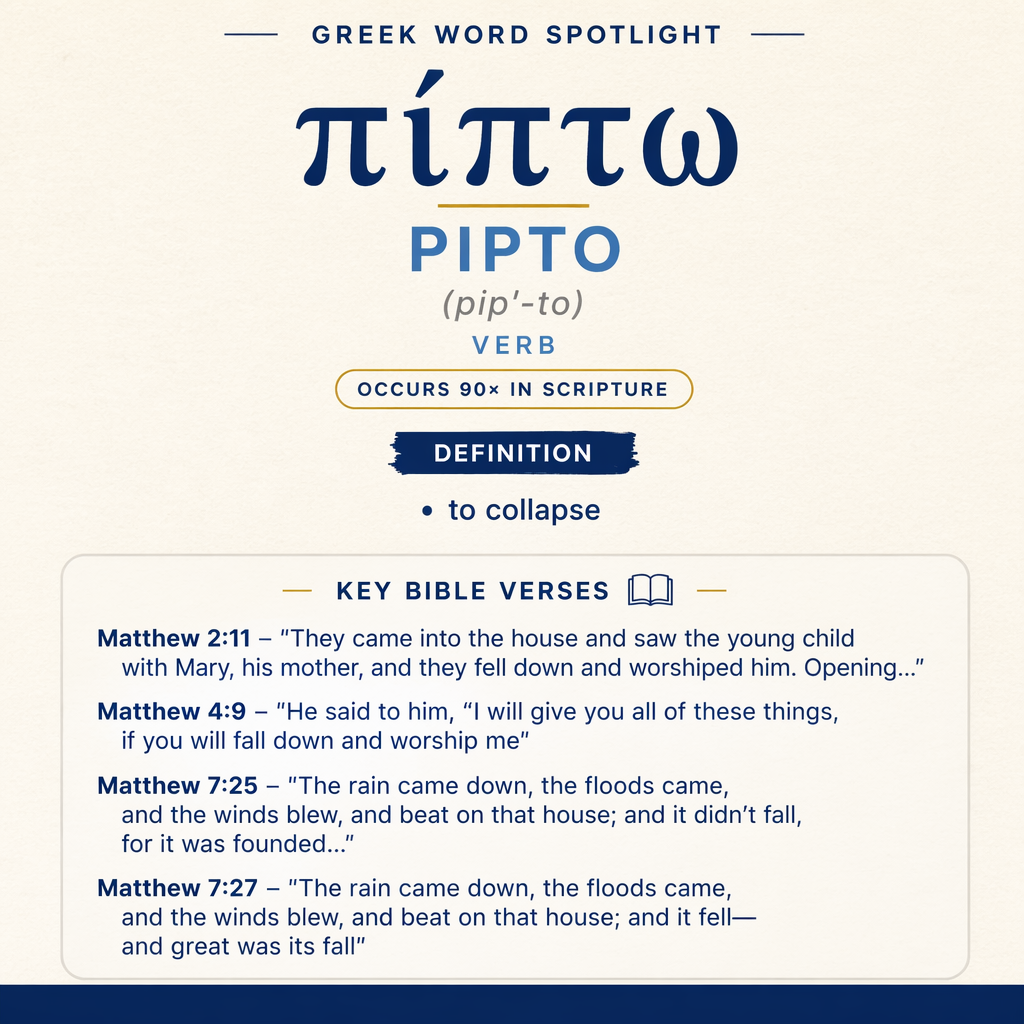
πίπτω means “to collapse” and occurs 90 times in Scripture, including Matthew 2:11; 4:9; 7:25,27; 10:29; 13:4–7.
Core Meaning
πίπτω is defined as “to collapse.” It is used for falling down and for things falling to the ground.
Learn More →Matthew Examples
In Matthew 2:11 and 4:9 it describes falling down in worship. In Matthew 7:25,27 it describes a house that does not fall or that falls greatly.
Learn More →Common Scenes
It is used of sparrows falling to the ground (Matthew 10:29). It is also used of seed falling in different places in the parable (Matthew 13:4–7).
Learn More →πίπτω is a Greek verb meaning “to collapse.” In the passages quoted here it describes bodies dropping low in reverence or fear, objects and living creatures coming down to the ground, and structures giving way under pressure.
Occurrences
Matthew 2:11 — “They came into the house and saw the young child with Mary, his mother, and they fell down and worshiped him. Opening their treasures, they offered to him gifts: gold, frankincense, and myrrh.”
Here πίπτω marks a decisive bodily movement that accompanies worship. The visitors’ action is not merely inward honor; it is expressed as a physical collapsing downward before the child, followed immediately by the opening of treasures and the presentation of gifts. The verb helps frame worship as something enacted with the whole body in a concrete space (“into the house”).
Matthew 4:9 — “He said to him, “I will give you all of these things, if you will fall down and worship me.””
In this demand, πίπτω is joined to worship as the required posture for giving honor. The conditional offer turns the act of collapsing down into a test of allegiance: the one speaking asks for a visible, embodied submission (“fall down”) as the gateway to receiving “all of these things.” The verb carries the weight of an outward sign that would seal an inward commitment.
Matthew 7:25 — “The rain came down, the floods came, and the winds blew, and beat on that house; and it didn’t fall, for it was founded on the rock.”
πίπτω is used negatively to describe what does not happen to the house under repeated assault. The scene stacks pressures—rain, floods, winds, and the beating of the house—yet the key outcome is that the structure does not collapse. The verb expresses structural failure as the feared result, and its denial highlights stability tied to the house’s foundation.
Matthew 7:27 — “The rain came down, the floods came, and the winds blew, and beat on that house; and it fell—and great was its fall.”
In contrast to the previous house, this one does collapse when struck by the same forces. πίπτω depicts a total giving way, and the added line “great was its fall” stresses the magnitude of the collapse and its consequences. The verb is the turning point in the picture: the moment a structure can no longer stand against sustained external pressure.
Matthew 10:29 — ““Aren’t two sparrows sold for an assarion coin? Not one of them falls on the ground apart from your Father’s will,”
πίπτω is applied to a small creature coming down to the earth. The statement sets the commonplace event—one sparrow collapsing to the ground—within a larger claim about oversight and intention. The verb supplies the ordinary, observable action (a sparrow’s fall) that anchors the argument in something tangible and easily imagined.
Matthew 13:4 — “As he sowed, some seeds fell by the roadside, and the birds came and devoured them.”
Here πίπτω describes the seed’s downward drop during sowing, with emphasis on where it lands: “by the roadside.” The verb introduces the chain of outcomes: the place of collapse determines vulnerability, and the birds’ devouring follows directly from the seed ending up exposed in that location.
Matthew 13:5 — “Others fell on rocky ground, where they didn’t have much soil, and immediately they sprang up, because they had no depth of earth.”
πίπτω again depicts the seed’s landing, this time “on rocky ground.” The verb functions as the hinge between the act of sowing and the later growth description: the seed’s collapse onto shallow soil explains the quick sprouting (“immediately”) and also the underlying limitation (“no depth of earth”). The landing is not incidental; it shapes what follows.
Matthew 13:7 — “Others fell among thorns. The thorns grew up and choked them.”
In this line πίπτω places the seed “among thorns,” and that setting becomes the problem. The verb’s simple depiction of collapse into a crowded, hostile environment sets up the consequence: the thorns’ growth and the choking of what was sown. The fall is a placement into competition and constraint.
Matthew 13:8 — “Others fell on good soil, and yielded fruit: some one hundred times as much, some sixty, and some thirty.”
πίπτω here leads to the most favorable outcome. The seed collapses “on good soil,” and the result is fruitfulness with varying measures of yield. The verb itself remains the same physical action, but the context shows that the significance of collapsing down depends greatly on the receiving surface and what it supports afterward.
Matthew 15:14 — “Leave them alone. They are blind guides of the blind. If the blind guide the blind, both will fall into a pit.”
πίπτω is used metaphorically within a concrete image: falling “into a pit.” The picture is of misdirected movement ending in a sudden collapse downward into danger, and the verb underscores the inevitability of the outcome when guidance is impaired (“blind guides of the blind”). The collapse is shared—“both”—so the verb also conveys the cascading effect of one person’s misdirection on another’s ruin.
Matthew 15:27 — “But she said, “Yes, Lord, but even the dogs eat the crumbs which fall from their masters’ table.””
πίπτω describes small pieces of food collapsing from a table to a lower place where dogs can eat them. The verb contributes a domestic realism: crumbs are not handed down; they drop. That downward movement supports the speaker’s point by portraying access that comes through what falls rather than what is formally served.
Matthew 17:6 — “When the disciples heard it, they fell on their faces, and were very afraid.”
πίπτω depicts an immediate bodily collapse “on their faces” in response to what they heard, paired with intense fear. The verb conveys a loss of upright composure: the disciples’ reaction is not measured but overwhelming, expressed in a sudden downward motion that matches the stated emotion (“very afraid”).

Sense and Usage
Across these scenes, “collapse” appears in several recognizable patterns. First, there is deliberate collapsing as an enacted posture: in Matthew 2:11 and 4:9 the downward movement is paired with “worship,” making the action a visible demonstration of honor. The same kind of bodily dropping occurs in Matthew 17:6, though there it rises from fear rather than an offered act of homage; the collapse registers the hearers’ inability to remain standing in the moment.
Second, πίπτω describes collapse as failure under pressure or as a sudden plunge into danger. The paired house sayings (Matthew 7:25, 7:27) treat collapsing as the decisive outcome of a storm’s sustained assault: the verb marks the boundary between endurance and ruin, with “great was its fall” intensifying the picture of total structural giving way. In Matthew 15:14 the “pit” image draws on the same physical logic—downward collapse into a lower, hazardous space—while applying it to the consequences of misguided leadership. The verb’s force lies in the abruptness of the change from standing to down, from safety to peril.
Third, πίπτω appears in ordinary downward movement that sets conditions for what follows. Matthew 10:29 uses the collapse of a sparrow “on the ground” as an everyday event, chosen precisely because it is small and easily overlooked. The sower sayings (Matthew 13:4–8) repeatedly use the seed’s collapse as a way of locating it: roadside, rocky ground, among thorns, good soil. The action itself is simple, but each landing place carries a different future—exposure to devouring, thinness of earth, choking competition, or fruit-bearing growth. Similarly, Matthew 15:27 turns on crumbs collapsing from a table: the downward movement creates an avenue for eating that exists beneath the level of those who sit at the table.
These uses show how πίπτω can describe a single basic movement—going down in a collapse—while the surrounding details determine whether the collapse is chosen or compelled, beneficial or disastrous, small and routine or large and final. The verb can portray reverence, fear, vulnerability, ruin, and provision, all by focusing on the moment something that was higher ends up lower.
Imagery
The passages cluster around vivid downward motion: bodies dropping to the floor, a house giving way in a storm, a bird reaching the ground, seed landing on various surfaces, people tumbling into a pit, crumbs descending from a table. πίπτω ties these images together by keeping attention on the concrete transition from standing or being held up to being down—an action that can signal worship, expose weakness, or determine what becomes of what has fallen.
Sources: Lexical data from Strong’s Exhaustive Concordance and the Translators Brief Lexicon of Extended Strongs for Greek (STEPBible, CC BY). Occurrence data from the Translators Amalgamated Greek New Testament (STEPBible, CC BY). Scripture quotations from the World English Bible (public domain).